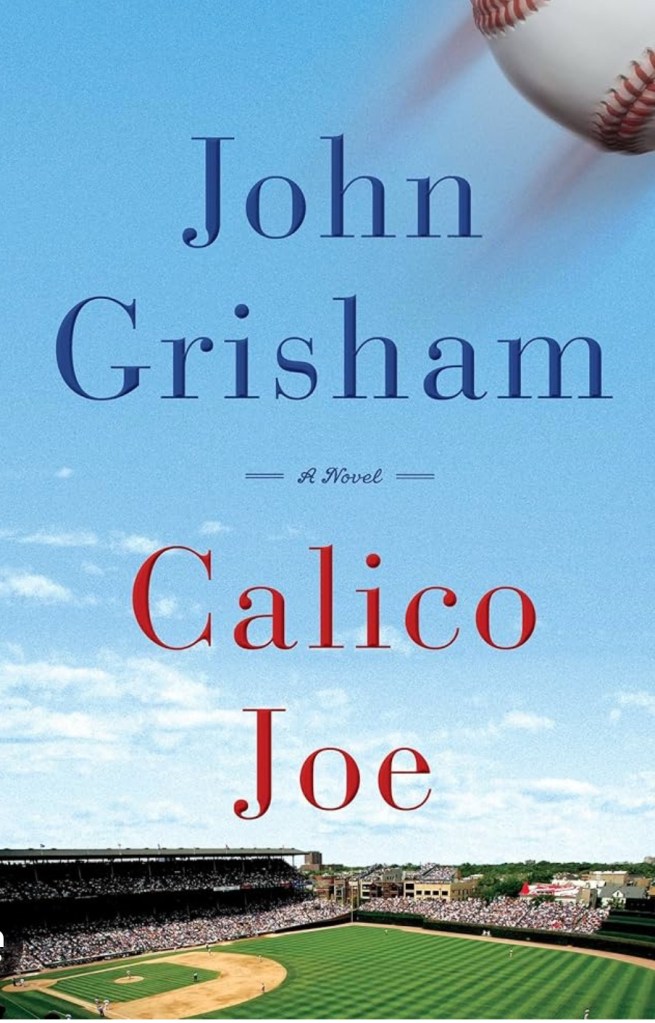
John Grisham wrote a book that I read some time back. The book is entitled “Calico Joe,” a well told baseball story. I like baseball stories. Some of the most enjoyable novels I have read have had a baseball backdrop. The sport lends itself to a rhythmic narrative that punctuates the pace of life. Like the game itself, novels set in the context of baseball games fall naturally into a pattern of action, followed by interludes of memory, observation, and commentary.
“Calico Joe” is fitted into a fictionally reconfigured 1973 baseball season. It is about a man named Paul, whose father was a major league pitcher and whose hero, Calico Joe, was a rookie-phenomenon in 1973. It is also about the boy Paul who grows up to become the man, and who tells the story. Now, I was about the age of the boy Paul during the baseball season of 1973, and the story’s accents about that time, seen through the eyes of an 11 year old, turned my eye to a part of the memory I had not visited in a while. To me, that fact alone was worth the price of admission to the story. But there is more.
Baseball is beautiful to watch, with its manicured fields, its clean, chalked lines stretching out, in principle, to infinity to define and embrace time and space, all providing a paradise-like field on which to play a free and fair game (tip of the hat to Bart Giamatti, may he rest in peace). But, as in all things human, there is pain and sorrow between the chalked lines, just as there is grace and beauty. “Calico Joe” has to do with a boy who must make peace as a man with the smashed hopes, the sorrow and the pain that enveloped his childhood. He must re-visit the troubling memory of his father’s self-absorption, and his child-like admiration of a player, Calico Joe, who in addition to being a figure of heroic proportions, was not his father.
There are pitches in the game, and there are pitches in life. Some seem uniquely aimed to ruin things forever, and some can make it possible to get to a better place. You need a special kind of eye to see either kind of pitch coming. The theme is simple, perennial, human: in the end, which pitch prevails?
I recommend the book because it is gently and elegantly told, spare in its use of literary ornament, yet capable of pulling you into a serious reflection about what it means to forgive someone. The story-teller does not provide you with a light-hearted path to this reflection on forgiveness, but he does show you what is humanly possible when the truth is brought to light. We can try to re-write the past, or try to bury it; neither of these opens life to a curative path. You can, though, have the courage to face things as they are, and —like a kid who still remembers how to hope for a good pitch—you can take a chance that anger and resentment can give way to something better.
And because baseball is a graceful game, whenever a good story explores what is humanly possible in the environs of a baseball park, it explores, often clandestinely, what is at the same time a gracefully possible next play in life.
+df
 Words and Things