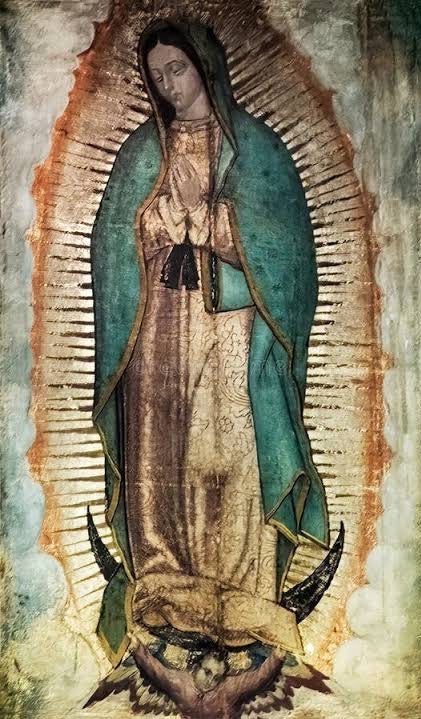
La Virgen ve al mundo y a la Iglesia con ojos de ternura, con aquella mirada que reconoce y llama a la dignidad de los hijos de Dios, porque por ser portadora de la humanidad de Dios hacia la humanidad, está concretamente saturada de la gracia del Hijo; y gracias a esta condición de “llena de gracia / Madre de Dios”, anuncia e invita a quienes mira a compartir la mirada / perspectiva del Dios victorioso en ella; y por esta misma razón porta en su persona la figura de la Iglesia, la asamblea de los que reciben la novedad de esta gracia, y por consecuencia, comparten la ternura de aquella su mirada como Madre de gracia, Madre de misericordia.
+++
The Virgin looks upon the world and the Church with eyes of tenderness, with that gaze which recognizes and calls forth the dignity of the children of God because, as the bearer of God’s own humanity to humanity, she is concretely saturated with the grace of the Son; and by virtue of this state of being «full of grace / Mother of God,» she announces to and invites those she beholds to share in the gaze / perspective of the God who is victorious within her; for this same reason, she carries in her person the figure of the Church, the assembly of those who receive the newness of this grace and, consequently, share in the tenderness of this her gaze as Mother of grace and Mother of mercy.
+df
Addendum:
St Thomas On Psalm 44: the Church and the Blessed Virgin
Commenting on Psalm 44,10ff St Thomas explains the verses on the Queen “standing at his right hand” in a primarily ecclesiological sense: Sponsa Christi est Ecclesia etc. After exposing the sense of the text in that light he adds the following about the Blessed Virgin:
Et potest exponi totum hoc de beata virgine, quae regina et mater regis est, quae astat super omnes choros in vestitu deaurato, idest deaurata divinitate: non quod sit Deus, sed quia est mater Dei.
“And all of this can be explicated about the Blessed Virgin, who is the queen and mother of the king, who stands above all the choirs [of angels] in a gilded garment, that is, gilded with divinity: not because she is God, but because she is the mother of God.”
«Y todo esto puede ser explicado con referencia a la Santísima Virgen, quien es reina y madre del Rey, y que se alza por encima de todos los coros [de ángeles] vestida con un manto de oro —es decir, dorado por la divinidad—: no porque ella sea Dios, sino porque ella es la Madre de Dios».
Santo Domingo pausado recuerda quieto lo que el Maestro dice, habita silencios que el Verbo ofrece, contempla la pasión que el Amado padece y atraviesa calles donde la caridad carece.
+df
Fra Angelico (c 1395–1455) St Dominic, detail of fresco “The mocking of Christ” , Convento di San Marco, Florence.
[Translations here are mine, favoring the specificity of the words. +df]
Fray Luis de León, OSA, Los Nombres de Cristo, Libro Primero:
«Y como Dios tenía ordenado de hacerse hombre después, luego que salió a luz el hombre, quiso humanarse nombrándose.»
“And since God had ordained to become man afterward, as soon as man came into being, God wished to humanize himself by naming himself.”
The “humanarse nombrándose” here refers primarily to the fact that God gave himself to be known through the name he gave to Moses; this is a drawing close, a humanizing move on God’s part, preparatory for the Incarnation.
What the name given signifies (something only God can intimate) is made a question for us, which is a move that pulls us into the dynamic of becoming like to the One whose name we know. We become like what we know, even if we know very little. That is the drama of the intellectual creature.
2. On the Human Kindness of God:
Wisdom 12,19 Docuisti autem populum tuum per talia opera, quoniam oportet iustum esse humanum, (.. δίκαιον εἶναι φιλάνθρωπον)
And you taught your people, by these deeds, that those who are just must be kind;
Con todo esto has enseñado a tu pueblo que el justo debe ser humano,
The Gk filánthropon taken into the Septuagint, with variant forms appearing in the New Testament (see Titus 3,4).
The “esse humanum” refers to the specific “human-loving quality of human beings”. The source of this in us is a prior reality said of God, who is human-loving. This ends up translated as “being kind” in the first reading today. The lectionary from Mexico uses “ser humano”.
In Titus 3,4 the Vulgate reads: “Cum autem benignitas et humanitas (φιλανθρωπία) apparuit Salvatoris nostri Dei”. Even today we say “where is your humanity?” referring to a specific kind of kindness.
Although not the primarily intended sense, in the Vulgate tradition, “Magnifica humanitas” could be rendered “Magnificent human kindness”, something God shows us, and we, on our good days, show each other.
And here St Bernard: The key to this passage below is the citation of Titus 3,4, (Vulgate), at the beginning. The word “humanity” governs the overall movement of the text.
St Bernard (Sermon 1 On the Epiphany) Appáruit, inquit Apóstolus, benígnitas et humánitas Salvatóris nostri Dei. Magna plane et manifésta benígnitas Dei et humánitas! et magnum benignitátis indícium declarávit, qui humanitáti áddere nomen Dei curávit.
La bondad y humanidad de Dios nuestro Salvador se han manifestado, dice el Apóstol. ¡Oh, la manifiesta bondad y humanidad de Dios! Y declaró la gran evidencia de su bondad al encargarse de añadir a la humanidad el nombre de Dios.
The goodness and humanity of God, our Savior, have appeared, says the Apostle. Great and manifest, indeed, are the goodness and humanity of God, and a great evidence of goodness was made known by Him who took care to add the name of God to humanity.
+++
3. St Augustine (Sermo 78) on the Transfiguration, where Peter receives a rebuke for wanting to hang around the Mountain:
Nunc autem ipse dicit: Descende laborare in terra, servire in terra, contemni, crucifigi in terra. Descendit vita, ut occideretur; descendit panis, ut esuriret; descendit via, ut in itinere lassaretur; descendit fons, ut sitiret: et tu recusas laborare? Noli tua quaerere. Habe charitatem, praedica veritatem: tunc pervenies ad aeternitatem, ubi invenies securitatem. +++ But now he himself says [to Peter]: Come down to labor on the earth, to serve on earth, to be despised, to be crucified on the earth. Life came down, that he might be put to death; Bread came down, that he might be hungry; the Way came down, that he might be weary on the journey; the Fount of water came down, that he might be thirsty: and you refuse to labor? Do not seek after your own well-being. Have charity, preach the truth: then you will reach to eternity, where you will find freedom from care. +++ Pero ahora él mismo dice [a Pedro]: «Desciende para trabajar en la tierra, para servir en la tierra, para ser despreciado, para ser crucificado en la tierra. La Vida descendió para sufrir la muerte; el Pan descendió para padecer hambre; el Camino descendió para fatigarse en el recorrido; la Fuente de agua descendió para sentir sed: ¿y tú te niegas a trabajar? No busques tu propio bienestar. Ten caridad, predica la verdad: así alcanzarás la eternidad, donde hallarás libertad de toda preocupación».
+++
4. Some excerpts from St Ambrose, On Psalm 118:
St Ambrose, On Psalm 118, sermo I,4, offering a description of the state of the Church across the ages.
Ita ergo et sancta Ecclesia quae in primordiis mundi desponsata in paradiso, praefigurata in diluvio, annuntiata per Legem, vocata per prophetas, diu redemptionem hominum, Evangelii decorem, dilecti exspectasset adventum, impatiens morae in oscula ruit dicens: Osculetur me ab osculo oris sui. Et delectata osculis adjicit: Quoniam optima ubera tua super vinum.
So then, holy Church, who in the beginning of the world was espoused in paradise, prefigured in the flood, announced through the Law, and called through the prophets, had long awaited the redemption of men, the beauty of the Gospel, the coming of the beloved, and so, made impatient by the delay, she rushes into kisses, saying: Let him kiss me with the kiss of his mouth. And delighted in the kisses, she adds: For your breasts are better than wine.
Así pues, la santa Iglesia, que al principio del mundo fue desposada en el paraíso, prefigurada en el diluvio, anunciada por la Ley y llamada por los profetas, había aguardado largamente la redención de los hombres, la belleza del Evangelio y la venida del Amado; y, impaciente por la tardanza, se apresura a los besos diciendo: «Que me bese con los besos de su boca». Y, deleitándose en los besos, añade: «Porque tus pechos son mejores que el vino».
St Ambrose, On Psalm 118, sermo I,5, referencing the Song of Songs, on the mysticism of the Incarnation. St Bernard speaks similarly in the 12th Century:
Osculetur me ab osculo oris sui; quoniam optima ubera tua super vinum. Jam volebat adhaerere Christo caro, jam festinabat innubere; ut esset unus spiritus, et fieret caro Christi, quae erat ante meretricis. Osculetur, inquit, me (osculatur nos Dei Verbum, quando sensum nostrum spiritus cognitionis illuminat); et tamquam despiciens omnes jucunditates et delectationes suas, coelestibus cupiens inhaerere mandatis ait: Quoniam optima praecepta testamentorum tuorum super omnem appetentiam carnis, et saeculi voluptatem.
«Deje que me bese con el beso de su boca; porque tus pechos son mejores que el vino». La carne ya quería adherirse a Cristo, ya se apresuraba a desposarse; para que la que antes era meretriz fuese un espíritu con él, se hiciese carne de Cristo. Que me bese, (nos besa el Verbo de Dios, cuando el espíritu de conocimiento ilumina nuestro sentido [percepción sensible]); y como despreciando todas sus jocundidades y delectaciones, deseando adherirse a los mandatos celestiales, ella dice: Porque óptimos son los preceptos de tus testamentos y sobre toda la apetencia de la carne, y la voluptuosidad del mundo..
“Let him kiss me with the kiss of his mouth; for your breasts are better than wine.» The flesh already yearned to cleave to Christ, hastening to be espoused to Him, so that she who was once a harlot might become one spirit and be made the flesh of Christ, saying, «Let him kiss me» (the Word of God kisses us when the spirit of knowledge illuminates our sense [sensible perception]); and, as if spurning all worldly joys and delights while desiring to cleave to heavenly commands, she declares: «For the precepts of your covenants are most excellent—surpassing all fleshly desire and the voluptuousness of the world.»
St Ambrose, On Psalm 118, sermo I,6 (on doctrine without innocence)
Nam nisi se unusquisque intus mundaverit, etiamsi foris speciosus videatur et justus, similis erit dealbatis sepulcris; ut foris quidem justus videatur, intus vero sit fetidus. Sic est doctrina sine vitae innocentia. Sed nec ipsa doctrina potest mercedem habere, ubi gratiam non habet innocentiae. Peccatori enim dixit Deus: Quare tu enarras justitias meas (Psal. XLIX, 16) ?
Pues si cada cual no se purifica interiormente, aunque por fuera parezca hermoso y justo, será como los sepulcros blanqueados: por fuera parecerá justo, pero por dentro estará corrompido. Tal es la doctrina sin la inocencia de vida. Mas la doctrina por sí sola no puede recibir recompensa allí donde falta la gracia de la inocencia. Pues Dios dijo al pecador: «¿Por qué proclamas mis justicias?» (Sal 49, 16).
For unless each one cleanses himself within, even though he may appear beautiful and righteous on the outside, he will be like whitewashed tombs; so on the outside he may indeed appear righteous, but on the inside be foul. Thus is doctrine without innocence of life. But doctrine cannot itself have a reward, where it does not have the grace of innocence. For God said to the sinner: Why do you declare my justices (Ps. XLIX, 16)?
Sermo I,16 (the inner room of the Church is the body of Christ)
Quod si cubiculum quaerimus, ipse nos edoceat, qui ait: Tu autem cum orabis, intra in cubiculum tuum: et clauso ostio ora patrem tuum in abscondito (Matth. VI, 6) . Cubiculum Ecclesiae corpus est Christi. Introduxit eam Rex in omnia interiora mysteria, dedit ei claves; ut aperiret sibi thesauros scientiae sacramentorum, clausas antea fores panderet, cognosceret quiescentis gratiam, defuncti somnum, virtutem resurrectionis.
But if we seek the inner room, let Him teach us, who says: But when you pray, enter into your room, and having shut the door, pray to your Father in secret (Matt. 6:6). The inner room of the Church is the body of Christ. The King introduced her into all the interior mysteries, gave her the keys; that she might open to herself the treasures of the knowledge of the sacraments [the mysteries made visible], might open doors previously closed, might know the grace of those who rest, the sleep of the departed, the power of the resurrection.
Pero si buscamos la habitación interior, dejemos que nos enseñe Aquel que dice: «Pero cuando ores, entra en tu habitación y, tras cerrar la puerta, ora a tu Padre en secreto» (Mt 6,6). La habitación interior de la Iglesia es el Cuerpo de Cristo. El Rey la introdujo en todos los misterios interiores y le entregó las llaves para que pudiera abrirse a sí misma los tesoros del conocimiento de los sacramentos [los misterios hechos visibles], abrir puertas antes cerradas y conocer la gracia de quienes descansan, el sueño de los difuntos y el poder de la resurrección.
+++
5. San Juan de la Cruz, Cántico Espiritual 39, an example in the Tradition on the importance of 2 Peter 1,4:
«“… muy grandes y preciosas promesas nos dio, para que por estas cosas seamos hechos compañeros de la divina naturaleza” (2 Pet 1,4). Hasta aquí son palabras de san Pedro, en las cuales da claramente a entender que el alma participará al mismo Dios, que será obrando en él, acompañadamente con él, la obra de la Santísima Trinidad, de la manera que habemos dicho, por causa de la unión sustancial entre el alma y Dios.»
«“… He has given us very great and precious promises, so that through them we might become companions of the divine nature” (2 Pet 1,4). To this point are the words of Saint Peter, clearly giving us to understand that the soul will participate in God Himself, working within Him, in company with Him, the work of the Most Holy Trinity, in the manner we have described, by virtue of the substantial union between the soul and God.»
Translating is something we do every day. It is how we take into ourselves an understanding of the people around us. Here are a few authors I have spent time with recently. +df
Ex Sermónibus sancti Leónis Magni papæ (Sermo in Nativitate Domini 7, 2. 6: PL 54, 217-218. 220-221)
Nascens Dóminus noster Iesus Christus homo verus, qui numquam déstitit esse Deus verus, novæ creatúræ in se fecit exórdium, et in ortus sui forma dedit humáno géneri spiritále princípium.
En naissant comme un homme véritable, notre Seigneur Jésus Christ n’a jamais cessé d’être vrai Dieu, il a réalisé en lui les débuts d’une création nouvelle et il a donné au genre humain, par la manière dont il est venu, son principe spirituel.
Al nacer nuestro Señor Jesucristo como hombre verdadero, sin dejar por un momento de ser Dios verdadero, realizó en sí mismo el comienzo de la nueva creación y, en la manera de llegar, dio al género humano su principio espiritual.
By being born as a true man, our Lord Jesus Christ never ceased to be true God; he brought about in himself the beginnings of a new creation and gave to man, by the way in which he came, his spiritual principle (beginning).
I fiddled with the various vernaculars I could consult, and decided “ortus” is too narrowly translated as birth, and “princípium” should be translated respecting the varied and related Latin subtleties: beginning, origin, source etc. Leo was aware of all of those “implicities”.
+++
Faustus of Riez, referring to the Wedding at Cana. Ex Sermónibus Fausti Regiénsis epíscopi (Sermo 5, de Epiphania 2: PLS 3, 560-562):
Hæc ítaque vidéntibus mirácula erant, intellegéntibus sacraménta.
«To those who see with the eye, these happenings are wonders to observe; to those who understand, they are events that contain the mysteries [sacraménta].»
«Para quienes ven con los ojos, estos acontecimientos son maravillas para observar; para quienes entienden, son eventos que encierran los misterios.[sacraménta].»
[We don’t get the sense of “sacraménta” among the patristic Latins with a simple use of words like “sign” or “señal”.]
+++
Augustine Sermo185 Celebrémus festum diem, quo magnus et ætérnus dies ex magno et ætérno die venit in hunc nostrum tam brevem temporálem diem.
Celebremos el día festivo en el que el inmenso y eterno día que viene del inmenso y eterno día, llegó a nuestro tan breve día de tiempo.
Let us celebrate the festive day on which the great and eternal day (who is) from the great and endless day, came into our ever so brief temporal day.
+++
Leo the Great, Ep 31: De hac autem participatióne mirábili sacraméntum nobis regeneratiónis illúxit, ut per ipsum Spíritum, per quem Christum et concéptus est et natus, étiam nos spiritáli rursus orígine nascerémur.
«Por esta admirable participación ha brillado para nosotros el sacramento de la regeneración, de tal manera que, gracias al mismo Espíritu por cuya virtud Cristo fue concebido y nació, hemos nacido de nuevo de un origen espiritual.»
«Through this admirable participation the sacrament of regeneration has shone forth for us, so that, thanks to the same Spirit by whose power Christ was conceived and born, we have been born again of a spiritual origin.»
I think for us to appreciate Leo’s frequent use of the word “sacramentum” we have to combine in our minds the word “mystery” with “visible participated sign”. This is how Jerome tended to use it in the Vulgate, and Augustine after him in his preaching.
+++
Anselm, Proslógion 1 Doce me quǽrere te, et osténde te quærénti; quia nec quǽrere te possum, nisi tu dóceas, nec inveníre, nisi te osténdas.
Enséñame a buscarte y muéstrate a quien te busca; porque no puedo buscarte a menos que tú me enseñes ni encontrarte si no te manifiestas.
«Teach me to seek you and show yourself to one who seeks you; for I cannot seek you unless you teach me, nor find you unless you show yourself.»
The encounter with the Most Holy is not something we can unearth. He is not hiding in some here of there of our place and time. He first intimates himself to us, to enkindle desire to look for him. And then we wait.
+++
St Augustine, at the end of tract 8 on John, knowing the condition of his hearers:
Sunt forte hodie multi qui propter solemnitatem, diei, non propter audiendum sermonem convenerunt. Crastino qui venient, veniant audituri; ut nec fraudemus studiosos, nec gravemus fastidiosos.
Perhaps many here today have come for the solemnity of the day, not to hear a sermon. Those of you who will come tomorrow, come to hear it. That way I will neither disappoint those who are interested nor tire those who are unenthusiastic.
Quizá hay hoy aquí muchos que han acudido por la solemnidad del día, no para oír el sermón. Quienes vendrán mañana, vengan a oírlo. Así no defraudaré a los interesados ni cansaré a los desganados.
+++
Augustine, Sermo 256,
Quómodo solent cantáre viatóres: canta, sed ámbula; labórem consoláre cantándo, pigrítiam noli amáre; canta et ámbula. Quid est, ámbula? Prófice, in bono prófice.
Como suelen cantar los caminantes: canta, pero camina; encuentra consuelo en tu trabajo cantando, pero no te dejes llevar por la pereza; canta y camina al mismo tiempo. ¿Qué significa caminar? Avanzar, progresar en el bien.
As travelers often do, sing: sing, but walk; find solace in your work by singing, but do not give in to laziness; sing and walk at the same time. What does it mean to walk? Move forward, make progress in goodness.
+++
Augustine on Psalm 32
Ineffábilis enim est, quem fari non potes. Et si eum fari non potes, et tacére non debes, quid restat nisi ut iúbiles?
«Es inefable, pues, lo que no puede ser expresado con palabras. Y, si no puedes expresarlo en palabras y, por otra parte, no te es lícito quedar callado, ¿qué te queda si no es cantar con júbilo?»
«What cannot be expressed in words is ineffable. And if you cannot express it in words, and moreover, you are not permitted to remain silent, what else is left but to sing with jubilation?»
+++
Augustine, Sermo 21 Unde autem iucundámur in Dómino, si a nobis longe est Dóminus? Et non sit longe! Ut longe sit tu facis. Ama et propinquábit; ama et habitábit. Dóminus in próximo est, nihil sollíciti fuéritis. Vis vidére quam si amáveris tecum sit? Deus cáritas est.
Pero ¿cómo podemos alegrarnos en el Señor si está lejos de nosotros? ¡No está lejos! Si lo está, es por tu culpa. Ama, y él se acercará; ama, y él habitará en ti. El Señor está cerca; no te preocupes. ¿Quieres saber cómo estará contigo si lo amas? Dios es caridad.
How can we rejoice in the Lord if he is far away? He is not far away! If he is, that is your doing. Love, and he will draw near; love, and he will dwell within you. The Lord is at hand; have no anxiety. Do you want to know how he will be with you if you love him? God is caritas.
+++
Augustine, on 1 John (sermo 7, 6):
Ergo habere sacramenta ista omnia et malus potest; habere autem caritatem, et malus esse, non potest. Hoc est ergo proprium donum; ipse est singularis fons. Ad hunc bibendum, vos hortatur Spiritus Dei; ad se bibendum vos hortatur Spiritus Dei.
Así pues, también el malo puede poseer todos los sacramentos y ser malo, pero lo que no puede es ser malo y poseer la caridad. Éste es, pues, el don propio; es la fuente singular. El Espíritu de Dios os exhorta a beber de la caridad, a beberle a Él.
Thus, even the wicked can possess all the sacraments and still be wicked, but what they cannot do is be wicked and possess charity. This, then, is the proper gift; it is the singular source. The Spirit of God exhorts you to drink from charity, to drink from Him.
+++
S Bernard, Sermo 2 Hanc ergo glóriam tota et tuta ambitióne concupiscámus. Sane ut eam nobis speráre líceat et ad tantam beatitúdinem aspiráre, summópere nobis desideránda sunt suffrágia quoque sanctórum, ut quod possibílitas nostra non óbtinet, eórum nobis intercessióne donétur.
Deseemos ardentemente esta gloria con un afán seguro y total. Mas, para que nos sea permitido esperar esta gloria y aspirar a tan gran felicidad, debemos desear también, con fervor, la intercesión de los santos, para que ella nos conceda lo que nuestro alcance no puede obtener.
Let us ardently desire this glory with a sure and total desire. But, in order that we may be permitted to hope for this glory and aspire to such great happiness, we must also greatly desire the intercession of the saints, that it may grant us what our efforts cannot obtain.
+++
St Thomas Aquinas, ST 1a,34,2,ad 3 Ut ostendatur connaturalis patri, dicitur filius; ut ostendatur coaeternus, dicitur splendor; ut ostendatur omnino similis, dicitur imago; ut ostendatur immaterialiter genitus, dicitur verbum. Non autem potuit unum nomen inveniri, per quod omnia ista designarentur.
para mostrarlo connatural con el Padre, se dice “Hijo”; como coeterno, se dice “Esplendor”; como del todo semejante, se dice “Imagen”, como inmaterialmente engendrado, se dice “Verbo”; y esto porque no ha sido posible hallar un nombre a propósito para designar todas estas cosas.
… and this because it has not been possible to find one name to signify all these things.
+++
Gregory the Great (Homily 17):
Prædicatóres enim suos Dóminus séquitur, quia prædicátio prǽvenit, et tunc ad mentis nostræ habitáculum Dóminus venit, quando verba exhortatiónis præcúrrunt, atque per hæc véritas in mente suscípitur.
«El Señor sigue a los predicadores, porque primero la predicación avanza, y entonces el Señor viene a la morada de nuestra mente; cuando las palabras de exhortación se adelantan, entonces por estas cosas la verdad es recibida en nuestras mentes.»
«For the Lord follows after the preachers, because preaching goes ahead, and then the Lord comes to the dwelling place of our mind; when the words of exhortation hasten forward, then by these things the truth is received in our minds.»
+++
Augustine today, Tract 26 on John
… non necéssitas sed volúptas, non obligátio sed delectátio, quanto fórtius nos dícere debémus trahi hóminem ad Christum, qui delectátur veritáte, delectátur beatitúdine, delectátur iustítia, delectátur sempitérna vita, quod totum Christus est?
«… no por necesidad, sino por placer, no por obligación, sino por gusto, ¿no podremos decir nosotros, con mayor razón, que el hombre se siente atraído por Cristo, si sabemos que el deleite del hombre es la verdad, la justicia, la vida sin fin, y todo esto es Cristo?»
«… not by necessity but by delight, not by obligation, but by pleasure, then how much more must we say that a man is drawn to Christ, when he delights in truth, in blessedness, in holiness and in eternal life, all of which is in Christ?»
The poet Augustine cites in the passage just prior to this line from Tractate 26 on John, is Virgil, Eclogues II.65.
10-16-25
+++
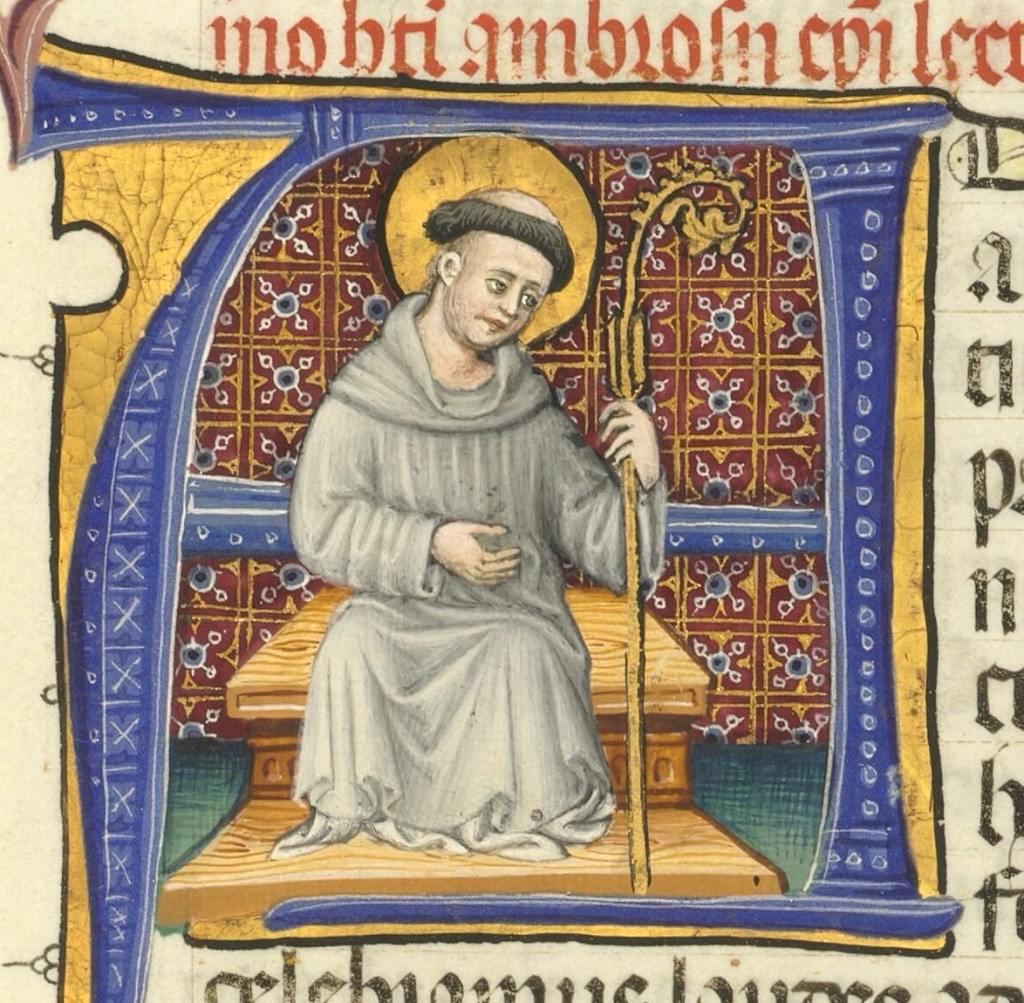
Saint Bernard as an Abbot From a Breviary Spanish (Catalan), c. 1398-1430 Paris, Bibliotheque nationale de France MS Rothschild 2529 (16b)lVI(bas), 1, 18, fol. 374r
Venerable Fulton Sheen had a great influence on me as a teenager and young adult, through his books and cassette recordings of his conferences. His love for Christ and his Church, and his faithfulness to Peter is what most impacted me then and now. His life is a narrative of grace and tireless service. He helped many of my generation keep focused on the important things while there was a lot of craziness going on around us. And he did it without bitterness. Inevitably there will be efforts to make him say— out of context, or out of thin air— what people want him to have said. This is not a new phenomenon in the Church, but it wields more subtle power today. The great preacher can speak for himself, in a way we can understand. That was God’s gift to him, and his gift to us. I am grateful to God who in the providence of his servant Fulton Sheen, and many others, opened a way for me, and many others, into the priestly vocation. +df
As God Would Have It / Como lo quiere Dios Homily for Vespers,prior to the Ordination of +John Jairo Gómez 2nd Bishop of Laredo (29 June 2026)
(I wish first of all to offer a personal thanks to Bishop Tamayo.)
I have known the bishop-elect, John Jairo Gómez, since he entered the theological seminary in Houston quite a number of years ago. I was teaching there at the time, and I was younger then, though I’m not so sure he was. En los años que lo he conocido, me parece que no ha cambiado. Madurado, sí; pero sigue siendo el mismo: sencillo, cumplido, respetuoso, inteligente y sobre todo, hombre de caridad. Ama a Cristo y a su Iglesia.
A bishop has a lengthy job description, such that no one could really list it to him completely, nor explain its dimensions. This is so because the many preoccupations and responsibilities of a bishop are hidden within the first and primary charge given to him in 1 Peter 5,2: Tend the flock of God in your midst, (overseeing) not by constraint but willingly, as God would have it.
Apaciente el Rebaño de Dios, que le ha sido confiado; vele por él, no forzada, sino espontáneamente, como lo quiere Dios. Be a shepherd, as God would have it. Como lo quiere Dios. Secundum Deum, says the Vulgate, translating the Greek κατὰ θεόν. It is all there, in that simple phrase. If you know how God would have it, how he does things, then you implicitly have the rest of the job description.
Con esta breve agregación de palabras, apaciente como lo quiere Dios, el obispo recibe la totalidad de su carga. En el lenguaje de la fe, las formulaciones más sencillas contienen dentro de sí todo el desarrollo y detalle de la vida en Cristo. Así como cuando el Señor, dirigiéndose al mismo San Pedro, pregunta. ¿Me amas? Apacienta mis ovejas (Jn 21,17).
En la exhortación de San Pedro a los pastores percibimos su propia transmisión a las nuevas generaciones de lo que él había recibido del Señor. ¿Y cómo entendió San Pedro lo que había recibido del Señor? Tal vez como una carga especifica de lo que el Señor Jesus les había dicho a todos y a cada uno de sus discípulos: ámense unos a otros como yo los he amado (Jn 13,34).
Tal como lo quiere Dios equivale decir, tal como Jesús lo hizo. Se trata del contenido de su pastoreo, y también de su estilo y forma. En la vida de Jesús, su estilo es el contenido, y el contenido, el estilo.
When Simón Peter exhorts that the bishop love as God would have us love, como Dios lo quiere, he urges that we love as Christ has loved us. For the Church received from the Lord, and has transmitted through the ages, the simple truth that the manner of Christ’s love is the visible expression of the Gospel he announced. Through this he reveals the heart of the Father. This love of the Father has been spoken into the world in the flesh and blood taken up by the WORD, and then poured out to us during the course of his earthly life, culminating in his Passion, death, and Resurrection.
The charge, love as God would have it, is beyond us, and would be impossible to fulfill were it not for the fact that the Lord gives what he asks for. As for the whole Christian people, so also for their poor servant the bishop, we know that this manner of love is not something we must first perfect and give, but rather something he has first to us given, and which we must continually receive in order to give. The giving is expressed in the words of Scripture love one another, but is not precisely the same thing as the saying or receiving of these words. The words encase the mystery so that we never lose sight of them. St Paul speaks of this in Romans 5,5, the charity of God has been poured into our hearts.
The words name the thing, but the thing is the love beyond words. This love has been poured out to the whole body. And the receiving of it, the living and preaching, and conveying of it is the fruit of the Mystery of the Faith. The new and eternal covenant began with the speaking that is Christ’s flesh, and the outpouring into us that is his gift of the Spirit. Only after that were the disciples able to speak of it efficaciously, of what had been given, what has been and is being received and transmitted.
For a bishop this is central, because he must announce this Misterium fidei; teaching it, and enacting it in the Eucharistic sacrfice, he cultívates it in the ordered witness of each and every member that adorns Christ’s body the Church. The bishop, and the Church entrusted to him, are handing on the Paschal outpouring, a way of life that witnesses to the truth that the love of God, vibrant and alive, has been poured into our hearts.
The entire Church lives out the faith through the charity poured into our hearts. The bishop receives this charity in the communion of the Church, and he lives it within his particular vocation for the sake of the Church; yet, he does not live it alone; he always lives it in communion with and at the service of the whole People of God, just as God would have it. Caritas Christi urget nos, St Paul says (2 Cor 5,14). Indeed, the bishop serves so that this life, poured out upon us, may flourish within the body of believers. He gives his life to this flourishing that God so desires. Where charity is weak, he works to strengthen it, where it is strong, he learns and teaches from it and about it: Así como lo quiere Dios.
The Lord spoke to us about his love for the Father, and his love for us. We might sometimes think he was speaking of two different kinds of love. But no, the love of Christ is one, and it is present in its totality in everything he said and did. When he went to the mountains to pray, it was an act of love directed to the Father and yet simultaneously an act of love for us; for, unlike the elder brother in the parable of the Prodigal Son, Christ Jesus loves what is in his Father’s heart; and we are in the Father’s heart. And so the bishop must go to his chapel, close the door and pray to the Father in secret. He must do this so that in the silent communion with the Father he might truly know the Father’s heart, revealed in the Son, received in the Spirit. He must know that his people are there.
And when the Christ of the Father stopped at the Samaritan well and healed the woman (figura de la Iglesia) waiting there of her fears, her guilt, and when he satisfied her deepest thirst, he was directing himself to her because he loves the Father, knows the Father, and thus desires that all might have life and have it abundantly. Porque así lo quiere Dios. This is summed up in Jn 10,15, where the Lord says: As the Father knows me, so I know the Father; and I lay down my life for my sheep. St Gregory the Great explains this passage beautifully in one of his homilies: [the Lord Jesus speaks] As if to say openly, “The proof that I know the Father and the Father knows me is that I lay down my life for my sheep; that is to say: in the charity with which I die for my sheep, I demonstrate my love for the Father.”(1)Here, then, in the gloss of St Gregory, is the job description of the bishop, and of his people, each living it within the circumstances God provides.
The bishop must know the Father. And to know the Father, he must know Christ. He must feel in his bones how the charity with which Christ lays down his life for the sheep, shows his love for the Father. This is what it means to say to a bishop that be must tend to the sheep as God would have it / Así como Dios lo quiere. Within this magnum sacramentum we realize that the life of God poured into our hearts is not so much a list of specific things to do, but a rather a way of doing all the good things we are called upon to do. The way for us in Christ is to love God with all our mind, heart and soul, knowing that this is inseparable from the love and service we give one another. If we love the Father in the charity of Christ, we will love and serve one another in the charity of Christ, espontáneamente, de buena gana, as God would have it.
A bishop must know his people, he must know the poverty of our human riches, and the riches found in our human poverty. He must weep with those who weep, and rejoice with those who rejoice. He must touch the lepers to heal and console, and be willing to stand firm in the face of threats to his flock. He must speak a word to the weary lest they lose heart. His pastoral priorities are already given to him in the answer the Lord gave to the disciples of the Baptizer: Go and tell John what you hear and see: the blind see, the lame walk, lepers are cleansed, the deaf hear, the dead are raised, and the poor have the good news proclaimed to them. And blessed is the one who takes no offense at me” (Mt 11, 4-6). Our blindnesses are many, our deafness severe. The bishop must help us love one other, for Christ’s sake.
In closing, Most Reverend Father, a Word to your people, to your priests, and to you. Al pueblo de Dios, oren por su obispo, como lo quiere Dios. Pray that he may know the intimate love of the heart of Jesus, and thus know the heart of the Father. Pray that in darkness he might have firm faith, and in sorrow the consolation of the Holy Spirit. And that by his obedience to Christ, he may know joy in his self-giving service to you, in his daily laying down of his life for you. (2)
To the priests: Padrecitos, tengan paciencia con su obispo, no porque sea joven, sino porque es obispo; y por oficio les dará aún más razones para pedir paciencia. I ask that you be patient and forebearing. We are only men, who need to beg for God’s mercy and light to govern wisely. Help him by praying for that same mercy, light and wisdom. You are his principal support in the work of shepherding. Juntos con su obispo, les pido que no se olviden de los pobres, los pequeños y maltratados, porque olvidar de ellos es olvidar a Cristo, y a los que él ama en el corazón del Padre. Apacienten el Rebaño de Dios, que les ha sido confiado; velen por él, no forzada, sino espontáneamente, como lo quiere Dios.
Señor obispo-electo, mañana se consagra. La totalidad de la Iglesia, cuerpo y alma, se une en oracion con usted y por usted. El Pueblo de Dios sabe de la caridad de Cristo, y sabe que esa caridad sostiene la misión y carga que Dios y el Santo Padre León XIV le han confiado. Con la mitra llega una cruz de dimensiones misteriosas. Tengan valor: dice el Señor, yo he vencido al mundo (Jn 16,33). Respáldese en la fe de la Iglesia, esa fe que encuentra fuerza en la victoria del Resucitado. A causa de esa fe, y la caridad por la cual opera, el Pueblo de Dios a su alrededor, comparte con usted y su familia la alegría de este momento. Que Dios le dé valor para apacentar a este pueblo, con caridad, tal como Dios lo quiere. Amén.
+df
——
Notes
1. Gregory the Great: in Evangélia (Hom. 14, 3-6): Unde et in hoc loco Dóminus prótinus subdit: Sicut novit me Pater, et ego agnósco Patrem, et ánimam meam pono pro óvibus meis. Ac si apérte dicat: In hoc constat quia et ego agnósco Patrem, et cognóscor a Patre, quia ánimam meam pono pro óvibus meis; id est, ea caritáte qua pro óvibus mórior, quantum Patrem díligam osténdo.
2. See Augustine, Tract in I Ioannem, Sermo 7,10: Qualem faciem habet dilectio? qualem formam habet? qualem staturam habet? quales pedes habet? quales manus habet? Nemo potest dicere. Habet tamen pedes; nam ipsi ducunt ad Ecclesiam: habet manus; nam ipsae pauperi porrigunt: habet oculos; nam inde intellegitur ille qui eget: Beatus, inquit, qui intellegit super egenum et pauperem (Ps 40,2). Habet aures, de quibus dicit Dominus: Qui habet aures audiendi, audiat (Lc 8,8). Non sunt membra distincta per locos, sed intellectu totum simul videt qui habet caritatem. Habita, et inhabitaberis; mane, et manebitur in te.
Ofrecí esta breve reflección dentro de un seminario de web sobre la encíclica Magnífica Humanitas, organizado conjuntamente por CELAM, la USCCB, y la Pontificia Comisión para América Latina.
Magnífica Humanitas: desafios pastorales frente la mística de la objetividad
El papa León XIV publicó su primera encíclica, «Magnifica Humanitas», el 25 de mayo. La encíclica ofrece un análisis considerado de los desafíos y las oportunidades que plantea la tecnología de la inteligencia artificial. En la enseñanza del papa, el ámbito amplio y apropiado para discernir y decidir sobre el buen uso de las tecnologías avanzadas es la de la identidad y dignidad del ser humano, y su propio bien.
***
Unas semanas antes de que se publicara la encíclica Magnifica Humanitas participé en un encuentro con estudiantes universitarios en mi diócesis sobre el tema de la inteligencia artificial. La gran mayoría de los alumnos son de ascendencia mejicana, viviendo en los EEUU, y para muchos de ellos son de la primera generación en sus familias con oportunidad de llegar a la universidad. Hubo mucho interés en el tema. Aprendí mucho esa noche. Mencionaré tres puntos: que los jóvenes conocen lo de AI en cuanto lo encuentran cómo fuente de información útil para el progreso de sus estudios. También, que lo conocen como sombra que pueda influir sutilmente la dinámica de los medios sociales. La realidad del “fake news” les preocupa. Y, tercero, no estaban fuertemente conscientes de las implicaciones sociales de las nuevas tecnologías. Es decir, de las ramificaciones que puedan tener sobre el bienestar de la sociedad, y los más vulnerables dentro de la sociedad.
También en mi diocesis tenemos las instalaciones de SPACEX, donde se ha desarrollado recientemente mucha actividad alrededor de los cohetes y satélites comerciales destinados a misiones con fines de llegar a marte, y avanzando mejores sistemas de comunicación y distribución de datos informáticos. También he llegado a conocer y dialogar con los jóvenes adultos, Católicos, empleados en ese ámbito científico y comercial. Ellos conocen más a hondo las tecnologías avanzadas, y tienen muchas preguntas sobre sus responsabilidades frente este tipo de trabajo. Pero tampoco se han enfocado en la dimensiones sociales de lo que estamos afrontando con las nuevas tecnologías.
La encíclica habla de estas cosas y mucho más. El Papá Leon XIV nos ha regalado una perspectiva amplia y coherente para colocar y responder a lo que se va desarrollando en nuestros tiempos. Y pienso que me orienta como pastor a enfocarme en promover y ampliar el diálogo y la formación de las nuevas generaciones precisamente para que ellos puedan dialogar y influir la cultura que ellos habitan diariamente. Creo que el primer punto que debemos enfatizar con ellos es esta: ¿que, precisamente, es un ser humano?
La urgencia de nuestra situación radica en la integración silenciosa, en gran medida por manos invisibles, de métricas basadas en datos en el proceso de la toma de decisiones. Este aspecto de la inteligencia artificial afecta a todos, sean jóvenes en la universidad, ingenieros recientemente empleados por las grandes empresas de tecnología, y los pobres que dependen de asistencia pública para navegar cuestiones de alimentación y salud.
El acceso rápido a los datos ofrece grandes ventajas; sin embargo, medir datos no es lo mismo que tomar una decisión humana, y el análisis estadístico por sí solo no genera prudencia ni sabiduría. Las decisiones son hechos sumamente humanos y, por esa razón, también asuntos morales. Implican consideración y responsabilidad.
Yo oigo la voz del papá pidiéndole al mundo humano de no ceder a la tecnología aspectos importantes de la toma de decisiones humanas. El Papa propone que debemos reflexionar sobre el factor humano y su autoridad sobre las métricas de los datos informativos.
Hay un misticismo que envuelve la Inteligencia Artificial, y reside en el aura de autoridad objetiva que rodea la información generada. Esto influye a las nuevas generaciones. Creo que nos incumbe profundizar y purificar lo que significa la objetividad. La palabra objetividad tiene dos sentidos que, si se confunden o combinan sin pensar, nos causan problemas.
Hay un sentido que se entiende como opuesto al favoritismo: Esa persona es mi amigo entonces mis juicios siempre van a su favor. En este uso de la palabra, objetivo se entiende como no afectado por criterios de emoción o gusto. El otro sentido de la palabra se opone a la realidad del sujeto, o sea, la perspectiva personal desde la cual vemos la realidad. Como seres humanos es inevitable que tomemos el punto de vista del propio “yo” para relacionarnos con las realidades a nuestro alrededor.
El misticismo del AI se respalda con el primer uso de la palabra objetivo. La métrica y el análisis de la información agregada disfrutan de una autoridad científica. La frase “esto es lo que dicen los datos” apela a una obiectividad que pretende eliminar el peligro de prejuicios y favoritismos humanos.
De todos modos el Papa señala que la verdad es otra. Detrás del programa hay un editor remoto de criterios, o un editor inconsciente de sus propios prejuicios ideológicos. No podemos delegar al programador, en gran parte anónimo, la autoridad de organizar datos objetivos con criterios de importancia que puedan influir decisivamente decisiones sobre el bien del individuo y la comunidad.
Consideremos, por ejemplo, un programa que recopila información sobre qué constituye un objetivo militar legítimo. ¿Qué criterios se incluyen en la programación predeterminada? O si se establecen programaciones sobre quién tiene acceso a asistencia alimentaria o sobre quien califica para recibir una cirugía mayor, ¿quienes determinan los criterios? Sobre este punto el Papa León dirige nuestra atención sobre los prejuicios humanos que ineludiblemente entran en la programación técnica, incluso la más avanzada y sofisticada. Creo que necesitamos enfatizar este aspecto social de lo que estamos viendo y viviendo.
Y aquí entra en juego la responsabilidad de una sociedad de organizar con transparencia procesos políticos adecuados para llegar a acuerdos y consensos políticos sobre el bien humano y cómo proteger los más vulnerables del uso manipulado e injusto de la tecnología. El papa habla mucho sobre este tema. Pero aquí hay un desafío grande, porque un cinismo fuerte sobre el valor de los procesos políticos ha afectado la apertura, específicamente de los jóvenes, a participar en los procesos políticos.
Soy realista, y por eso digo que parte del cinismo político tiene que ver con las desconocidas influencias de AI en los medios de comunicación. Los desafíos que enfrentamos giran precisamente en torno a este problema en nuestra cultura social. Los resúmenes generados artificialmente, mezclados con fragmentos fabricados o truncados, inevitablemente simplifican los discursos, generan indignación y se reducen a mera información estadística sobre cuántas personas están de acuerdo o en desacuerdo con lo que han escuchado.
En este contexto, el timbre y el tono de la voz humana, del pensamiento y de la emoción, del corazón, se erosionan dentro de una concepción programada para el consumo general. Esto reduce y disminuye la manifestación de la grandeza de la humanidad, del ser un humano.
***
Quisiera terminar con unas indicaciones sobre el segundo sentido de la palabra objetivo. La objetividad no es en sí misma el árbitro de la verdad sobre el bien humano. El sujeto humano toma decisiones normativamente en función de su impacto en las vidas de otros sujetos humanos. La justicia, la misericordia y el amor no son programables; se disciernen humanamente. No podemos reducirnos a métricas matemáticas objetivas, a la suma total de los datos. Somos los autores y receptores subjetivos de las recopilaciones métricas que creamos y consideramos. Las consideramos, pero podemos tener buenas razones humanas para elegir algo distinto a lo que produce la métrica.
El ser humano siempre está presente en lo que piensa, siente y inventa. Y querer superar el propio “yo” de la persona, y el propio “nosotros” de la comunidad no es una meta humana digna de perseguir. Al contrario, el problema de malas decisiones humanas requiere respuesta humana y divina, desde la perspectiva del sujeto. Nos apremia cultivar las virtudes de prudencia, caridad y justicia, y las perspectivas de misericordia y compasión, porque lo que creamos y organizamos no puede más que reflejar imagen de nosotros mismos.