(Or, if you prefer, “What conversion looks like”, or perhaps “a lecture in praise of the Charity of Jerome and Augustine”)

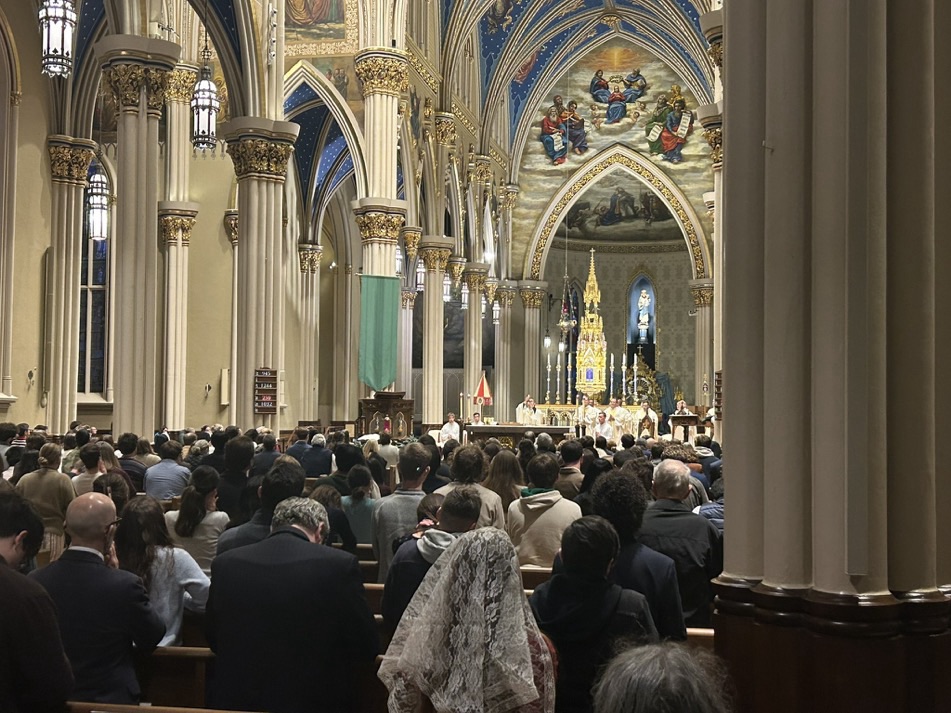
The Translated Word. (Living Tradition Lecture, Center for Ethics and Culture: University of Notre Dame, 14 November, 2025)
Behind this lecture is a desire to share with you my love for words, and my sense of both their efficacy and limitations. And also to sketch my conviction that if we open the door to the issue of translation, we step into the dramatic center of the mystery of salvation itself.
Words and Translation
So what is a word? Words, St Thomas points out, are intentionally directed outward manifestations of what is understood within the mind of the speaker. (1) Words are therefore invisible in their origin, made visible in their manifestation and trajectory, and inherently relational. They have an origin and a destination. Words do not come into existence in isolation from this relation. There may exist sounds through air, or scribbles on paper, but they do not exist as words apart from the sense intended by the speaker (or writer), and the understanding that in some way dawns in the mind of the hearer (or reader). This means also that they are a part of history. They are present signs of human relations existing in the world.
What is in the mind of the speaker, though, is derived from our being physical creatures in a material world. We form of an understanding of what our senses encounter. And from that interior word we make a physical sign, also known as a word, of what we understand. Our speech is constantly trying to make sense of our experience of our human relations and of the wider world around us. And we desire to communicate our understanding to someone else.
It is true that we can understand words in a letter or paragraph without knowing who wrote them or why, and without knowing to whom the writer wished to speak. This is because we have a reservoir of communal memory about what words generally mean. This reservoir is what we call a language. If we catch words in mid-air, so to speak, without knowing where they came from or to whom they were directed, we can still hear and read them, but the burden of interpreting them (translating them for ourselves) is carried solely by our sense of what the language understands through words like these. We know these words came from someone, and someone first heard and understood them in a certain way. And when they are in a different language, we have to understand the sense over there, and move it to a sense understandable over here.
The English word translate literally derives from prior words in the Latin tradition that inhabit the thoughts of people who move things around, or carry them across from some place or other. Latin antiquity took the past participle of transferre, translatus, as an adequate way to describe these movements. The Romans themselves preferred to describe their translators as interpreters (interpres), deriving from people involved in diplomatic missions or the market place.(2) What Roman antiquity mostly interpreted, or translated, were the peoples they conquered or traded with, and Greek texts. Our modern sense of the term translate basically suggests moving the signs of understanding from one language to another. Or, more precisely, trying to understand in one language what is expressed and understood in another language.
From the Greeks we have hermēneuō for interpreting or translating, from which we have our word hermeneutics, deriving its sense (it would seem) from Hermes the messenger / interpreter of the gods to men. I will avoid the word hermeneutics this evening. It is a perfectly good word, but we have made it into an overly professional word. I am more interested in the translating we humans do everyday. (3)
Other languages unknown to me may have radically different ways of deriving the sense of what we call translating. I would enjoy learning from others about what those word histories might suggest. But, part of our poverty is the human limits of our knowledge of languages, and my poverty is mostly Latin derived and applied. Language limits can be a blessing, though, if we understand them right. Borges certainly thought so. He used to say that he was opportunely ignorant of Greek, which allowed him to focus his attention on what English poets, as English poets, had made of Homer. (4)
2. The Translation of the Word
At the center of the revelation is the Only-begotten Son of the Father who became flesh and dwelt among us. In speaking to us about this, St John’s prologue calls the Son also the WORD. The Nicene Creed says a lot about the WORD, but only actually refers to him as the Son. The Word / Son are one and the same, of course, but the two words move our minds to distinct aspects of his identity. This already points to a basic reality in us: what is One in God requires multiple words for us to approach. Son and Word overlap in sense in some ways: they both come from a source distinct from themselves, for example. But they signify from different contexts. The words unite in our minds, but we cannot think them identically.
St Thomas has a nice little summary of our worded limitations somewhere in his treatise on the Trinity in the Summa when, speaking of the Word, he says the following: To show that he is connatural with the Father, he is called “Son”; as co-eternal, he is called “Splendor”; as entirely similar, he is called “Image”; as immaterially begotten, he is called “Word”; and this because it has not been possible to find a suitable name to designate all these things. (5)
Theologically speaking, the first translatus that should occupy us is the movement of the Son / Word from his place to ours. We could say Et Verbum Translatum est, et habitavit it in nobis. The Word translated himself to where we are. The issue of movement is evidently a concern of the Evangelist. Where he came from is not a physical place, for he came from being with or in the Beginning; where he moved to is our house. The Beginning, on the reading of the Fathers, East and West, is not primarily a reference to time or to before time: rather, it is more properly a reference to the Father, origin, principle, and source. He is the principium that the Word/Son is in and with. (6)
The medium of his self-translation to us is his flesh. What we have seen and touched. (7) For the Evangelist, his movement across eternity to our dwelling place is primarily for the sake of signification, that is to say, of being seen, heard, understood and known: and we saw his glory, the glory as of the Father’s only Son, full of grace and truth. (8) John will make explicit later the sort of things we should know when we behold Christ. (9)
The translation of the WORD, thus, is not simply a movement of place; it is simultaneously a signifying move, such that it would be true to say that the WORD’s taking flesh is the self-interpretation of God to us. Verbum caro factum est, et interpretavit se nobis. He became flesh, and interpreted himself to us. St Thomas, in his commentary on the Epistle to the Hebrews says that the Word expressly manifested himself to us. (10) In other contexts St Thomas uses the word expresse to mean literally, plainly, fully. In his flesh the inexhaustibly intelligible WORD of the Father showed himself to us most expressly, most directly, most clearly. (11) The manifestation occurs in his being present to us, and acting among us in the flesh. The flesh of Christ is the exteriorization of the Father’s inner Word. To use Augustine’s phrase, the Verbum Cordis of the Father became the Verbum vocis; that is to say, the Word that the Father has in his heart from all eternity became the Word spoken into our physical hearing. (12)
The hearing encompasses more to Augustine than just that Jesus preached publicly; the audible Word refers to the whole of his incarnate presence. The clarity of the manifestation is through the radical character of the showing. The life of Christ in its totality is one long self-pronunciation of himself into our seeing and hearing. The pronunciation is as much in what he does and suffers, as it is about his spoken words. (13) This is why the totality of the human life, death and resurrection of Jesus is the self-translation of the Word. The revelation is his self-expressiveness within the limitations of a single human life. This is his self-imposed poverty. He has no other language at his disposal to speak to us so directly, save a poor human life. As Javier Sicilia states in one of his novels: But he remained within the limits of his own flesh, in his own poverty, in his own death, so poor, so miserable, so hard. (14) Such is the form of the revelation.
The clarity of the sign that is Christ’s flesh is at the same time inherently enigmatic. This is so not because he could be more explicicitly present to us, but because humans can only perceive direct presence through the senses. We see who someone is and what they are about through how they present themselves to us. The Incarnation is thus an invitation to see through the expressive manifestation and rightly interpret the truth shown us through his flesh. There is no getting around this need for true interpretation of Christ; nor should we hope their were. This is the human way.
The interior move from sensible perception of other persons to an understanding of some kind of the persons themselves is what is most mysterious about us. It happens, and so we can speak of it. We craft words for it. We say them to ourselves and to each other.
The primordial translation of the Word among us is a move that gives birth to new words in us that have to do with the fact of his presence and the understanding of his person; basically who he is and why he comes. These are words we would not have thought to think and say before. The only reason we are interested in translating words about him, even inspired words, is to perceive what the enfleshed Word among us is saying to us by being who he is, and by acting as he does while he is with us.
It is undoubtedly a matter of providence that save for the words written on the ground in front of the condemned woman’s accusers, we have no indication that the Lord was interested in writing. What we have are the memories of disciples who saw and heard, and urgently spoke of this to anyone who would listen. The New Testament is a written record of what they glimpsed in him and what they understood about him: As Pope Leo the Great so elegantly puts it in his sermon on the Beatitudes: writing in the hearts of the disciples the swift hand of the Word established the ordinances of the New Testament. (15)
The first letter of John would have us remember what we truly know of Christ: John’s epistles provide the most explicit and briefest formulations of what the disciples perceived about the Word made flesh: In this way the love of God was revealed to us: God sent his only Son into the world so that we might have life through him. (16) What the faith perceives about the Word’s self-translation through the fully expresive enigma of his flesh is inextricably bound to the word love. This is the knowing of faith: We have come to know and to believe in the love God has for us. (17)
The word love, of course, is word with an intended meaning. St John and St Paul and the other apostolic evangelizers used the word a lot. But as with all words, we need to think about it’s intended sense, the content of the word. That is what I will attempt to do as we move forward.
3. The Conversation of the Son
Son is a most personable word, with a history as old as human culture and molded into an instrument of theology since the earliest Scriptural discourses. It is the primary New Testament name for Jesus. Adam and Eve started with two sons. One killed the other. The primordial act of violence burns in our collective memories. I cannot read the opening lines of the parable of the Prodigal Son (There was a man who had two sons), without thinking of Cain and Abel.
Son and daughter both are inerradicably relational words, and point to an enfleshed connection of the most intimate kind. The son or daughter can have brothers and sisters, cousins and in-laws. The biology of the connections can be traced, though the humanly charged lives of loves and betrayals flowing from the biological are resistent to transparency. Especially when viewed by the mildly interested bystander observing a family dynamic.
If you’ve ever been invited to a celebratory dinner prepared by a family not your own, than you know that the familial conversation often darts about quickly and at different levels, offering glimpses of personal histories of great affection and unresolved resentments. To the outsider, they are only worded and gestured glimpses, though. If you want to know the meaning of some things said or done at a large family gathering, you basically have to hang around these people long enough to get a sense of where the affections and resentments come from, and how the conversation both hides and reveals them.
So if Christ in our midst is the self-enunciation of the Father’s Word, and the Word’s human life speaks Love, then we have need to be in his company to begin to sense what manner of love this might be. Reading about it will not suffice, nor will a brief exposure. Jesus speaks various parables about being invited to the Son’s wedding banquet. (18) The thing about the parables is that they are stories that you can step into at some point. You have to step into it to really understand it, but hearing it gives you a chance to think about whether you want to step into it or not. The call to enter the banquet is like this. Like any invitation that comes to us, it elicits the question: do I really want to go? We accept or reject the invitation depending on what we know about it. Or if we have anything better to do.
The satisfied will be less likely to take up the invitation to the celebration than the poor and the lame will, because for the poor at least it’s something different, and there’s a good chance it will be better than what I have now.And even if we count ourselves among the poor, the blind, and the lame who get an unexpected invitation to a place at the dinner because the first invited had better things to do, we cannot expect to catch on immediately to the bewildering conversation. Even if we all speak the same language, we will struggle to catch how the words signify for the speakers. It is about more than the words; it’s about knowing what the words mean within the context of the kind of life on display there. And, God forbid, we should show up in the wrong attire and get thrown out. For the invited there is a steep learning curve into the language of the ethos, and the ethos of the language, and we don’t have forever to figure it out.
So let us think about Jesus’ banquet conversation for a moment. Conversation is a word we use mostly to describe how humans who are not angry at each other speak together. Jesus did in fact have conversations with people, and they with him. Take Nicodemus, for example. But in an older sense of the term, only the disciples actually entered into the conversation of Christ. Conversatio in the patristic age and after primarily referred to a style or way of life. (19) Walking in his company, watching what he does, listening to what he says and who he says it to, and how he says it, is all part of discipleship. Everything from the first Come and see, to the Eschatological banquet itself, is a deliberate path into the conversatio Christi. The longer we stay with Christ, the more we realize his conversatio involves also the Father and the Spirit, and of course other human beings besides us.
The Lord Jesus spoke the blessing upon the poor in spirit, and his first hearers likely understood the words in their continuity with the language of the Psalms and the prophets. The disciples would later have apprehended their sense in light of Jesus’ particular mission to the little ones, the tax-collectors and sinners; and, if the disciple persevered in his company, they would have understood the Beatitudes even more profoundly in light of the Lord’s own Passion, death and Resurrection. He stands revealed as the preeminent man who lives, dies and rises in poverty of spirit.
Our sense of the words coalesces in our minds to the extent we have taken up the invitation to dwell in the company of Christ.Without this we will understand the words in a host of different ways that may or may not have a connection to what Jesus meant when he opened his mouth and pronounced them. The company we keep may even prevent an efficacious reading of the Gospel, because the way of life transmitted in such company can be at odds with understanding the conversatio Christi. The Son’s translation into our dwelling places becomes a matter of our understanding him by moving towards and into his way of life. This is our first translation. The Church, the communion of the baptized, is meant to be a community where the conversatio Christi is enacted through time. We are supposed to show one another what Christ’s love looks like. Perhaps we do not fully appreciate this. If we did, we might be more deliberate about it.
A human life lived in relation with others is the principal medium for understanding love; and this is nowhere more true than when we are trying to understand the love shown in Christ. But in the pursuit of a better understanding about his love, we begin to perceive that there is a way the love of Christ understands. The Lord Jesus understands the world differently than we do because he understands it through his love.
There are two distinct ways of knowing. To understand love you need to observe how it works; to have love’s understanding you have to have love so as to understand through it. In the broader perspective of the pedagogy of the Word Incarnate we are suitably moved from trying to understand Christ’s love to possessing his love’s understanding.
4. The Spirit as Translator / Interpreter of the Son
Augustine, preaching on John 16,13, when he comes, the Spirit of truth, he will guide you to all truth, has a remarkable passage wherein he comments about how a Christian comes to the Truth, that is to say, the Word understood, through love. How does the Spirit guide us to the truth? Augustine urges his hearers:
Be renewed in the spirit of your mind, (Eph 4,23) and understand what is the will of God, what is good and acceptable and perfect (Rom 12,2) that you, being rooted and grounded in love, may be able to comprehend with all the saints what is the length and breadth and height and depth, and to know the charity of Christ which surpasses knowledge, that you may be filled to all the fullness of God (Eph 3,17-19). For in this way the Holy Spirit will teach you all truth, as he pours out charity, more and more, into your hearts (Rom 5,5). (20)
Rhetorically, Augustine’s explication is a string of carefully chosen Pauline texts about love and knowledge, culminating in Romans 5,5: and the charity of God has been poured into our hearts. The essential point is Augustine’s insistence that the Spirit guides to all truth through a renewal of mind that enters into the depths of Christ; this love poured into our hearts fills us with the truth of God.
This knowledge of the truth, this love poured out, is not primarily a worded concept; we have terms for it, but this love poured out is something else and something more than the terms. We can build accurate worded descriptions of this love, and its effects, based on what Scripture says about it. These can be conceptually apprehended by the hearer, but Augustine is saying that the Scriptures and the experience of the Church teach that the Christian life lived through the pouring out of love into us is the knowing, and the knowing is in the love poured out.
We cannot know this love without participating in it. This is the more the words approach but do not capture. In the Christian lexicon, participation is not primarily a social category, as in how many people came to the meeting. Participation is first a metaphysical word connoting sharing in the form and likeness of its source. We participate in the charity of Christ through the grace of baptism and beyond. This we can call living with and through love’s understanding. This love given to us is generative: it is a participation that makes us able to love him in return. As Augustine says elsewhere: it is not that we loved him first, for he loved us to this end: that we might love him. (21)
Christ’s example in the flesh summarizes the whole move; it signifies it; and in the Spirit that he breathes upon us he makes it something inside of us, moving us. Moving us into what? The conversatio Christi, the ethos of the banquet hall, the kingdom where giving life is the only way to preserve it. The truth of Christ is the love of the Spirit. Christ’s pouring himself out on the Cross is the Word speaking the word Love, that is to say, the Spirit. And the Spirit poured out is this love taking hold in us such that this love operates in us. If this love is not in us, we do not really know the Word that the Christ has so expressly spoken to us.
5. The Charity of St Jerome
In the year 382, at the request of Pope Damasus, St Jerome began work on the revision of the Latin texts of the Scriptures then in use in the Latin West. (22) St Jerome worked with the Hebrew text of the Old Testament, the Septuagint translation into Greek, and the existing Latin versions of both the Septuagint and the Greek New Testament then circulating in the Latin speaking churches. The scope of his work was unprecedented, and the fruit of his labor was not universally well received. Jerome made some translation decisions of great consequence, and that impact our Christian speaking today.
First, in examining how the Septuagint, and early Latin translations of it, handled the Hebrew terms for love, he noted that the Hebrew word Hesed was at times translated in the Greek version through either noun or verb forms of agape (ἀγάπη). He also noted that the earlier Latin translations of the Old Testament, following the Septuagint, at times translated hesed / agape as caritas.
Jerome understood the hesed–agape sense continuum in the phrases of the Psalm more like eleison, the compassion God offered to rescue Israel from their historical sufferings. Thus he does not use caritas in the Vulgate revision of the Psalms to misericordia. In his Old Testament revisions he usually chose to use Misericordia (mercy) for instances where forms of agape appear in the psalms and prophets, leaving caritas to just a handful of Old Testament texts, mostly in the Song of Songs. In fact the word caritas does not appear at all in Jerome’s revisions of the Latin Psalters then in use.
Jerome also noted that the same Greek word agape is abundantly used throughout the New Testsment. Only here the older Latin translations favored dilectio as the appropriate translation. Jerome then moves rather systematicslly to translate the agape of the New Testsment as caritas.
For Jerome, in historical context the sense of agape of the New Testament should be distinguished from agape used in the Septuagint version of the Psalms and prophets. Jerome’s intuition here is to translate and mostly reserve the Latin caritas for the New Testament term agape as a term more specific and more suitable word to name Christ’s work.
As a Latin word caritas was used occasionally in pre Christian Latin. Cicero and Pliny, for example use it to name a preferential love for the homeland. (23) In this it differed from dilectio, which tends more to name the preferential love of friendship. In the second century caritas was picked up by Tertullian and others to name Christian love and responsibility for the poor. But the pre-vulgate Latin New Testament manuscripts did not generally use caritas consistently to name the work and love of Christ. (24)
Jerome made the case that caritas, understood as a generous self-giving love is better to name the environs of the love of Christ. Obviously, there is great emphasis in the New Testament on the mercy we have received in Christ, but for Jerome the mercy comes by way of the outpouring, the generosity of Christ’s life poured out. This in turn is the same love poured out and into our hearts.
What we have here is an example of a word chosen because it tends toward the sense of love described by agape in the New Testament. Yet, once chosen and incorporated into the New Testament translation, the word caritas itself has its specific sense filled out (so to speak) by the content it names. The content of caritas is Christ and the gift of the Spirit. The sense of caritas is further explicated through Johannine and Pauline usage of agape.
It is theologically and historically decisive for the Latin West that Jerome positioned caritas the way he did. The remedy (the mercy) comes to us through a pouring out action, a self emptying love offered by God on behalf of his people, for whom he has a preferential love. Jerome’s translation decision in favor of caritas over either misericordia or dilectio attemps to name what is New about the New Testament revelation, the expressed manifestation of Christ and the gift of the Spirit. In the New Testament it is the how of the love that most warrants our attention; this is the singular quality that initiates and consummates a relation of union between Heaven and earth. Christ and the human race. The coming and self-donation of the Word and the Spirit unveils the what of God’s mercy by manifesting the completeness of Christ’s self-gift, his charity. (25)
6. The Charity of St Augustine
Augustine, we know, incorporated Jerome’s New Testament translations into his preaching and writing as soon as he could obtain copies. (26) Augustine’s late works, including the Confessions, and his sermons on the Gospel and Epistles of John, for example. already either use the vulgate translations for key passages, or invoke the language of Jerome’s translations as he develops his theological expositions. (27) We can fairly well trace Augustine’s gradual incorporation of Jerome’s use of caritas beginning in the late 390’s.
By the time Augustine is writing Book XV of De Trinitate in the 420s his useage of Jerome’s translation is more uniform. This too is notable because of Augustine’s citation of Jerome’s textual revisions regarding the New Testament’s use of caritas.
It may be impossible to estimate how much Jerome’s specification of the Scriptural terms for love and mercy in Latin spurred or influenced Augustine’s theology of the Holy Spirit and Charity, but the influence cannot have been negligible. I say this because words once received, and seen in relation to other words of similar senses, are very intimate to us. Jerome gave Augustine a set of stable, accurate terms that could be sounded, meditated and contemplated in fruitful yet disciplined ways. The Latin tradition after Augustine, then fruitfully develops both Trinitarian and moral theology, with caritas at the center of it all.
Here, though, I want to focus on Augustine and how he understands the word caritas. In one of Augustine’s sermons on the first letter of John, for example, he explicates charity as both the meaning of the Cross and the way of Christian life.
«In what way, brothers, (should we walk as he walked)? What does the Apostle admonish us? He who says that he remains in him, that is, in Christ, must walk as he walked. Maybe he admonishes us to walk on the sea? Don’t even think it! In fact, he admonishes us to walk on the path of justice. In what path? I have already reminded you. He was nailed immobile to the Cross, and on this path he walked: this is the path of charity.» (28)
Augustine pokes at overly literal interpretations of walking as he walked. Yet his identification of the way of Charity and Justice as the very immobility of Christ on the Cross must have shaken his hearers.
In an earlier sermon on 1st John, he expresses himself forcefully about the primacy of charity in the Church, and this, because it is the defining gift of our Christian identity:
«Thus, even the wicked can possess all the sacraments and still be wicked, but what they cannot do is be wicked and possess charity. This, then, is the proper gift; it is the singular source. The Spirit of God exhorts you to drink from charity, to drink from Him.» (29)
For the mature Augustine caritas is what God is in his unified substance; and caritas is the proper name of the Holy Spirit. And caritas is what is poured into our hearts at the coming of the Holy Spirit (Rom 5,5). And it is the caritas of Christ that urges us to see, judge and act as he did: Caritas Christi urget nos. This means acting through the same love animating Christ and expressely signified through the course of his life. Thus, in De Trinitate XV, Augustine says:
«For this reason Holy Scripture proclaims: God is caritas, and as this love is from God, and acts in us that we might remain in God and he in us, and since we understand this because of his own Spirit that he gave to us, this very Spirit is God caritas.» (30)
In the Confessions Augustine gives us a particularly compelling example of how his conversion has affected his vision. First, let us hear again the words by which he describes God’s action at his conversion, and consider that without using the word, he is describing the outpouring of the caritas Dei at his conversion. Among other things, this is Augustine claiming he has been brought to his senses:
«You called, shouted, broke through my deafness; you flared, blazed, banished my blindness; you lavished your fragrance, I gasped; and now I pant for you; I tasted you, and now I hunger and thirst; you touched me, and I burned for your peace.» (31)
This is the key moment from which he can describe how he now understands the narrative of his own life. He now sees more clearly, in retrospect, what only recently he had utterly failed to understand at all.
The understanding he writes about is the fruit of the charitable seeing as love sees that was granted at his conversion, when charity was poured into his heart. A scribe could have been there to write Monica’s words to Augustine, but only Augustine can tell us how he now understands the truth in the words St Monica spoke. The words are for the sake of things understood. But what is Augustine understanding? He is telling us about how he understands his loves, and about how by love, he understands his own life and that of those around him.
The understanding of Augustine in the Confessions is from his memory acted on by charity. Memory is a privileged place for Augustine. The words we use to express the things we understand derive from there. Memory is the present state of how we have understood something. It is not a data base. It carries the contour of our living. We remember what we understood when something that happened in the past comes back to us. Or, we remember what we didn’t understand. Or we remember that at that time we understood something that we no longer understand that way. Memory, with its mysterious mounts and crevices, is the principle terrain of our maturing self-understanding as human beings. Inasmuch as memory involves retrieval and the drive to put words on it, it is the place of our personal re-translation. Such is the work of the mature Augustine remembering and understanding anew his younger self. It is his charity that sees the past with renewed understanding.
As he tells us in Book XIII:
«And in your gifts, which we confess, we praise you, the giver, whose ‘Spirit was hovering over the waters’, and wherever he came, he brought back praise to you. This is what your gift does, for your gift turns us to you, and your love has been poured into our hearts through the Holy Spirit who has been given to us [Rom 5:5], and through this our hope does not disappoint. This gift of yours, the Holy Spirit, is your gift, who teaches our bones to live in you and not die in themselves.» (32)
The drive of memory moves toward a better understanding, not just of ourselves as individuals, but also of those around us, whom we loved, or perhaps loved not so much as we should have. Sometimes we want to behold them again, in the flesh, so as to understand again how that love was. I didn’t say ‘what that love was’, I said how it was, because I don’t think love’s understanding is primarily about the essence of a thing; it’s more about the quality of the relation than its quiddity.
Relation is a heavier word than we likely realize. It is made so by its having been pulled up into the Trinitarian discourses of the Cappodocian Fathers in the wake of the Council of Nicaea. It was singled out as a term more consequential than Aristotle and his later commentators realized. (33) One substance in the Godhead, but the Father is not the Son, nor the Son the Father, nor the Spirit either of the others. They are distinct in view of their mutual relations of self-donation: Father, and Son, and the mutual love of the Spirit, as Augustine teaches. (34) It is exactly by our graced participation in the divine relations that our worded relations of divine and human love find their proper cohesion.
7. The Word Translated into our Flesh
The world has lost confidence in the existence of unselfish love. This is the challenge of our generation. Our age consoles itself by trying to deconstruct everything, especially love. What word are we saying to the world? By what love can this word be shown?
I think that the two most important questions that appear in the Gospels are relational questions. The first is who do you say that I am? And the second great question is And who is my neighbor? The witness of the church requires a faithful testimony of love to answer both questions. But it appears clear that the credibility of our response to the first question depends upon the authenticity of our lived answer to the second. How can we believably profess love for the Christ of God if there is no love shown to the ones he loves?
Love is shown, and the selfless love of Christ in us is credible to the extent we love generously from that love, to the extent we drink from it, as Augustine says. If our lives seek to live from both the mercy we have received and the charity of Christ that suffuses it, we can signify something of Christ. But only persuasively if the charity within is allowed to manifest itself. The Christian testimony is persuasive with the persuasiveness of generous self-giving. There is no profit motive here. Nor does our word offer a syllogistic proof: It tempts the hearer to conversion into the Christ, whose appearing remains both clear and enigmatic, waiting for the hearer to sense the pull of the narrative translation in the Spirit to the sense of Christ. But the narrative translation of Christ to the world depends on the life that announces the narrative, and on the quality of the charity that animates it. The gift poured out to us can make us into a word that speaks him.
«What face does love have?», Augustine asks. «What shape, or what stature, what feet, or what hands does it have? No one can say. And yet, it has feet, for they are what lead to the Church; it has hands, for they are what give to the poor; it has eyes, for by them the destitute are understood. Blessed, it says [in Psalm 40], is the one who understands about the destitute and the poor. It has ears, about which the Lord says: He who has ears to hear, let him hear. These are not spatially diversified members distinct by location; no, he who has charity sees everything and at once with his intellect. Dwell in it and it will dwell in you; abide in it and it will abide in you.» (35)
This seeing everything at once by love is what makes our life a kind of word in the Word; a kind of love in and from his charity. Our love signifies him. Or so he would have us let him do for us.
Just as the significational and curative aims of the Incarnation involve the translation of the Word through the specificity of the flesh, so the Spirit’s work is to translate us over to the state of participation in the charity of Christ, so that the specificity of our flesh can speak him too. The Spirit does this by insinuating himself into our perceptions of Christ. Conversion is the word we would use to speak of this translation being brought to completion. From the Spirit’s perspective it is a translation. It is a making of us into a word understandable to the Word, and for the world.
Christ, indeed, pronounced his blessing upon the poor. His mission and his love cannot be sounded to its depths until we let his love for the little ones take hold of us. For this love understands about the poor, Augustine says, quoting the psalm. These are the vulnerable, the powerless poor who have never been at the center of the world’s narrative about itself. (They are in the center of the Gospels, as R Girard knew.) They were most certainly at the center of Christ’s narrative about himself and about us. He died in the condition of the rejected; the but I am a worm and no man, scorned by everyone, despised by the people, of Psalm 21, the Psalm he spoke from the Cross, announces this.
What does he see, or better, how does he see, as he gazes at us and the world from the Cross? The one who has charity, Augustine says, sees everything and at once with his intellect. Christ sees the Father through the love of the Spirit. And from this gaze he has motive and light to love us in our poverty. We are blessed to be invited to the banquet, to see ourselves and others as he sees us. And by the Spirit poured into our hearts, to respond to who and what we see.
Caritas Christi urget nos.
+Daniel E. Flores, STD, Bishop of Brownsville, Texas
[Translations of Latin authors that appear in the text are my own doing. I have no one else to blame.]
(36)
Notes
1. Super ad Hebreos, cap. 1, lect. 1: Ad cuius evidentiam sciendum est, quod tria requiruntur ad locutionem nostram. Primo, verbi conceptio, qua scilicet praeconcipiatur in mente id quod ore loquendum est; secundo ipsius verbi concepti expressio, qua insinuetur quod conceptum est; tertio ipsius rei expressae manifestatio, qua res expressa evidens fiat.
2. Basically what an interpres does is an act of moving words, verba translata sunt.
3. Spanish, by the way, does not usually say trasladar to translate; in Spanish that term primarily refers to moving things around. To translate, Spanish usually says traducir, rooted in the Latin terms meaning to lead things across. The idea of movement remains, but the verb roots are different. The paths of our modern lexicons are varied and often quirky. Words have a present sensible signification, más o menos, and have past uses not far below the surface.
4. See Efraín Kristal, Invisible Work: Borges and Ttanslation: Vanderbilt University Press, 2002. p. 23 he cites Borges’ “Homeric Versions” in Selected Non-Fictions, note 73: “The Odyssey, thanks to my opportune ignorance of Greek, is an international bookshelf of works in prose and verse.”
5. 1a,34,2,ad 3: Nam ut ostendatur connaturalis patri, dicitur filius; ut ostendatur coaeternus, dicitur splendor; ut ostendatur omnino similis, dicitur imago; ut ostendatur immaterialiter genitus, dicitur verbum. Non autem potuit unum nomen inveniri, per quod omnia ista designarentur.
6. St Thomas summarizes the readings of the Fathers on the words in Principium in his commentary on the Prologue of the Gospel of John.
7. 1 Jn 1,1
8. Jn 14,39
9. For example: The world must know that I love the Father (Jn 14,31). And we must know that as the Father loves me, so I also love you. Remain in my love (Jn 15,9). In fact, for John the sign to the world that the Son loves the Father is his mission to love us to the end.
10. Super ad Hebreos, cap. 1, lect. 1: Secunda vero expressio, quae est editio specierum in mente angelica, vel humana, ordinatur tantum ad cognitionem sapientiae divinae, et ideo potest dici locutio. Tertia vero, quae est per assumptionem carnis, ordinatur ad esse, et ad cognitionem, et ad expressam manifestationem, quia per assumptionem carnis, et verbum factum est homo, et nos in cognitionem Dei perfecit. . (Io. XVIII, 37: ad hoc natus sum, ut testimonium perhibeam veritati). Et se nobis expresse manifestavit. Bar. c. III, 38: post haec in terris visus est, et cum hominibus conversatus est. Sic ergo, licet Deus loquatur in novo et veteri testamento, perfectius tamen in novo nobis loquitur, quia ibi per revelationes in mentibus hominum, hic per incarnationem filii.
11. San Juan de la Cruz, Subida de monte Carmelo, Lib 2, Cap 22, n. 5: Por lo cual, el que ahora quisiese preguntar a Dios, o querer alguna visión o revelación, no sólo haría una necedad, sino haría agravio a Dios, no poniendo los ojos totalmente en Cristo, sin querer otra alguna cosa o novedad. Porque le podría responder Dios de esta manera, diciendo: «Si te tengo ya habladas todas las cosas en mi Palabra, que es mi Hijo, y no tengo otra, ¿qué te puedo yo ahora responder o revelar que sea más que eso? Pon los ojos sólo en él, porque en él te lo tengo todo dicho y revelado, y hallarás en él aún más de lo que pides y deseas.”
12. Tractatus 1,8 in Ioannem: Verbum Dei apud Patrem erat, et verbum in voce nostra sonuit; Verbum aeternum caro factum est, et habitavit in nobis.
De Trinitate 15.11.20: Quomodo ergo verbum nostrum fit vox corporis, et tamen verbum manet in mente nostra, sic Verbum Dei caro factum est, et tamen apud Patrem manet. Sicut verbum meum, quod in corde meo est, fit vox cum id profero, et manet in corde meo; ita Verbum Dei, cum caro factum est, non est mutatum, sed assumpsit naturam humanam, et apud Patrem incommutabile permansit. Non enim factum est Verbum caro, ut desineret esse Verbum, sed ut caro per Verbum viveret, sicut vox mea non desinit esse verbum meum, cum fit vox corporis, sed vox fit, ut verbum meum audiatur.
13. Cf ST, III, prologue.
14. Javier Sicilia, La confesión: Debolsillo, 2016: Sabe qué me maravilla de la encarnación? —continué—, que es todo lo contrario del mundo moderno: la presencia del infinito en los límites de la carne, y la lucha, la lucha sin cuartel, contra las tentaciones de las desmesuras del diablo. No sabe cuánto he meditado en las tentaciones del desierto. ”‘Asume el poder’, le decía el diablo; ese poder que da la ilusión de trastocar y dominar todo. Pero él se mantuvo en los límites de su propia carne, en su propia pobreza, en su propia muerte, tan pobre, tan miserable, tan dura. Nuestra época, sin embargo, bajo el rostro de una enorme bondad, ha sucumbido a esas tentaciones. ‘Serán como dioses, cambiarán las piedras en panes, dominarán el mundo’… A ella le hemos entregado a Cristo y no nos damos cuenta.
15. St Leo the Great: et in córdibus discipulórum velox scribéntis Verbi manus novi testaménti decréta condébat.
16. 1 Jn 4, 9: In hoc apparuit caritas Dei in nobis, quoniam Filium suum unigenitum misit Deus in mundum, ut vivamus per eum.
17. 1 Jn 4,16: Et nos, qui credidimus, novimus caritatem, quam habet Deus in nobis.
18. See Matthew 22:1-14; Luke 14, 7-24.
19. See, for example, ST, III, 40.
20. Tract 96, 5, on John: Renovamini ergo spiritu mentis vestrae (Eph 4,23), et intellegite quae sit voluntas Dei, quod bonum est et beneplacitum et perfectum (Rom 12,2): ut in caritate radicati et fundati, possitis comprehendere cum omnibus sanctis, quae sit longitudo, latitudo, altitudo et profundum; cognoscere etiam supereminentem scientiae caritatem Christi, ut impleamini in omnem plenitudinem Dei (Eph 3,17-19). Isto enim modo vos docebit Spiritus sanctus omnem veritatem, cum magis magisque diffundet in cordibus vestris caritatem.
21. Tractate on 1st John, 7, 9: Non illum dileximus prius: nam ad hoc nos dilexit, ut diligamus eum.
In his commentary on Romans, chapter 5,5, St Thomas distinguishes the two senses of the Pauline phrase the love of God poured into our hearts. The text speaks of God’s love for us, and secondarily of our love for him. The latter is made possible by the former. See Super ad Romanos, Chapter 5, Lecture 2.
22. For studies on Jerome’s work of review and revision of the texts of the Vetus Latina, see H.A.G. Houghton. The Latin New Testament: Oxford University Press, 2016; Andrew Cain, Jerome’s Commentaries on the Pauline Epistles and the Architecture of Exegetical Authority: Oxford University Press, 2021. J.N.D. Kelly, Jerome: His Life, Writings, and Controversies, Hendrickson: 1975. Esp Ch 15 and 25. Michael Graves, Jerome, Epistle 106 (On The Psalms). Introduction, translation, and commentary, SBL Press: 2022
23. See the entry for caritas in Oxford Latin Dictionary, Oxford University Press, 1983.
24. The Old Latin was inconsistent in translating agape in the New Testament. It most often used the word dilectio. So, for example, Deus dilectio est, or dilectio Christi urget nos, or dilectio dei infunditur in cordibus nostris.
25. The issue of discerning between two Latin words that could be used to translate one Greek word is not an issue for the Greek Fathers. It had to become an issue for Latins. The Greek Fathers establish a different trajectory for theological reflection on the distinct content of the word agape.
Likewise, it’s worth noting that agape in Greek has a verb form. The Latin caritas does not. Jerome, for his part, takes the word dilectio (a preferential love) and uses its verb form (diligere) as the usual couple for caritas. This has the effect over time of aligning the sense of diligere more towards caritas.
26. Augustine was not so fond of the Old Testament revisions produced by Jerome. He did consult them, however. For various reasons he thought it unwise to prefer the extant Hebrew text over the Septuagint. For one thing he thought it would be a cause of disruption with the Greek speaking churches.
27. Tractate on 1 John, sermon 7. Augustine cites the Old Latin text useage of dilectio Deus est (he probably had it in front of him), yet explicated it using caritas. Here in 7,6: Quia vero dicit Apostolus: Caritas Dei diffusa est in cordibus nostris per Spiritum sanctum qui datus est nobis; in dilectione Spiritum sanctum esse. Ipse est enim Spiritus sanctus, quem non possunt accipere mali; ipse est ille fons de quo dicit Scriptura: Fons aquae tuae sit tibi proprius, et nemo alienus communicet tibi
28. Tractate on 1 Jn 1. 9: Quomodo, fratres? Quid nos monet? Qui dicit se in ipso manere, id est in Cristo, debet sicut ille ambulavit et ipse ambulare. Forte hoc nos monet, ut ambulemus in mare? Absit. Hoc ergo, ut ambulemus in via iustitiae. In qua via? Iam commemoravi. Fixus in cruce erat, et in ipsa via ambulabat: ipsa est vía caritatis.
29. Augustine, on 1 John (sermo 7, 6): Ergo habere sacramenta ista omnia et malus potest; habere autem caritatem, et malus esse, non potest. Hoc est ergo proprium donum; ipse est singularis fons. Ad hunc bibendum, vos hortatur Spiritus Dei; ad se bibendum vos hortatur Spiritus Dei.
30. De Trinitate XV, 19, 37: Quapropter si sancta Scriptura proclamat: Deus caritas est; illaque ex Deo est, et in nobis id agit ut in Deo maneamus, et ipse in nobis, et hoc inde cognoscimus, quia de Spiritu suo dedit nobis, ipse Spiritus est Deus caritas.
31. Augustine, Confessions, Bk 10, ch 27: Vocásti et clamásti et rupísti surditátem meam, coruscásti, splenduísti et fugásti cæcitátem meam, fragrásti, et duxi spíritum et anhélo tibi, gustávi et esúrio et sítio, tetigísti me, et exársi in pacem tuam.
32. Confessions XIII, 7,8: Et in donis tuis, quae confitemur, laudamus donantem te, qui ‘Spiritus tuus ferebatur super aquas’ [Gen 1:2], et in quemcumque locum veniebat, ad te referebat laudem. Hoc facit donum tuum, quoniam donum tuum nos ad te convertit, et caritas tua diffusa est in cordibus nostris per Spiritum Sanctum, qui datus est nobis [Rom 5:5], et per hoc spes nostra non confundit. Hoc donum tuum, Spiritus Sanctus, donum tuum est, qui docet ossa nostra, ut vivant in te, et non moriantur in se.
33. See Giulio Maspero, The Cappadocian Reshaping of Metaphysics Relational Being, Pontifical University of the Holy Cross: Cambridge University Press, 2024
34. See Lewis Ayres, Augustine and the Trinity (Cambridge, 2010) p. 255 ff for a textual discussion about Augustine’s teaching and sources on this point.
35. Tract in I Ioannem, Sermo 7,10: Qualem faciem habet dilectio? qualem formam habet? qualem staturam habet? quales pedes habet? quales manus habet? Nemo potest dicere. Habet tamen pedes; nam ipsi ducunt ad Ecclesiam: habet manus; nam ipsae pauperi porrigunt: habet oculos; nam inde intellegitur ille qui eget: Beatus, inquit, qui intellegit super egenum et pauperem (Ps 40,2). Habet aures, de quibus dicit Dominus: Qui habet aures audiendi, audiat (Lc 8,8). Non sunt membra distincta per locos, sed intellectu totum simul videt qui habet caritatem. Habita, et inhabitaberis; mane, et manebitur in te.
36. In the course of preparing this lecture, I sketched a section that attempted to address a relation I see between the principal theme and some important observations made by Juan Gabriel Vásquez in his lectures at Oxford on the viability of the novel as a literary genre. (La traducción del mundo: Las conferencias Weidenfeld 2022: Alfaguara, 2023) Unfortunately, I could not yet articulate the relations sufficiently well; further, what I had written would have made the lecture too long and of a different kind. I do want to acknowledge, though, that in general and indirect ways the book mentioned influenced the kinds of theological issues I ultimately focused upon. In his dedicatory pages of the published lectures he cites Marcel Proust (El tiempo recobrado): Me percataba de que este libro esencial, el único verdadero, no necesita que un gran escritor lo invente, en el sentido corriente del término, sino que, puesto que el libro ya existe en cada uno de nosotros, lo traduzca. El deber y la tarea de un escritor son los de un traductor. The citation gives a sense of JG Vásquez’ concerns as a literary critic, and as a gifted novelist. Si Dios me presta vida, maybe at some point I’ll take up the early sketches I wrote, and develop the theme. Whether I do or not, I do owe the author a debt of gratitude for the fruitfulness of the questions he asks.
 Words and Things