Dei Verbum: Christ, Scripture and the Life of the Church (September 2018)

In September, 2018, I gave a lecture to a conference for «Young Theologians» in Washington DC. Conferences of this kind are held every few years, sponsored by the Doctrine Committee of the USCCB, as part of an ongoing effort to encourage conversation and dialogue between bishops and theologians for the good of the Church. I am grateful for having had the opportunity to participate in the conversations engendered during the conference. There is such a great richness of thought and experience in many of our younger theologians, so many of them articulate lay voices in the Church today. The topic in general on that occasion was loosely entitled «Connecting the Disconnects» in theological education. My contribution aimed at focusing our attention for a while on the importance of recovering the vison of  Dei Verbum and the centrality of Scripture in the life of the Church. And I am particularly grateful to Doctor John Cavadini, Director of the McGrath Institute for Church Life at the University of Notre Dame, for his work in organizing the conference, and for his early suggestions to me about the importance of this topic.

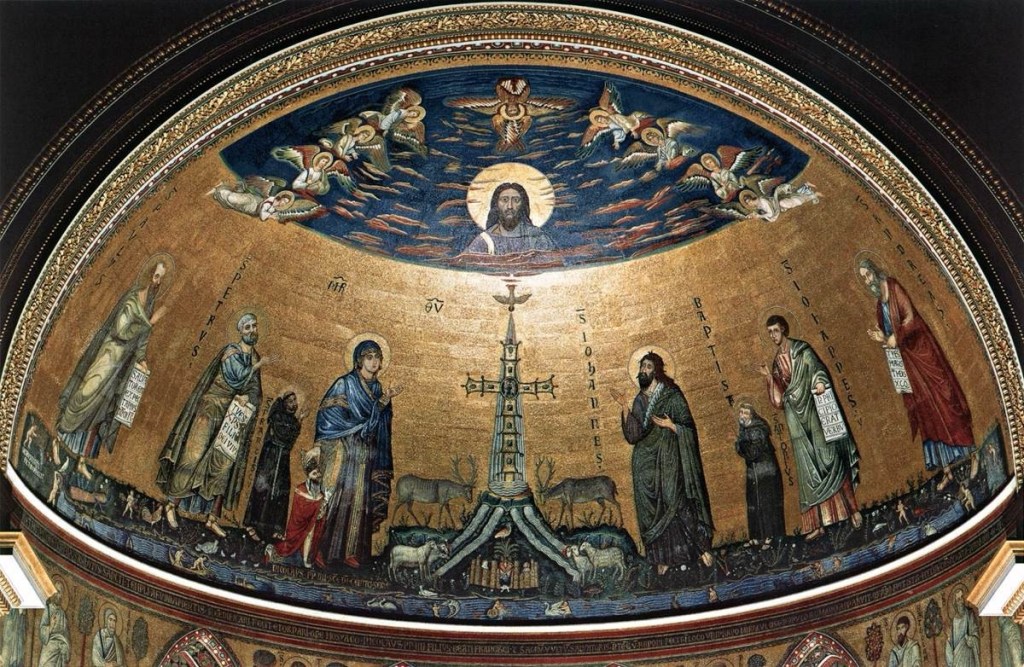
Apse mosaic, St John Lateran Archbasilica, Cathedral Church of the Bishop of Rome

Dei Verbum: Christ, Scripture and the Life of the Church

+Daniel E. Flores, STD

Bishop of Brownsville in Texas

Part of our moment, I think, is a searing reminder to us all that in some mysterious sense, we never live in ordinary times. We kid ourselves into what Pope Francis once called the “grey pragmatism of the daily life of the Church”, that the Holy Father, quoting Bernanos, then described as “the most precious of the devil’s potions”.[1] The Church in the world is more like Bernanos’ descriptions in The Impostor than even Greene’s simple Whiskey Priest. The battle between grace and sin goes on every day more on the scale of Benson’s Lord of the World than in the form of Chesterton’s The Man who was Thursday. There are elements of Apocalypse Chapter 12 that are operative in history, have been and will be until the final consummation of all things. We have been for too long content with programs and policies, as if by themselves they can keep the ship afloat. Oh, the ship will remain afloat and will be righted, and God’s inscrutable providence will not be frustrated, but it will not be because we figured out the right formula. The Lord would have us be conformed to the charity of his poor Crucified Son, even if it kills us: I admire thee, master of the tides, […] Ground of all being, and granite of it: past all / Grasp God, throned behind / Death with a sovereignty that / heeds but hides, bodes but abides; […].[2]

+++

This lecture is based on the conviction that if we do not sustain an effort to get the connections right between Christ himself, the Scriptural Tradition and the life of the Church, all of our efforts aimed towards the renewal of Church life and theology ultimately fail.

1. “The work of at least another whole generation”

From Dei Verbum 12:

«For the correct understanding of what the sacred author wanted to assert, due attention must be paid to the customary and characteristic styles of feeling, speaking and narrating which prevailed at the time of the sacred writer, and to the patterns men normally employed at that period in their everyday dealings with one another. But, since Holy Scripture must be read and interpreted in the sacred spirit in which it was written, no less serious attention must be given to the content and unity of the whole of Scripture if the meaning of the sacred texts is to be correctly worked out.[3]»

Theologians hold an office. St Thomas used the language of his day in what I still consider the noblest description of your office: Magistri Sacrae Paginae, Masters of the Sacred Page, Teachers of Sacred Scripture. If the University teaching of theology in Thomas’ time recognized the magistri as canonically missioned by the Church, it was because they were understood to be at the service of the same ends evidenced in Scripture itself, pursued by the preaching and teaching office of the bishops, and at the service of the whole Church. St Thomas says this in his commentary on the Sentences:

«To teach Sacred Scripture happens in two ways. One from the office of prelates, like those who preach and teach,… the other way is from the office of Magister, like the masters of theology teach,.. the aim of those who teach Sacred Scripture is the same aim as those who brought forth Sacred Scripture; hence, since the publication of sacred Scripture was ordered to this, that man might attain to eternal life, as is clear from John 10, whoever impedes the end of this doctrine, sins by teaching.[4]»

I like this exemplary passage because Thomas articulates a deep part of the common tradition. The exposition of Scripture either by the ordained or by the teachers of theology shares in the aims and ends of the Scriptural authors themselves. This element of the Tradition was repeated forcefully in Dei Verbum when it speaks of Scripture being interpreted in the sacred spirit in which it was written. In some ways this phrase from Dei Verbum seemed remarkable at the time. Ignace de la Potterie puts it this way:

«Certainly, even the Constitution Dei Verbum says that «due attention must be paid both to the customary and characteristic styles of feeling, speaking and narrating which prevailed at the time of the sacred writer» (DV 12:2). But this affirmation is immediately followed by a truly novel paragraph on the ecclesial interpretation of Sacred Scripture «in the sacred Spirit in which it was written» (DV 12:3); strangely enough, after the Council, this remained a dead letter.[5]»

The formulation in Dei Verbum 12 may be described as novel in that it unites the contemporary problematic of the critical appraisal of the sacred writers’ historical setting together with the notion that teaching Scripture necessarily involves participation in the Spirit that inspired its composition. But the latter point is as traditional a theological given as you will find. Thomas is a spokesman for the tradition; De Lubac can give us countless other pre-critical citations from the tradition. De la Potterie’s contention that the pre-critical datum of the tradition emerged from the Council without much attention in a certain way helps frame the circumstance I wish to address.

Cardinal Ratzinger’s critical appraisal of the state of Scriptural exegesis in his 1988 lecture on Biblical interpretation in Conflict remains a pivotal and fruitful post-Conciliar theological text.[6] You’ve probably read it, or if you haven’t I hope you soon will. Still, it might be useful to recall a few things Ratzinger said in the 1988 lecture.

First, he notes the bleakness of the disconnect  between Scripture and dogma:

«The negative side of what has happened consists in the fact that the gap between exegesis and dogma has become complete now among Catholics, too. Scripture has become for them so many words from the past; everyone tries to transport to the present in his own way, without being able to put too much faith in the raft he is relying on to do the job. Faith sinks to the level of a sort of philosophy of life that the individual tries to distill from the Bible as best he can. Dogma, now deprived of grounding in Scripture, no longer holds. The Bible, detached from dogma, has become a record of past events that therefore itself belongs to the past.[7]»

Ratzinger’s point about the separation of dogma and Scripture speaks for itself. It is useful to note that he uses the word dogma here, which testifies to the cascading bifurcations of theological disciplines since the Counter-Reformation. The diversification of theological disciplines and courses is a dominant feature of post-Tridentine, baroque, modern and contemporary theology. This is a great part of our reality today. How to link specialized areas of study like theological bioethics or theological appraisals of a neo-liberal social and economic order with the Scriptural revelation would require a whole series of lectures by a series of specialists. I am not such a specialist. Thomas, though reminds us of an older way; he would rather us speak of Sacred Doctrine as a wider term naming the whole tradition of teaching that flows from Scripture read in the Church. Thomas, in fact, practically equates Sacred Doctrine with Sacred Scripture itself, (Sacra Scriptura seu doctrina) testifying to the close identification with which the patristic and medieval tradition understood the living voice of the Church and the Sacred Scripture itself.[8]

A little later, the future pope goes on to restate the dilemma, cautioning us against withdrawing our efforts to the mere repetition of pre-critical perspectives:

«[Exegesis] also cannot withdraw to the Middle Ages or the Fathers and use them as a shield against the spirit of modernity. That said, it also cannot take the opposite tack of dispensing with the insights of the great believers of all ages and of acting as if the history of thought begins in earnest only with Kant. In my judgment, the recent discussion surrounding the problem of biblical hermeneutics suffers to a large extent from this restricted horizon. One does not dispose of patristic exegesis simply by labeling it «allegorical,» nor can one set aside the philosophy of the Middle Ages by classifying it as «pre-critical.»[9]»

Dei Verbum quite clearly wanted to shepherd bishops and theologians and theology as a whole toward a recovery of the primacy of the revealed Word in the Church in a way that both transmits the pre-Enlightenment depth of theological exposition, and integrates the varied tools of critical textual analysis. But as many of us know by experience and as many great post-Conciliar minds have observed, we are yet far from that. Again, from the 1988 Ratzinger lecture:

«[…] hardly anyone is likely to affirm that we are already ready in possession of a convincing master idea that would do justice to the irrevocable insights of the historical method, while at the same time overcoming its limitations and opening it up to an appropriate hermeneutics. The achievement of this goal still requires the work of at least another whole generation.[10]»

2. A Direct yet Mediated Word

De facto, we teach by saying something like “in Matthew’s account of Christ tempted in the desert, etc.” Or we say “the Johannine theology of Logos and flesh suggests, etc.” Both examples may be followed with expressive statements that are quite true critically speaking and quite Catholic, theologically speaking. Yet, the teacher, and certainly the preacher desires ultimately to say something more than “Matthew tells us”. And the Church’s preaching tradition certainly insists on saying more. This is a given of Tradition. Matthew, John, the Church, and the contemporary preacher need to be able to say with the conviction of faith: It is the Lord Himself who asks, who teaches, who reprimands, cajoles and heals. Without this capacity to hear the Lord speak his word directly, without this voice that is in the Church but not of her making, we are denied the grace of prophetic announcement and of authoritative self-critique.[11]

Theologically we must speak of the Word of the Lord as both directly from him yet mediated through Scripture, the Tradition of faith, and the contemporary teaching voice of the Church. This is a problem for us today, because the dominant metaphysics of knowing sees direct speaking and mediated speaking as mutually exclusive. Theologically, I think a Catholic must affirm that mediated direct address is possible; how to account for its manifestation is another matter.[12]

If as Thomas taught and Dei Verbum insists, the expositor shares in the Spirit of the sacred authors of Scripture than surely this must include the graced ability to say: It is the Lord who speaks. If we cannot say this, we may speak with learned authority, but we do not speak with the authority of Christ.[13] It is Christ who changes people by the impact of his Word and presence. Teachers in the Church either aim to be transparent to this direct address or we labor in vain.

We have, it seems to me, reduced most all of our disputations about Christian faith and life to ecclesiology. Sooner or later a teaching about the Eucharistic sacrifice as constitutive of the Church Jesus established, or about immigration, or the death penalty is distilled into a dispute about what level of ecclesiastical authority proposes the teaching. A self-referential Church is not only a Church focused on itself, it is also a Church that cannot, for the most part, remember how to talk more about Christ than about herself, even when discussing outward looking issues. We do not even realize the dimensions of our own reductionism, which, paradoxically, are enormous in their narrowness.

The profound disconnect in practice between our customary ways of citing Scripture as authoritative and our conviction that it is the Lord whose voice is heard through the text is in large part responsible for what Ratzinger described as everyone trying to transport Scripture to the present in his own way, “without being able to put too much faith in the raft he is relying on to do the job.”

This, then, is part of our theological muddle today. We have forgotten how to express with confidence the Church’s Scriptural access to the person of Christ Himself. This is a wide, varied and deep problem that has been with us for a while. Scripture is no longer expected to be transparent to a presence in a way analogous to the Sacrament. Yet, the Tradition does hear a Voice speak directly from the Scriptural text, it is a kind of sacramentally mediated presence. Surely not in the same way as the preeminent Eucharistic presence, but an efficacious sign nonetheless, through which we attain to knowing WORD himself, and not another.

Scripture is truly expressive for the same reasons the Eucharistic sacrifice is truly expressive. The WORD, after all, is known personally and most perfectly in the Incarnation; expresse se manifestavit, St Thomas says in his commentary on Hebrews 1.[14] This is to affirm that the direct address of the Eternal WORD is necessarily mediated through the humanity of Christ. Human nature, as it were, united to the Person of the WORD becomes an expressive word itself, transparent to the Wisdom interior to the Godhead. The human words of the WORD are themselves physical signs expressive of his person, which is itself mediated to us through his enfleshed existence.[15]

I want to pull this notion of Christ’s mediated immediacy together in some way by referring to a novel entitled La Confesión by Javier Sicilia, a Mexican poet/novelist/human rights activist. In it he describes the mystery of the poverty of the WORD made flesh. The novel itself is a devastating critique of the ecclesiastical culture within which the Maciel disaster was embedded. Early in the novel a fairly impractical, not to say useless priest, exiled to a poor mountain village in central Mexico, is having an interview with his fairly powerful Cardinal Archbishop. No one reading in Mexico would doubt the realism of the dialogue between poverty and power in the Church. Javier Sicilia’s vision of the poverty and powerlessness of Christ permeates the novel and is here encapsulated in this fragment. It picks up with the priest speaking quietly while the Cardinal sips a tequila. My translation cannot do justice to the beauty of this passage.

«Do you know what amazes me [Eminence] about the Incarnation? I continued, that it is altogether contrary to the modern world: the presence of the infinite in the limits of the flesh, and the fight, the fight with no quarter, against the temptations of the devil’s excesses. You do not know how much I have meditated on the temptations in the desert. “Take up the power”, the devil told him; that power that gives the illusion of being able to disrupt and dominate everything. But he maintained himself in the limits of his own flesh, in his own poverty, in his own death, so poor, so miserable, so hard. Our age, nevertheless, showing a face of enormous kindness, has succumbed to those temptations. “They will be like gods, they will change the stones into bread, and they will dominate the world”… to such an age we have handed over the Christ, and we do not even realize it.[16]»

Much later in the novel, the miserable priest is visiting with an elderly religious sister with whom he shares an abiding friendship. Here it is not so much the dialogue between poverty and power as it is the dialogue between poverty and the anguished preacher. This passage focuses on the denigration of the poor, and thus the denigration of the Christ. Father hears Sister utter the following:

«If misery exists, Father, and the statistics do not lie, it is because the dream of the rich has contaminated the dreams of the poor. At the bottom of things, poverty no longer exists, dear Father. The only thing that exists is wealth and misery, … Do you know why? I know well that you know … Because they have been made to believe that their poverty is a shameful disease, a wound unworthy of the world. Never before has humanity, and here, excuse me, Father, I also included our Holy Mother Church, spit so much on the face of Christ, as if his poverty were a filth, that unclean filth that they hung from the cross and which we, as did his detractors, make fun of.[17]»

These passages are deeply Scriptural, with a lively sense of the nearness of Christ in his poverty and powerlessness to us today. The Scriptural episode of Christ in the desert, tempted by the devil, acts as a mirror to the mystery of the Incarnation as a whole, and the brutality of the Cross in particular. Incarnation and the Paschal Mystery are the principal lights through which Christ’s particular words and deeds are interpreted. Now this is a very Catholic way of reading Christ, that is to say, of providing access to the identity and mission of WORD made flesh himself.[18] The contemplative apprehension of the meaning of the particular accounts of the Lord’s life contained in the Gospels is enveloped, so to speak, in the intense intelligibility of the Incarnation and Passion of the Lord.

The immediacy of the references to the Lord, in both the conversation with the Cardinal and to the elderly Religious Sister, presumes a transparent movement from the Christ of Scripture, the Christ of the Church, the Christ present today in our midst. A radically realist Johannine Christology, (God really did become flesh), and a fierce defense of his identification with the poor undergirds this passage scripturally. It is the Lord who speaks to us directly: what you did not do for the least, you did not do for me. Yet, these passages are a mediation of that direct address.

There is a difference between a naïve understanding of Scriptural composition and the profound attitude of faith that takes the Gospels as coherently expressive, giving us intelligible access to the voice of the Lord Himself.[19] To confess that it is part of the faith of the Church that Christ speaks directly through the Scriptures yet in a manner mediated by human authors is an important thing to reflect upon theologically. Yet, to begin to account for how this happens is a subtly difficult question.

3. CHRIST in History

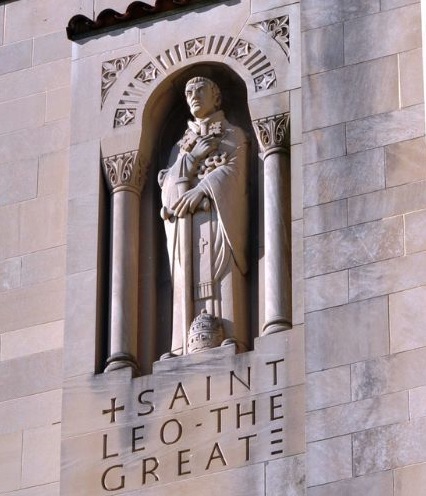
St Leo the Great, On the Beatitudes:

«And so it was that he who had spoken to Moses spoke also to the apostles. Writing in the hearts of his disciples, the swift hand of the Word composed the ordinances of the new covenant.[20]»

The tale of Scriptural exposition since the development of the critical methods is rather complex. It is fair to say, though, that we have been on the defensive about Catholic approaches to Scripture for quite some time now.[21] Theologians and magisterium alike have been searching for ways to defend the reliability of Scripture and the Gospels in particular. Sometimes we have labored from within the historicist frame, unaware of the limitations imposed by “today’s regnant plausibility structure”.[22] Klemens Stock, the Jesuit biblicist, puts the matter more succinctly and with greater authority than I could in the following remarkable passage:

«Our fundamental desideratum is to know Jesus as he really is in the integrity of his person. Now, it is widely believed that, in order to do so, we have to read the gospels against the grain. The gospels are used as quarries. Jesus and his deeds are extracted from them in their pure form, or at least that is the intention. The very thing that the gospels do not give us we must laboriously, if only fragmentarily, retrieve from them: «the audio and video recordings,» the «stenographic transcripts» of Jesus in action, now «freed» from the perspective of the gospel writers. These, so it seems, are what is indispensable for getting at the real Jesus. The question arises whether these «audio and video recordings» – even supposing that it is possible to reconstruct with a certain probability sufficiently long segments free from background noise and distortion – are indeed the best way to get at the real Jesus.[23]»

Jean Luc Marion, certainly Ratzinger himself, Klemens Stock, and to a certain extent even Rene Girard point us toward a less defensive position with respect to post-Enlightenment historicist hermeneutics.[24] Each in their own way argue for a more robust stance that takes its instruction from the phenomenon itself. As Cardinal Ratizinger stated it in 1988:

«[The exegete] must not rule out a priori the possibility that God can speak in his own voice in the world using human words; he must not rule out the possibility that God can work in history and enter into it without ceasing to be himself, however improbable this might appear. He must be ready to take instruction from the phenomenon.[25]»

For our purposes I would like to focus on Stock’s contribution to this approach that seeks instruction from the phenomena itself:

«Do not the gospels, […] correspond much better to the whole character of how Jesus actually acted and what he actually intended? It is clear that the gospels are not stenographic reports. […] But Jesus did gather a circle of disciples, who accompanied him on all his journeys and were under the constant influence of his person. The real Jesus is never isolated and alone. Rather, he always lives in communion with his disciples. He does not want literal exactness. What he wants is for these living men to understand him and to be shaped by him. […] Generally speaking, words and deeds are not the only things that come from a person and give us a glimpse into who he is. […] The impression and understanding grounded in this real, and not merely verbal, communication sometimes are not, and cannot be, formulated either at the moment of encountering this person or during the period of immediate communion with him, but become clarified only with time -and, despite this time lapse, still find a valid, truthful verbal expression. Jesus, then, is inseparable from the disciples.[26]»

Historical reliability is a human phenomenon wider than YouTube recorded accuracy. It is more true to human history and culture in its near infinite varieties to locate the ground of history in the human relation that is the basis of communication. This is to say, in the transmission of understanding not simply understood as the transmission of transcripted words, but in the transmission of human impact and interiorization. Put simply, human history is impossible without prior human communication, and communication is the experience of human apprehension of persons who say and do things. Perhaps our way forward is focused not on Scripture’s stenographic exactness, but rather on understanding the form of its transparency to Christ.

Within the New Testament the form of this transparency is inseparable from the phenomenon of the Spirit poured-out to facilitate the apprehension of the person of Christ. This gift described in Scripture itself opens us to a properly theological phenomenon. Luke in particular goes to great lengths to associate the ecclesial reading of Scripture as a gift from the Risen Christ: He said to them, «These are my words that I spoke to you while I was still with you, that everything written about me in the law of Moses and in the prophets and psalms must be fulfilled.» Then he opened their minds to understand the scriptures.[27]

For us, though, it is important to appreciate that the gift of the Spirit is embedded in the human phenomenon of personal communion as the basis for communication, and in the expressed desire of Jesus himself to throw all of his pedagogical intent into the forming of persons in his company and not in the composition of a text.[28] The text, he no doubt knew, was going to be produced in time, but that would be the work of those whom he impacted. The impact, ultimately rooted in Trinitarian missions, is the prior reality: the Son manifested in the flesh, the Spirit enlightening the apprehension of the Son and conforming the human will to him by charity.

Put another way, what if God knows that the only way we can know him as he is, is through his relation with those who have known him, for the simple reason that God in himself is Unity in relation?  If that is anywhere near the case, than the phenomenon of the formation of the New Testament itself witnessed to the Trinitarian economy, and is aimed at gathering a people into relation with the God who is Trinitarian relationality.

In this light, the formation of the New Testament is ordered to a mediated immediacy. The text of the New Testament witnesses to what the impacted apprehended, and the aim of reading the New Testament is perception of the One impacting. The perception is based on understanding the text as offering a mirror into the human authors precisely as impacted by Christ. They reflect Christ before their written words do; and their written words serve to open us to the phenomenon of Christ operative in them. But in the end, it is the Christ they knew that we wish to know. It is not enough to know Matthew or John or Paul.

There is a post-modern theological freedom to this way of appreciating the purposes of Scripture, because it situates the text as fruit of personal impact; the text has no authority apart from that relation to the Son’s engagement with his disciples, and the Spirit’s gift of guiding their apprehension over time, and our apprehension of the One they knew. This is a pedagogy of grace suitable to the way people teach and learn. This perspective on history and textual rootedness in prior human relationality actually frees many a non-theologian from an inhuman hermeneutic. Personal engagement of the teacher is the prior condition that makes it possible for the learner to teach another. This is the stuff of which history is made. It is always mediated. If we are to teach Scripture, though, we must ask for a share of the Spirit that informed those who composed it.

It should be noted that the modern impulse to know Jesus in isolation from those who knew him is a reflection of a wider anthropological move in modernity to understand the person first as an individual and discrete entity whose relations to other persons may initially be biologically necessary, but are not necessary to account for the person as person. The Gospels, therefore, in the way Stock and others describe them, propose an alternative anthropology, one that does not begin with a hostile view towards the claims and implications of human relation.

What then, becomes of the historical-critical apparatus? Well, certainly it is at the service of discerning what these persons impacted by the Person of Christ intended to tell us about him. That is not always an easy task, given the fact that our habits of reading are not usually attuned to what an ancient person wants to say through the text they wrote.[29] For us, the importance of this kind of approach lies in its freeing us from a defensive posture before the exegetical menace of approaching the Scriptural texts as somehow reliable only to the extent we can recover what Jesus was about prior to or apart from his relational impact on those around him. Quite the opposite is true.

This approach is not out of sync with the pre-critical testimony of Irenaeus who located the discipleship of the barbarians in the fact that they, though illiterate and unable to read the Scriptures, did in fact know Christ through the impact of the preaching and catechetical work of the Church, and the gift of the Spirit. Nor does this theological path upend the elegant line from Saint Leo the Great with which I began this section. And, Thomas’s insistence that the New Testament is first of all the Gift of the Spirit, and only secondarily a written text, is part of this tradition. [30]

4. CHRIST in Figure and the Figure in CHRIST

In an episode of Star Trek: The Next Generation, entitled “Darmok” Picard encounters the Temarians, a people who communicate only by making reference to landmark events engrained in their historical memory.[31] “Shaka, when the walls fell”, evokes a tragic loss, which then serves to situate in the mind of the hearer to how the speaker understands the present moment. “Temba, his arms wide”, signifies the giving of a gift. It takes Picard and the crew an hour episode to figure out how this language works, but the moment of understanding (“Sokath, his eyes uncovered”) comes too late to save Picard’s interlocutor, Dathon, from a heroic death (“Kailash, when it rises”). Still, a sort of breakthrough occurs (“Darmok and Jalad on the ocean»), so the sacrifice is not in vain. Obviously, if you don’t know the history, the references to foundational events, you don’t know the language, and you won’t understand the present moment. Not surprisingly, there is a fair amount of internet commentary, some of it good, some of it just weird, on the significance of this episode. I have found little or no reference to its similarity to the Scriptural tradition of figurative understanding. That, though, is where my mind immediately went the first time I saw the episode.

Figuration is an essential element within the Scriptural tradition, and in the Catholic tradition of Scriptural interpretation. Part of our problem is we have confused the theological category of figuration with the more ambiguous notion of allegory. Further, we read the Fathers without always perceiving the theological intuitions that guided them. History is about things that happen, and human history is about how peoples understand things that happen. In human matters, event and Word are inseparable. Even if we encounter events that are initially unintelligible, that in itself is a way of understanding them.

Figuration is built into the Scriptural self-understanding. It concerns events that are intelligible in light of other events. “Moses, with his arms upheld”; “Israel, with unmoistened foot”; “As at Meribah, when they hardened their hearts”. The Old Testament itself depends on these kinds of historical invocations in order to understand its later historical moments. In the last books of the Old Testament, the invocation of the Exodus event in remarkably nuanced ways both interpret the later moments of Israel’s history, and expand Israel’s perception of the meaning of Israel’s foundational historical event. Later events are figured in the foundational event.

Insofar as the Scriptural books are concerned, the dynamic invocation of the history through subsequent figurative readings all happens under the guidance and inspiration of the Holy Spirit. Or, in what amounts to the same thing, the WORD, who authored the first Word-Event, guides the later prophetic tradition to its figurative amplifications. One notes the variety of ways Scripture interprets itself by invoking its foundational history. These internal differences need not be read as competitive; they do witness to a super-intelligibiliy present in the founding. A unified super-intelligible requires a multiplicity if explications.

St Thomas’ commentary on the Psalms provides some help here. For Thomas, most of the Psalms are primarily about what the psalmist was going through, that is to say, they are historically situated in Israel’s history. Thomas respects that and shows remarkable dexterity in locating, or in wanting to locate, the historical references to anything from the Exodus, to troubles with Absalom, thanksgiving for victory in battle, to psalms composed to accompany cultic worship, etc. After locating the history, he then goes on to read those events as prefiguring something having to do with Christ. This is not an exercise in seeking out fanciful allegories; rather it is rooted in the theological conviction that Israel’s history was governed by a special providence, a grace that orders its signification in a way that is anticipatory of the final revelation of God’s historical intent in Christ. Old Testament self-understanding vía the Exodus figurations is thus also anticipatory figuration of Christ’s coming. This is perfectly legitimate, and serves as the basis for a Christian reading of the psalms that respects the history of the psalmists. Figuration, in this tradition, (and here I must insist Thomas is very traditional) is rooted in history, not in words; in events understood a certain way, not in poetic allusions.

Comes now Thomas’ notes on Psalm 21. Somewhere in his thirsty pursuit of Greek texts translated into Latin, St Thomas encountered the decrees of the Second Council of Constantinople (553), and it’s condemnation of Theodore of Mopsuestia.[32] Both in the prologue to his commentary on the Psalms and in his exposition of Psalm 21, Thomas explicitly cites the Council as having condemned Theodore for denying that the Old Testament prophets ever spoke literally of Christ. Thomas never uses the word heresy lightly, but he applies it to Theodore’s reported teaching. It is another question whether Theodore of Mopsuestia actually taught this. Thomas thinks that Constantinople II judges he did, and that such a teaching is a grave error.

This helps to account for the fact that in his commentary on Psalm 21, Thomas makes a fierce turn and makes a crucial distinction. [33]  He insists that the literal sense of the psalm refers to Christ’s passion. The history narrated in the Psalm is not about David, it is about Christ. This is its literal sense. On this reading, David (the psalmist) has a visionary perception of the Passion, and wrote of it. The psalmists own sufferings are secondarily referenced in the psalm, but only to the extent they are figured in Christ’s sufferings. David saw himself in Christ; he did not see Christ in himself. Now, you may think this is a distinction without a difference. But in fact, it sustains a whole theological understanding of spiritual progress. It is more perfect to see oneself figured in Christ than it is to see Christ figured in oneself. This is because Christ is the supreme locus of intelligibility, and I understand myself better if I see myself figured in him. This is the distinction Thomas wishes at all costs to preserve: Israel’s history pre-figures New Testament events, yet the prophets had moments of vision that saw the manifestation of the Christ, and read their contemporary events as figured within the history of Christ.

Now then, after the full revelation of Christ’s historical appearance, the Church has access to the aim of history. Hence, all the faithful now have the capacity by spiritual instinct and knowledge of the Gospel to see themselves in Christ. This, together with the gift of the Spirit guiding our reception of the history of Christ, is what is new about the New Testament revelation. And this is why the Fathers of the Church, following Saint Paul call the definitive revelation in Christ an “unveiling”. What is unveiled? The aim of human living and all of history. This is a datum in the tradition which witnesses to what Ratzinger called the laying bare of the intelligibility of history by the revelation of its end in Christ.[34] For us who live after the foundational events of the Christian revelation, the figurations are clearer, though not perfectly so. Many enigmas of Scripture remain. [35]

Thus the transparency of the ecclesial tradition of reading Scripture to the Eucharistic sacrifice emerges from the salvific economy. The re-presentation of the founding Word-event after the reading of the Scriptures is an unveiling of the fundamental ratio through which the Scriptures of both Testaments are understood. In the intensity of the sacrifice, all things are figured. The Eucharist itself is the paramount mediated immediacy available to us, following as it does the logic of the Incarnation of the WORD. Christian theology breathes of figuration or it dies. And the root of all figurative meaning is the Gospel history of Christ. The Christological truth revealed in Scripture and enacted in the Eucharistic intervention is the basis for all subsequent figurative readings.

+++

During these last weeks my Scriptural meditations have spontaneously turned to the Lamentations of Jeremiah: “Bitterly she weeps at night, tears upon her cheeks, With not one to console her of all her dear ones; Her friends have all betrayed her and become her enemies.” (Lam 1, 2). But as a Catholic I cannot weep the wound of the Virgin Daughter Zion without seeing her suffering figured in the concrete historical suffering of the Virgin Mother of God following the destiny of her poor, Crucified Son. And further, I cannot contemplate the wounds of the Church apart from seeing them figured in the bloody birth of the Church figured in Mary at the foot of the Cross. Immaculate honor of our race, she is also the recipient of the flowing blood and water, and in her is figured the whole People of God who in anguish attain to the Kingdom. The Church’s moments, our moments, are figured in him, and in her insofar as she is the Church born from his side. But not just us, so also the wounded, the abused, the poor, the immigrant with no place to lay his head, the death row inmate, the least of the discarded unborn. If we cannot see ourselves and others, and all our moments together in Christ, we should probably not be writing or teaching or preaching at all. We would have nothing to say because we will have seen but not understood: The Virgin Daughter of Israel, alone with none to console her.

+df

NOTES:

[1] Evangelii Gaudium, no 83.

[2] Hopkins, Wreck of the Deutschland.

[3] Dei Verbum 12, around which this lecture revolves is here given in full: «However, since God speaks in Sacred Scripture through men in human fashion, the interpreter of Sacred Scripture, in order to see clearly what God wanted to communicate to us, should carefully investigate what meaning the sacred writers really intended, and what God wanted to manifest by means of their words. To search out the intention of the sacred writers, attention should be given, among other things, to «literary forms.» For truth is set forth and expressed differently in texts which are variously historical, prophetic, poetic, or of other forms of discourse. The interpreter must investigate what meaning the sacred writer intended to express and actually expressed in particular circumstances by using contemporary literary forms in accordance with the situation of his own time and culture. For the correct understanding of what the sacred author wanted to assert, due attention must be paid to the customary and characteristic styles of feeling, speaking and narrating which prevailed at the time of the sacred writer, and to the patterns men normally employed at that period in their everyday dealings with one another. But, since Holy Scripture must be read and interpreted in the sacred spirit in which it was written, no less serious attention must be given to the content and unity of the whole of Scripture if the meaning of the sacred texts is to be correctly worked out. The living tradition of the whole Church must be taken into account along with the harmony which exists between elements of the faith. It is the task of exegetes to work according to these rules toward a better understanding and explanation of the meaning of Sacred Scripture, so that through preparatory study the judgment of the Church may mature. For all of what has been said about the way of interpreting Scripture is subject finally to the judgment of the Church, which carries out the divine commission and ministry of guarding and interpreting the word of God.»

[4] In IV Sententiarum, d. 19, q. 2, a. 2b, ad 4: […] docere Sacram Scripturam dupliciter contingit. Uno modo ex officio praelationis, sicut qui praedicat, docet; non enim licet alicui praedicare, nisi officium praelationis habeat, vel ex auctoritate alicujus praelationem habentis; rom. 10, 15: quomodo praedicabunt, nisi mittantur? alio modo ex officio magisterii, sicut magistri theologiae docent,…eorum qui docent Sacram Scripturam est idem finis et eorum qui Sacram Scripturam ediderunt; unde, cum ad hoc ordinetur Scripturae editio, ut ad vitam aeternam homo perveniat, ut patet Joan. 10; quicumque impedit finem doctrinae, docendo peccat.

[5] Ignace de la Potterie, “Biblical Exegesis: A Science of Faith” in Opening up the Scriptures: Joseph Ratzinger and the Foundations of Biblical Interpretation edited by Josë Granados, Carlos Granados, Luis Sánchez-Navarro (Eerdmans, 2008). Electronic format, pos 597.

[6] Ratzinger, “Biblical Interpretation in Conflict: On the Foundations and Itinerary of Exegesis Today”, in Opening up the Scriptures.

[7] Ratzinger, Biblical Interpretation, pos 269.

[8] Sacra Scriptura seu doctrina, in effect identifying Scripture with the doctrine taught with authority in the Church. See Prima pars, q. 1, art. 2, ad 2.

[9] Ratzinger, Biblical Interpretation, pos 413.

[10] Ratzinger, Biblical Interpretation, pos 275.

[11] This theme is related to the distinction between the Church in the holiness of her members and the Church as constituted also with an objective teaching office. See Von Balthasar, III, Dramatis Personae, (Ignatius, 1992), 358-359: “Only the Catholic Church has this bipolar character of Marian subjective holiness and Petrine, objective holiness. It constitutes her irreducible, inner dramatic tension and is what makes her the extension (“fullness”, “body”) of Christ as well as his partner (“bride”), enabling her to participate in Christ’s redemptive mission and, undergirding this, in his trinitarian being. There is drama in the encounter between the believer’s experiential knowledge, which comes from the fullness of Christ, and authorities official knowledge, which is imparted by Christ directly. … Rather, it invited the individual to examine in faith, his own conscience, which is only a Christian conscience if it lets itself be guided by the great stream of revelation — interpreted by tradition and official Church teaching and preserved in Scripture — and enters into it. Given all this, it is possible for the official Church to make demands, according to the mind of Christ, that seem unintelligible and extreme to an individual or group; there is nothing strange in Christ leading us along the path of the Cross not only in person but also, most definitely, through the institution he himself has appointed.”

[12] Even when we say something like “The Lord encountered three principal temptations from the devil in the desert,…”, we might actually think to ourselves that there is a whole critical mental reservation that would be too hard to unravel in a sermon or lecture, so we simply speak as the Gospel speaks. Many a preacher feels unease at holding two ways of speaking in his mind, one way for preaching, another for critical analysis of Matthew’s or John’s text.

[13] Learned authority has a place in theological teaching, but it is secondary and supportive of sacred doctrine, analogous to the relation Thomas describes between philosophy and Sacred Doctrine. The doctrine is authoritative because it is visibly and audibly linked to Christ who reveals, either in his Incarnate state, or in his mission as WORD generating the words of the prophetic ages.

[14] Ad Hebraeos, Caput 1, Lectio 1, (Marietti 15): Prima autem expressio, scilicet in creatione, non ordinatur ad manifestationem, sed ad esse, Sap. I creavit Deus ut essent omnia. Cum ergo expressio non habeat rationem locutionis nisi prout ordinatur ad manifestationem, manifestum est, quod illa expressio non potest dici locutio, et ideo numquam dicitur, quod Deus loquatur creando creaturas, sed quod cognoscatur. Rom. I, 20: invisibilia Dei per ea quae facta sunt, intellecta conspiciuntur. Secunda vero expressio, quae est editio specierum in mente angelica, vel humana, ordinatur tantum ad cognitionem sapientiae divinae, et ideo potest dici locutio. Tertia vero, quae est per assumptionem carnis, ordinatur ad esse, et ad cognitionem, et ad expressam manifestationem, quia per assumptionem carnis, et verbum factum est homo, et nos in cognitionem Dei perfecit. (Io. XVIII, 37: ad hoc natus sum, ut testimonium perhibeam veritati). Et se nobis expresse manifestavit. Bar. c. III, 38: post haec in terris visus est, et cum hominibus conversatus est. Sic ergo, licet Deus loquatur in novo et veteri testamento, perfectius tamen in novo nobis loquitur, quia ibi per revelationes in mentibus hominum, hic per incarnationem filii.

[15] Dei Verbum 13: “For the words of God, expressed in human language, have been made like human discourse, just as the word of the eternal Father, when He took to Himself the flesh of human weakness, was in every way made like men.” On Scripture as having analogous relation to the Incarnation itself, a line of thought I would have liked to pursue further in this lecture, see Denis Farkasfalvy, O, Cist., “Inspiration and Incarnation”, in Verbum Domini and the Complementarity of Exegesis and Theology (Eerdmans, 2015).

[16] Javier Sicilia: La confesión: El diario de Esteban Martorus (Debolsillo, 2016, electronic format): pos. 176: Sabe qué me maravilla de la encarnación? —continué—, que es todo lo contrario del mundo moderno: la presencia del infinito en los límites de la carne, y la lucha, la lucha sin cuartel, contra las tentaciones de las desmesuras del diablo. No sabe cuánto he meditado en las tentaciones del desierto. ”‘ Asume el poder’, le decía el diablo; ese poder que da la ilusión de trastocar y dominar todo. Pero él se mantuvo en los límites de su propia carne, en su propia pobreza, en su propia muerte, tan pobre, tan miserable, tan dura. Nuestra época, sin embargo, bajo el rostro de una enorme bondad, ha sucumbido a esas tentaciones. ‘Serán como dioses, cambiarán las piedras en panes, dominarán el mundo’… A ella le hemos entregado a Cristo y no nos damos cuenta.

[17] Javier Sicilia, La confesión, pos. 1669: Si la miseria existe y las estadísticas no mienten es porque el sueño de los ricos ha contaminado los sueños de los pobres. En el fondo ya no existe la pobreza, querido padre. Lo único que existe es la riqueza y la miseria,.. ¿Sabe por qué? Sé bien que lo sabe,… Porque se les ha hecho creer que su pobreza es una enfermedad vergonzosa, una llaga indigna del mundo. ”Nunca la humanidad, y aquí, discúlpeme, padre, incluyo también a nuestra Santa Madre, había escupido tanto sobre el rostro de Cristo, como si su pobreza se tratara de una porquería, de esa inmunda porquería que colgaron de la cruz y de la cual, como lo hicieron sus detractores, nos burlamos.

[18] Liturgically, this reception of the twin event-lights of Incarnation and Cross through which the rest of Scripture is understood is reflected in the Christmas- Easter cycles through which the readings of all the other seasons are ecclesially apprehended.

[19] Neither in the preaching tradition of the Church, nor in the theological novel is there any footnoting about what the source traditions say about the accounts of the Lord in the desert, and the historical accuracy of the different Gospel accounts. There is no re-positioning of the historical reasons that may have actually, apart from the Gospel’s telling, accounted for why Christ was arrested and crucified.

[20]Leo the Great, Sermon 95, 1-2: Qui ergo locútus fúerat Móysi, locútus est et Apóstolis et in córdibus discipulórum velox scribéntis Verbi manus novi testaménti decréta condébat.”

[21] See, Ratzinger, “Exegesis and the Magisterium of the Church” (originally published in Communio, 2003), in Opening up the Scriptures.

[22] Ratzinger, Biblical Interpretation, pos 460.

[23] Klemens Stock, “Christ in Contemporary Exegeis: Where We Are and Where We Are Going”, in Opening Up the Scriptures, pos 1272.

[24] Jean-Luc Marion, Givenness and Revelation, (Oxford University Press, 2016, electronic format) Introduction: “In fact, biblical revelation puts into operation the privilege of a givenness that surpasses every expectation, every prediction, and, finally, every reception: “If you knew the gift of God … ” (Jn. 4: 10). Indeed, gift and givenness offer a perfectly univocal concept: givenness in phenomenology (the excess of intuition and the advent of significations unthinkable by men) is found again and prolonged in “every perfect gift that comes from above” (James 1: 17). Paradoxically, but logically, revelation, by virtue of the givenness that it alone performs perfectly, would accomplish the essence of phenomenality.” René Girard, El Sacrificio (Ediciones Encuentro: 2012, electronic format), cap. 3: He Aquí la verdadera diferencia entre lo mítico y lo bíblico. Lo mítico permanece como el engaño de los fenómenos de chivo expiatorio. Lo bíblico desvela su mentira al revelar la inocencia de las víctimas. Si no se identifica el abismo que separa lo bíblico de lo mítico es porque, bajo el influjo de un viejo positivismo, se imagina que, para ser realmente diferentes, los textos deben referirse a asuntos diferentes. En realidad, lo mítico y lo bíblico difieren radicalmente porque lo bíblico rompe por primera vez con la mentira cultural por excelencia, hasta entonces oculta, de los fenómenos de chivo expiatorio sobre los cuales se ha fundado la cultura humana.»

[25] Ratzinger, Biblical Interpretation, pos 436.

[26] Stock, Christ in Contemporary Exegesis, pos 1277 ff.

[27] Luke 24, 44-45.

[28] Stock, Christ in Contemporary Exegesis, pos 1288: “Primarily, it is the living human beings who had the grace of knowing his person and his message in a community of life with him. Jesus did not act with an eye to documentation, but to living testimony.”

[29] Stock, Christ in Contemporary Exegesis, pos 2098: “One might ask, in fact, what need remains for the whole exegetical enterprise, if attentive listening to the texts in their present form is sufficient for easy access to the real Jesus. In response, we must not forget that these texts are almost two thousand years old. On the subject of attentive listening, it is just that this demands respecting the texts as historical realities, as realities of their time and environment, which in turn requires us to refrain from imposing our concepts, questions, and expectations upon them. […].”

[30] See Against Heresies, Book 3, Ch 4, no. 2; see also Summa Theologiae, I-II, q 106.

[31] Star Trek: The Next Generation, episode 102, (season 5, episode 2).

[32] I had occasion to write on this topic in “Thomas on the Problem of Theodore of Mopsuestia, Exegete” in The Thomist: A Speculative Quarterly Review, 69 (2), 251-277, 2005.

[33] Super Psalmo 21: Et inter alia specialiter iste Psalmus agit de passione Christi. Et ideo hic est ejus sensus litteralis. Unde specialiter hunc Psalmum in passione dixit cum clamavit, Heli Heli lammasabactani: quod idem est quod Deus Deus meus etc. sicut hic Psalmus incipit. Et ideo licet figuraliter hic Psalmus dicatur de David, tamen specialiter ad litteram refertur ad Christum. Et in synodo Toletana quidam Theodorus Mopsuestenus, qui hunc ad litteram de David exponebat, fuit damnatus, et propter hoc et propter alia multa; et ideo de Christo exponendus est. Sciendum est autem quod quinque Psalmi agunt de passione Christi prolixe: quorum iste Psalmus primus est. Alii enim brevius tangunt passionem Christi. Secundus est, judica domine nocentes me, Ps. 34. Tertius est, ibi, exaudi Deus orationem meam, et ne despexeris deprecationem meam. Quartus, Ps. 68: salvum me fac Deus, quoniam intraverunt aquae. Quintus, Ps. 108: Deus laudem meam ne tacueris. Et hoc propter quinque plagas Christi: vel propter quinque effusiones sanguinis. Et unus est modus procedendi in omnibus, quia incipiunt a gemitu, et terminantur in salutem populorum: quia ex passione facta est salus omnibus hominibus. 

[34] Ratzinger, Biblical Interpretation, pos 466: “When things have reached their goal, one can discover cover the true sense that so to say lay hidden in them. This sense appearing at the end of the movement transcends whatever sense might be inferred from any given section of the now completed path. «This new sense thus presupposes the existence of a divine Providence, the existence of a (salvation) history arriving at its destination.»» God’s action thus appears as the principle of the intelligibility of history. The unifying principle of the whole of past and present «history, which alone confers sense on it, is, however, ever, the historical event of Christ.”

[35] Thomas does occasionally use the term ‘allegory”, but he prefers the term “mystice”; the mystical sense is what is figured in the history of Christ. Thus, to state the matter briefly, the ecclesiological sense of a text is the figure of the Church present in the person of Christ; the moral sense of a text is the norm of Christian living present in Christ’s actions; the eschatological sense is the destiny of the Christ as anticipatory of the final destiny of the human race. All of this flows from the super-intelligibility of Christ in his Person, who, after all is said and done, reveals that the intelligibility of Word-event is a person. Thomas allows for a fluidity of readings in a text, so long as they do not oppose the rule of faith and the obvious intention of the human author. This way of speaking is shorthand for what Dei Verbum will call “the intention of the sacred writers” understood in relation to the “content and unity of the whole of Scripture.“

Compendium of the Four Reports I have given on Synodality to the US Conference of Bishops: June 2023- November 2024

Pope Francis announced in 2020 the beginning of worldwide synodal consultations in the local churches in preparation for two Synod of Bishop assembles in Rome. These took place in October, 2023 and October, 2024. I was asked by Archbishop José Gomez, then President of the United States Conference of Catholic Bishops, to help guide the process of consultation in the United States. As part of my responsibilities, I gave reports to the bishops of the country on the work that was being done in our local dioceses and eparchies, and on the pastoral / theological implications of synodality itself. Below, are the four principal reports I have given to date. They were given in public session to the bishops assembled. The work of the Synod goes forward under Pope Leo XIV. We are now in the implementation stage.

+df

From the Synod of Bishops, October 2023

Synod Update to the Bishops

June Plenary 2023

Thank you, Archbishop. Good afternoon, everyone. I would like to use this time to give you an update on the Synod: where we are, and what’s next.

As you know the North American Final Document for the Continental Stage of the Synod was sent to the Holy See last March.

I would like to express my deep gratitude for all those who participated in the assemblies themselves, including delegates from Canada and the United Stares, as well as the bishops of Canada and the United States who generously participated.

Thanks also to those that served on the writing teams from our Conference and from the Canadian Bishops Conference. I am particularly grateful to Bishops Betancourt, Stowe, Tyson, Walkowiak, and Zinkula; and I am grateful to Julia McStravog, Richard Coll, Alexandra Carroll, Father Michael Fuller, and Sr. Leticia Salazar, who have all worked tirelessly and creatively.

I would also like publicly to thank Cardinal Grech of the Secretariat for the Synod, who in the name of the Holy Father, asked me to be part of the preparatory commission for the upcoming meeting of the Synod in October.

The North American Synodal Report is one of seven such reports prepared around the world, all of which together form the basis of the soon to be released Instrumentum Laboris for the October 2023 episcopal Synodal assembly.

The Instrumentum itself will be a praying / working document. Its preparation has involved a variety of consultants and commissions, and has involved direct reporting to, and direction from the Holy Father himself. When it is released later this month, I encourage you to read it carefully.

The Instrumentum is intended to offer a basis for pastoral and theological reflection in preparation for the October 2023 gathering. The Synodal Assembly itself, presided by the Holy Father, (as is its nature), will discuss and discern its content as the October sessions unfold.

As we have moved through the Synodal consultations, from the sessions in our local parishes and dioceses, the regional and national gatherings, and the more recent Continental Report, we have heard and learned many things.

A fair reading of the Seven continental reports suggests that all of the reporting churches find great reason to value the style and content of the more local manifestations of Synodal consultation and discernment.

It is clear also that there are many things that can be addressed best at the local level, and addressing them with a strengthened capacity to work together seems to have been widely experienced in the local churches that made a serious effort to promote Synodal style prayer and listening.

Many questions have been raised through the process. Indeed, the Synodal Way has elicited diverse expectations, discussions and debates. What is a Synod? What is different about this one? What will it accomplish? Will it bring changes? And if so, what kinds of changes?

Sincethe Second Vatican Council, the Catholic Church has celebrated a number of synods of bishops. They have been convoked by the Pope, and have been presided over by him. They have tended to focus on specific pastoral themes, and have offered consultative advice to the Holy Father.

What is notably different about this upcoming Synod is that the Holy Father has asked that an extensive, energetic and creative effort of consultation with the body of the baptized take place in all the dioceses of the world prior to the gathering of the assembly of bishops, with the participation of representative laity, in Rome.

Why? To answer that question we should look to the Apostolic letter Episcopalis Communio that Pope Francis published in 2018. But the short answer is that it is fitting and just that the bishops of the Church actively consult their own local churches in order to gather a sense of the faith and practice that the local church lives in order “carry to Peter”, so to speak, the reality of faith and life in the local Church during the Synodal Assembly that gathers to offer counsel to the Holy Father.

The wide consultative effort is in some way reflected in the National and Continental Reports. Such wide consultation is new to the Synodal process, but not foreign to it.

If it has felt at times that we were creating a pathway as we walked it, it is largely due to the fact that some things you just have to start doing in order to learn how it can be done, and how it can be done better.

It seems to me that the Holy Father prefers this manner of proceeding: reflection on something already attempted, rather than meeting to draw up a theoretical schema about how such a thing could be done within the Communion of the Catholic Church.

“Ecclesia facit quod facit”, the Church does what she does; and when she does, we can think more fruitfully about what she is capable of doing while remaining true to herself.

This is particularly important if we keep in mind that the theme of the 2023 / 2024 Synod of Bishops is Synodality itself. The question before the Synod is “how is it possible practically to incorporate the active participation of the Body of the Baptized into the Synodal consultation that the world’s bishops offer to the Pope?” Many other questions flow from this, all of them focused on how the Church can strengthen the participation and communion of her members for the sake of the evangelizing and eschatological mission entrusted to us by grace.

During the local, national and continental stages, we heard many things, from our people; we were probably already aware of many of these things. But the passion, faith and hope with which a particular person or community speaks in the Church carries it’s own inherent dignity and realism. We are all better for engaging and listening attentively.

During the listening sessions particular issues emerged with great frequency, and often from widely divergent points of view. These are reflected in the reports, from the most local to the seven Continental Reports.

We heard about great love for the Church, and we heard great frustration and pain at how things sometimes are in the Church. This was natural enough. People were asked what they thought, what they felt, and those who generously gave the time, told us.

The voices we heard also on spoke about many other things: about the dignity of the baptized; about welcoming and inclusion; about formation in the corresponsibilty of the laity for the mission of the Church; about the importance of addressing the increasing polarization and division within the Church; and about the Holy Father’s call for a Church that goes out to those on the peripheries.

It is reasonable to expect that the upcoming synod will focus on how Synodality itself as a form of lived Catholic Communion especially needed in our time, can contribute to addressing our problems and contentious disagreements as a Church in an authentically Catholic way. (As opposed to ways adopted from secular models of decision-making.)

The impulse to gather, pray, listen and speak in a setting that promotes the life and participation of the Communion of the Baptised is a gift to the Church, and has given us new realistic insight into the way the Church lives her struggle in the present moment of history, in the great variety of different circumstances across the world.

One of the things we have learned is that we can do much better in the future to integrate a more effective consultative style in our local churches. For a first effort, the amount of participation was notable. Though obviously, there is an enormous work to be done to integrate a more robust Synodal style into our local and regional churches.

For bishops on the local level, the challenge going forward is to integrate the appropriate settings and vehicles by which our people can hear each other and we as shepherds can hear them, as they express their faith, their challenges, their struggles and hopes. It should be natural for us to want to hear these things. And then, in a broadly consultative way, think about pastoral priorities and strategies moving forward. The “how”of this is likely to be a major theme of discussion in October 2023 and 2024.

Wide consultation does not replace the munera of the bishop as taught by the Tradition and elaborated by the Second Vatican Council; it is a complement to our shepherding responsibilities. Through it the bishop’s discernment becomes more sober, more sensitive, and more realistic in assessing where we are and where we need to be heading.

And it highlights the truth that the office of bishop is only really understood in relation to his people, with his people, and in relation to the life of the Triune God we are all, together, called to share.

I ask for your prayers for the Holy Father, and for the Synod, that the Spirit lead us along the path that enters ever more deeply into the mystery of Christ in his body the Church, the same Christ who leads us to the Father.

There is much yet that we must do.

Thank you for your kind attention.

+df

+++

Synod Update to the Bishops

November Plenary 2023

(After the first General Assembly of the Synod of Bishops, October 2023)

I want to thank Fr. Iván, Cynthia and Bishop Rhoades for their remarks and for their generous spirit while in Rome.

Brothers, if you have not already, I hope you will read the interim synthesis report released after the first session of the XVI Ordinary General Assembly of the Synod of Bishops. I am hopeful that at our assembly in June we will have time for some in depth discussion of the content of the Interim Report. This will help us all prepare for the second general session in October, 2024.

We are now in the “between time” – when we can reflect on the synthesis of the first session, and prepare ourselves for the second session. I anticipate that the Secretariate for the Synod, and the Synod Office of the USCCB, will be sending some resource material for us to use with our people during this interim.

When you read the interim document, you will find it raises thoughtful questions of pastoral and theological import. Some might say that contentious questions are raised. I can say that many difficult issues were raised, but they were not discussed in a contentious way. This in itself is remarkable.

At its most basic the term synodality describes a properly ecclesial style that prioritizes regular conversational interactions among the people of God, as decisions are made for the sake of the mission the Lord gave to the Church.

The Conversation in the Spirit method utilized during our local gatherings and at the Synod of Bishops this last October is one effective way to promote this aim. This does not preclude the development of other conversational methods.

Conversation as the Latin root suggests, implies more than talking and listening. It involves sharing a way and a style of life, a style of communal life described succinctly by St Paul in Gal 5, 22, marked by love, joy, peace, patience, kindness, generosity, faithfulness, gentleness, self-control.

Thiswider sense of the word as a way of life is echoed in the Tertia Pars when St Thomas asks about the Conversatio Christi. He speaks thiswaywhen referring to the Lord’s habitual manner of life: St Thomas notes how the Lord Jesus intentional moved and spoke easily among the people so as to instill in us confidence to approach Him, and through our approach receive the mercy he offers for the salvation of us sinners. This grace of approachability inaugurates the grace of the Kingdom. (cf ST III, 40). This is his conversatio.

We could say the conversations of the Synod are for the sake of building up an ethos, the conversatio of communion and confidence in the accessibility of Christ as He manifests himself in the Church. Our mission is meant to mirror his. The point is accessibility to Christ. The endeavor, we pray, is to be animated by the Spirit, who purifies and elevates our conversatio in every way.

In its primary instantiation the Synodal Conversatio Christi is local and particular. You cannot really listen to or speak with, or share an ethos with people in general. In the Church, though, the particular life of the community, our conversatio, can bear the sacramental imprint of the whole.

Thus, in its flesh and blood particularity, the local is already a manifestation of the Catholic mystery, since the Catholicity of the Church is sacramentally embodied in each community gathered around the local Bishop, celebrating the Eucharist, living and often dying in witness to the Faith in Christ we profess together. St Ignatius of Antioch witnesses to this, and Lumen Gentium explicates it.

Communio lived in the conversatio is already an expression of the Mission of the Church since we are called to be an anticipatory sign of the tribes, nations and tongues gathered around the heavenly throne of the Lamb who was slain.

During the gathering in Rome, great attention was given to how our sense of mission can flow more cohesively from the communion that baptism generates.

Thus, for example, many local churches seem at times to experience a disconnect between the Church as communion and the Church as evangelizing mission; and between the evangelizing mission and our public witness of Charity and social justice; and between the public witness of Charity and justice, and the eschatological horizon that the redemption anticipates. How can we better manifest the cohesivenesses of the Mystery we live?

Thus, the third section of the interim report asks about synodal approaches to formation, and about the Church’s pastoral structures governing participation in various aspects of ecclesial life.

All of this leads to reflection, discernment, and will ultimately lead to decisions, about how the conversatio can be promoted within the structures of the Church’s life to encourage a more conscious engagement in the mission, in all its variously related aspects. The whole Body has many gifts to put to the service of the mission.

That the laity by virtue of Baptism have an indispensable role in the mission of the Church is not in doubt. The questions are about how corresponsibility can be encouraged and facilitated in a way that respects the doctrinal principles that undergird ecclesial life and sound pastoral practice. Structure alone, of course, cannot insure a Christian way of life and a mission shared and promoted in common; for without the Spirit, the letter is dead.

As we read the interim report of the Synod, we can hear the many issues that the local churches grapple with globally. The Synod offers us a Catholic way to do so faithfully, realistically, prayerfully, thoughtfully and charitably. We have a lot of work to do, but we, together with our people, need to be actively involved in the conversation.

Finally, I want to close by giving special thanks to all of our US delegates for their witness, and good humor. They “done us proud”, as we say in Texas. We all learned a lot, and we laughed a lot. And I thank God for the friendships fostered during our time together.

Archbishop Broglio, I am happy to return the floor to you, and receive any questions from the body.

+df

+++

Synod Update to the Bishops

June Plenary 2024

Thank you, Archbishop Broglio, for this opportunity to address the body. Brothers, I would like to offer a few thoughts about the Synodal dynamic before I invite Archbishop Zinkula to share his reflections on this moment in the synodal experience. I first want to offer my gratitude to the many who participated in this interim moment in the United States. They have given vivid expression to deeply held hopes and concerns experienced by the People of God in the US. And thanks also, to you my brother bishops for continuing to shepherd your people along the synodal path with resourcefulness. I would like also to thank the diocesan synod leaders who, with their creativity and flexibility, have been indispensable in helping us achieve the aims set out by the Holy See. I especially want to thank Bishops Betancourt, Tyson, and Walkowiak and Archbishop Zinkula for their continued encouragement and companionship.

The interim report sent to the Secretariat for the Synod offers two images to express the hopes and tensions we live out in our local communities and institutions: the desire for the Church to serve as a Safe Harbor, and the desire to engage more robustly the prophetic mystery of the Church as a Fiery Communion that leans into the Kingdom. These images are not exhaustive, but can be elucidating.

The Safe Harbor speaks of a people who desire to embrace and sustain not just one another, but also the vulnerable, the walking wounded, the marginalized. It includes also those who tell us we need to communicate more clearly about what it means to be Catholic. But we hear also a desire to be bolder in expressing what distinguishes the way of Christ from the standard patterns and whims of the world we live in. The prophetic word is by its nature abrupt and disconcerting.

I think it is safe to say that our people speak from the heart about the importance of both of these ecclesial aspirations. And at the same time often disagree about how to live both aspirations faithfully in our time. I take it as a hopeful sign that what disagreements and tensions we talk about are rooted in a more basic agreement about what we should be about. We should be about the embracing love of Christ and about prophetic witness to what he announced and did. In this context, I think. evangelization can come into clearer focus for us.

In my own diocese, evangelization generally means going to newly established communities of immigrant families, often poor and isolated, and asking them first what they need. Often the first answer is simply “no se olvide de nosotros”, “don’t forget about us.” Hearing this is both sobering and challenging. We can go to those who suffer the poverty of isolation, we can listen to them, accompany them, “not forget them”. But we must be willing to learn from them also, and be willing to let the Gospel challenge our own complacent presuppositions and those of the world. I’m sure many of you could offer similar examples.

The Harbor of the Church welcomes persons who might never think of themselves as being in the same boat as “those others” who also seek respite with us. And, the fire is quite capable of singeing persons who feel called to wield it. And this is so because the Spirit desires to work through us, but is never limited by our individual or communal blind-spots. In this context, I would like to quote gratefully what one of the bishops said during our listening sessions: “The Synod fosters communion and creates space for relationship… It is important to come with humility.”

The process is not magic, it’s an invitation to the humility of the Gospel as we try to go out, to listen and to think together about how to be about, what we should be about, the concerns of Christ the Lord. Creating the space for relationship is the prerequisite for moving forward together, large and rambunctious communion that we are, faithful to the mission the Lord has given us.

+df

+++

Synod Update to the Bishops

November Plenary 2024

(After the Second General Assembly of the Synod of Bishops, October 2024)

The Synod on Synodality concluded its second and final general session just a few weeks ago. The Holy Father accepted the document approved by the synodal assembly and indicated he would not be issuing an Apostolic Exhortation in response to the synodal consultation; rather, he decided that it be sent to the local churches so that work can begin on implementation. It is necessary that we bishops receive the document in a spirit of docility, study it carefully, and discern its implementation. Although we have a provisional translation of the final document, we do not yet have the official English translation.

During the Holy Father’s discourse at the conclusion of the Synod, after he indicated that he was accepting the document as his own, I remember him saying: “there are yet decisions to be taken.” I take this to mean, at least in part, that there are some matters recommended in the document that will have to be studied by the competent dicasteries in Rome before decisions are made regarding any changes in canon law. I anticipate the making of those decisions will entail various kinds of consultation, perhaps even with the Episcopal Conferences.

Concerning Episcopal Conferences, the document treats them at some length. This will require us to study, reflect, and discern together. Obviously, the study and discernment should be consultative in style and substance.

As we all know, the nature of our communion involves, first of all our communion with the Successor of Peter, and it also involves our more local bonds within our provinces, regions and, notably our communion expressed at the level of the Episcopal conference. We also have important ties of communion with the Church in Canada, which in the synodal configuration, together with the Church in the United States, constitutes the North American Continent. We are also closely linked with the Church in Latin America and in particular, for historical and geographical reasons, with the Church in Mexico. According to the indications of the synodal document, we need to explore how to make these bonds even stronger and more effective. Attending to these bonds is not initially a structural issue, for we already have structures of collaboration in place, but we can look for ways, at different levels, of strengthening the coherent witness of the Church throughout North and South America.

At the level of our own dioceses, once we have an official translation in English and other languages, we can ask some of our consultative bodies to study the document we have received. I’m thinking of our presbyteral councils, pastoral councils, councils of Religious and Consecrated life, deacon councils, youth and young adult groups, Catholic Charities boards etc. They could be asked to get to know the document well, not just in its structural and organizational aspects, but also entering into its spirituality, and pastoral vision. I think it is helpful to remember that the ecclesiology of Lumen Gentium and Gaudium et Spes is mirrored in the teaching of Sacrosanctum Concilium and Dei Verbum, and as a consequence, our current engagement with a more synodal ecclesial praxis is best understood with these four pillars of the Second Vatican Council in mind.

Each diocese in this country has its unique history and organizational habits. So the move towards implementation has a decidedly local impetus. When we enter into local discernments about what we can begin to do now, we must understand that the priorities that emerge in one diocese may differ from those in a neighboring diocese. We act, however, as a communion at the service of announcing salvation in Christ Crucified and risen from the dead.

The document highlights an important distinction between “decision making” and “decision taking.” The former has to do with the consultations and discussions that go towards taking a final decision. Subsidiarity is already a significant part of our diocesan lives. Decisions, we know, need to be made at appropriate levels. Some matters, affecting the life of the whole diocesan church, only the bishop can take. The increased participation, collaboration and discernment with others on the way towards such decisions are what we will need to look at and act upon most carefully.

As we can see, the charge the Holy Father has given to us will involve a series of moving parts. The complexity might intimidate us; it need not. Our dioceses and the whole of the Catholic Church in the United States is richly blessed with an abundance of lay men and women, consecrated religious, apostolic movements, deacons, the young and the old, actively serving the mission in our dioceses. They are also ready and willing to work collaboratively with their bishops as we move toward a more participative ecclesial life, for the sake of that same mission. Many of the recommendations in the document involve habits of ecclesial life that are already a part of our practice. Some might require expansion, others a bolstering of participation, coordination and cohesion aimed towards our common witness to the Lord.

As we look forward, it is good to recall the tools, skills and personnel we have developed within the Conference during these last three years of synodal work. At the beginning of the 2021-2024 Synod, I was asked by Archbishop José Gómez, then President of the Conference, to be the “point person” for the Synod on behalf of the Episcopal Conference. We also hired a full-time person, Dr. Julia McStravog, to help coordinate the work of the Synod with other USCCB staff and with other working group of bishops. I might add that when we started we hardly had a clue about what the work would entail.

In the course of these three years we asked each bishop to designate a point person to be a diocesan synod leader. This helped us coordinate the diocesan, national, and continental listening sessions; as well as the reports we presented to the Holy See. These structures are still in place. These structures and practices, diocesan contacts and Conference staff, can help us move forward in developing and facilitating further plans and conduits for the implementation of synodal life within the Church at the level of the national conference, and at the level of our individual dioceses and eparchies. The work of the conference in these matters cannot and should not supplant the discernments and decisions of the diocesan Churches. It can help provide coordination and resources.

Our work as a Conference will include discerning and deciding what changes and adaptations we as a conference should undertake in light of the Synod on Synodality. In the short term I think we need first to decide how to understand the implications of the document as a whole.

As I mentioned, the USCCB has over the last three years developed a strong network of diocesan synod leaders from many of our dioceses that should be employed to further develop synodal practices with diocesan pastoral and presbyteral councils. It makes sense that as we move forward, we would build on this network and expand its availability to continue offering digital resources to particular dioceses.

I think much theological work is needed as we move forward. There are ecclesiological questions that need to be explored, as, for example, the place of episcopal conferences in the life of the Church. This was an issue widely discussed at the synodal assembly. Also, there is the topic of the sensus fidelium. In what sense can the synodal assembles, both local and more universal, be said to offer a kind of expression of the sense of the faithful? I phrase this carefully. This is far from a settled question. But we have a tradition to help us understand this. I think that we as bishops and as a Conference can encourage our many theologians to think together across institutional and cultural boundaries about these and other questions.

It is also true that we have a responsibility to help our presbyterates understand and engage the spiritual and pastoral dynamics of synodal life in our parishes. Participation in the communion of the church is mostly a local thing; organizing ourselves to fulfill the mission is also mostly a local thing. As the history of moments of renewal in the Church shows, if it does not reach the parishes, it hardly reaches the People of God. Here, in particular, the vital work of formation in «listening in the Holy Spirit» emerges in its most elemental form. The ability to hear each other with the patience and generosity that grace demands is a habitus in danger of being lost in our time. Yet it is the indispensable building block of more cohesive and less polarized ecclesial culture. Jesus listened without being threatened by what he heard; all of us in the Church, with the help of the Holy Spirit, can strive for the same.

Finally, recalling our national reports during the earlier phases of the synodal process, I think we heard consistent voices expressing a desire that we all be strengthened in our witness to the faith we have received from the Apostles, and at the same time that we make every effort to welcome the poor, the wounded, those who struggle with our teaching; those who just want to have a chance to walk with us as they seek to discover the voice of Christ in their lives. Doing both things at the same time has never been easy, but in the better moments of our history we have, with the Lord’s help, been able to do just that. If we can remember how we have done this, it will help us to do it better now. The issue is the credibility of our common witness as a body of sinners renewed and anointed in Christ, announcing a Gospel that is bigger than all of us.

Synodality is not a retreat from episcopal responsibilities; it is an invigoration of them in that it highlights our responsibility as bishops to encourage the active participation of all the baptized in our common movement forward to announce and live the Gospel in our time. The mission involves many things: it involves evangelizing, teaching, and our service in justice and charity to uphold and defend human dignity wherever it is neglected or threatened, to name a few. But, in the end the mission is one: To witness to Christ Jesus, Crucified and Risen, in every aspect of lives, and to offer the hope and love he brings to us and to the whole world.

Thanks for your kind attention.

+df

Pope Leo XIV with members of the Synod Council, June 2025

Sobre las fuentes de la sinodalidad en el sacrificio de Cristo / On the Sources of Synodality in the Sacrifice of Christ

I put this piece together in readable form based on notes I have used at various gatherings over the last couple of years dedicated to the topic of synodality. Some of my notes are in Spanish, some are in English. So I prepared both a Spanish and an English versión. The English follows below after the Spanish versión. Después del texto en Español sigue la versión en Inglés.

+df

The Holy Trinity, Masaccio, c. 1426,
Santa María Novella, Florence

Sobre las fuentes de la sinodalidad en el sacrificio de Cristo

Quisiera destacar brevemente las fuentes de la sinodalidad en el sacrificio de Cristo. En particular, deseo abordar la importancia de la puerta única por la cual entramos en la nueva vida de los bautizados.

Los bautizados participan en nuevas relaciones de comunión y misión como iglesia precisamente porque el bautismo nos da esta vida nueva; es decir nos hace partícipes de la vida interior de Dios mismo, Padre, Hijo, y Espíritu Santo, y de las misiones que de allí derivan.

La vida ecclesial se constituye a través de — y simultáneamente con — esta participación bautismal. Sin embargo, me parece desorientador hablar de la nueva vida, la participación, y la misión sin anunciar y enseñar el misterio actual que impulsa el renacer de los bautizados: el misterio del Cristo que nos da la vida a través de su vida dada, su muerte.

La vida nueva es obra de Dios, y la obra se hizo a través de la entrega por amor de Cristo “quien murió por nosotros cuando todavía éramos pecadores”, como dice San Pablo. Es preciso colocar de manera concisa y fuerte en nuestros pensamientos y en nuestra enseñanza la grandeza del misterio de la muerte de Cristo, el misterio en que fuimos sumergidos cuando nos bautizaron, como dice San Pablo a los Romanos.

Este es el misterio de su sacrificio pascual, de su sangre derramada, la cual en cada Misa se manifiesta de nuevo “para el perdón de los pecados”. Esta es la fuente de vida que nos llega desde el costado abierto del Señor. Sin esta fuente actual, la vida nueva no nos toca, no llega a donde estamos. En este sentido el sacrificio de Cristo antecede la gracia que llega a los bautizados. Su sacrificio nos atrae a la pila bautismal. Nos incumbe entender esto, con la luz del Espíritu Santo quien ilumina a los bautizados. Es preciso hablar del amor del Buen Pastor y el perdón que nos ofrece desde la Cruz. Como dice el poeta: “Oye, pastor, pues por amores mueres, no te espante el rigor de mis pecados, pues tan amigo de rendidos eres.”

La muerte y la resurrección del Verbo hecho carne nos rescata del dominio de la muerte y del pecado, y nos ilumina la consciencia. A través de este misterio, el magnum sacramentum, come dice San Pablo, nos llega la gracia de la reconciliación con Dios, y esta misma gracia nos hace participantes del amor trinitario, capacitándonos a ser agentes vivos de su reconciliación en el mundo.

Si deseamos ser agentes del perdón y de la reconciliación, nos urge beber profundamente de la fuente de nuestro propio perdón y nuestra propia reconciliación. La grandeza de la obra de Cristo obrando en nosotros nos inspira — si lo permitimos — con humildad y con un espíritu de misión.

Los pobres conocen a este Cristo, el que murió rechazado, el que vive, el que respira la nueva vida. En mi diócesis los humildes se acercan al templo para tocar los pies del Crucificado. Este gesto sencillo da un testimonio que puede instruir a teólogos y a obispos.

En la carne crucificada de Cristo no hay nada en abstracto. Los pobres se identifican con él, y saben bien que en él empieza todo: en el Cristo “quien se hizo pobre, para hacernos ricos” como dice San Pablo. Nos hace ricos en la vida trinitaria, y ricos en los dones del Espíritu Santo, equipándonos e impulsándonos hacia la misión.

+df

22 de junio de 2025, Solemnidad del Cuerpo y la Sangre del Señor

+++

On the Sources of Synodality in the Sacrifice of Christ

I would like briefly to highlight the sources of synodality in Christ’s sacrifice. In particular I wish to address the importance of the unique door through which we enter the new life of the baptized.

The baptized participate in new relationships of communion and mission as a Church precisely because baptism gives us this new life; that is, it makes us sharers in the interior life of God, Father, Son, and Holy Spirit, and in the missions that from there flow.

Ecclesial life is constituted through—and simultaneously with—this baptismal participation. However, it seems to me disorienting to speak of this new life, participation, and mission without announcing and teaching the actually present mystery that prompts the rebirth of the baptized: the mystery of Christ who gives us life by giving over his life through his death.

New life is God’s work, and this work was accomplished through Christ’s loving gift, «Christ who died for us while we were still sinners,» as Saint Paul says. It is necessary to concisely and forcefully place in our thoughts and teaching the greatness of the mystery of Christ’s death, the mystery into which we were immersed when we were baptized, as Saint Paul tells the Romans.

This is the mystery of his Paschal Sacrifice, of his shed blood, which is manifested anew in every Mass “for the forgiveness of sins.” This is the source of life that comes to us from the Lord’s pierced side. Without this present source, new life does not touch us; it does not reach where we are. In this sense, Christ’s sacrifice precedes the grace that comes to the baptized. His sacrifice draws us to the baptismal fount. It is incumbent upon us to understand this with the light of the Holy Spirit who illumines the baptized. It is necessary to speak of the love of the Good Shepherd and the forgiveness he offers us from the Cross. As the poet says: “Oye, pastor, pues por amores mueres, no te espante el rigor de mis pecados, pues tan amigo de rendidos eres.”

The death and resurrection of the Word made flesh rescues us from the dominion of death and sin and enlightens our conscience. Through this mystery, the magnum sacramentum, as Saint Paul calls it in Ephesians 5, the grace of reconciliation with God reaches us, and this same grace makes us participants in the Trinitarian love enabling us to be living agents of Christ’s reconciliation in the world.

If we desire to be agents of forgiveness and reconciliation, we must draw deeply from the source of our own forgiveness and reconciliation. The greatness of Christ’s work working in us inspires us — if we let it —with humility and a spirit of mission.

The poor know this Christ, the one who died rejected, the one who lives, the one who breathes new life into us. In my diocese, the humble approach the Church to touch the feet of the image of the Crucified Christ. This simple gesture gives a witness that can instruct theologians and bishops.

In the crucified flesh of Christ, there is nothing abstract. The poor identify with him, and they know well that everything begins in him: in Christ «who became poor, so that we might become rich,» as Saint Paul says. He makes us rich in the Trinitarian life, and rich in the gifts of the Holy Spirit, equipping and propelling us toward mission.

+df

22 June 2025, Solemnity of the Body and Blood of the Lord

A short talk on the Christian Humanism of Pope Francis (March 2025)

I gave this reflection on Pope Francis at Fordham University on March 13, 2025, about a month before the Holy Father died. I was part of a panel of theologians more distinguished than I. I publish it now, because it seems the right time. The occasion was an opportunity for me, briefly, to pull some things together from my mind and heart. I shall always be grateful to God for the gift of Pope Francis, and grateful to Pope Francis, for giving himself to us so completely until the end. Que en Paz descanse. +df

+++

Fratelli Tutti and the Christian Humanism of Pope Francis

March 13, 2025

If I should ever have a quiet moment with the Holy Father, Pope Francis, I would ask him what it was like to converse with Borges. We know of the Holy Father’s love for literature and poetry. It is for him a quintessential sign of the inherent creativity that is ours by virtue of having been created in the image and likeness of God, created by the Father, through The Word, in the Spirit. Hence, Francis invited Borges to give lectures to Jesuit scholastics. I would ask him what that was like.

There is a saying Attributed to Terence the Roman playwright: nihil humanum mihi alienum / nothing human is foreign to me. In some ways I think of Fratelli Tutti as Pope Francis’ continuation of the Christian apprehension and deepening of this saying, focusing our attention on the quality of our human relationality. And not just Fratelli Tutti, but it is a common thread throughout his writings, from Evangelium Gaudium, to Laudato si, to the recent encyclical Dilexit nos,

I think of the enormous effort Pope Francis has marshaled to articulate a Christian humanism for our time, taking into account how our greatest human gifts can become also the greatest threats to the authentically human. There are economic and dominational tendencies to manipulate the poor, creation, and human relation. There is a kind of rebirth of a social Darwinism that announces a future that belongs to the strong. And there are also technological sophistications that can mimic human creativity without ever having had the human experiences that can move us to set to words or to music what most affects us. The danger of the latter is that it makes us diminish the true gift of human experiences and embodied encounters, of our capacity to craft, in relation to others, through the crucible of life, not despite it.

In Fratelli tutti Pope Francis pleads that all persons be respected for the dignity that is theirs. And he never ceases to defend the dignity of the powerless, the disabled, the migrant, the unborn, the elderly, all of whom can be counted among the poor precisely because they are largely defenseless before the manipulations of the powerful. It is this manipulative capacity in us that stifles the agency of the poor, of their ability to speak and describe for themselves what moves and animates them. Their voices, speaking of their deepest hungers for themselves and their families, are not often heard, and when heard, not much respected. Few, very few, political or economic leaders take the time to talk to an immigrant family, to get to know them. For if they hear, they might have to rethink something, “lest they be converted and be saved”.

Thus, for Pope Francis, the Church cannot waver in hearing and knowing what the world largely does not want to see and hear. This is a basic element of our nihil humanun alíenum mihi. The human factor is always under quiet siege, but prophetically the Holy Father names how we can be our own worst enemies, and points us towards social friendship.

The narrative he speaks to us is the narrative of the poor Christ who gives us life through his vulnerability and willingness to bear what the poorest among us bear. Christ bears it in them. It is an evangelical narrative of human dignity rendered most intelligible by the Paschal Mystery: of the suffering and the death, of the Master who seeks the lost. We are the lost, he found us; and his finding makes us seekers of the vulnerable, or we risk losing our gift of ever having been found.

Human Communication is different now. This is a sign of our times. We are on the cusp of losing our ability to have a conversation. This is a self-inflicted dehumanization. The conversation is the building block of human communication, of the indispensable local narrative; the universal narrative of the Paschal mystery is embedded in the local narrative.

The narrative as the basis of human speech is in eclipse, and with it a basic element of human community. Byung-Chul Han speaks of this in his book “The Crisis of Narration” and it is addressed amply in the recent document of the DDF on Artificial Intelligence.

Our time is powerfully marked by communication strategies that eschew the narrative: the mind is often unknowingly conditioned to think of truth as data and catalogued information, calculated into algorithms that determine what we see and what the questions are, and what the conclusions are to the questions so generated.

The Paschal Narrative, and the clarity of its setting into relief the sources of our dignity, are not easily heard in this setting. We should not try to compete with a communication structure that is largely bought and paid for by the interests that engender their own validation by the the number of clicks they can proudly display.

So what can we we do? We must learn the discipline of participating in the algorithm dominated media, being present to it, without falling into its designs. This is not easy. But more than this we must recommit ourselves to the full narrative: The Narrative sets in relief what is important and what is not. Like the Passion narratives themselves, not everything is said, only what is essential for us to understand the meaning of the gift. When seen or heard the narrative speaks for itself by generating a resonance in the soul. The Paschal narrative is the source of contemplation, seeing ourselves and the world in its light.

Thus the witness to the narrative of Christ crucified and risen in our midst is the principal thing. Building communities of attentiveness and respect for people out of love for Christ is our principal way forward. This has always been our way forward. As the Argentinian, one time Jesuit, Leonardo Castellani put it: We are specialists in restorations and regenerations, which are actually accomplished by investing our own blood. We do this in the Spirit of the Christ, who as Juan de Ávila said, saves the world by shedding no one’s blood except his own.

The more our Catholic Charities or our work among the poor in drought stricken parts of Africa are derided as subversive, the more we have to keep doing what we do. We can defend effectively what we do in the public square, but only if we do not waver in doing what the Lord commanded us to do. The narrative resonates when it is manifested.

And this, at length, is one of the basic aims of synodality. The Holy Father points us to become more what we are, a community of respect for one another, in faith hope and charity, a community that has a heart for the weak and discarded. The world’s expendables. In this sense, rebuilding and regenerating parish communities where our people are capable of coming out of themselves to listen, to speak, laugh and cry as a people aware that our common dignity, is prior to our disagreements and differences. This may well be the most significant aspect of Synodal renewal. It is, as Dilexit nos teaches, a matter of the heart, open to others, willing to be wounded by love, as Christ was. This is the work of the Spirit.

This is the Christian humanism that goes beyond Terence, deepening without losing the prior noble intuition. This is what Pope Francis has been saying to us in so many different ways, and by so many of his prophetic actions. We are meant to be bearers of the narrative, ready to give a response when asked: “by what authority do you do these things?”.

+df

~~~

Leonardo Castellani:

Nosotros somos especialistas en restauraciones y regeneraciones; las cuales en efecto se hacen con sangre propia:

San Juan de Ávila:

ha conquistado los corazones; no matando, sino muriendo; no derramando sangre ajena, sino la suya propria por todos  en la cruz.

(He has conquered hearts; not by killing, but by dying; not by shedding the blood of others, but his own blood for all on the cross.)

Sobre la evangelización, la pobreza, y la caridad de Cristo, (Septiembre 2019)

(San Óscar Romero, 1941, poco antes de su ordenación sacerdotal)

Meditaciones sobre la evangelización, la caridad de Cristo, y el Pobre que nos podría salvar

+Daniel E. Flores, STD

Obispo de Brownsville

(Conferencia Escobedo, Oblate School of Theology, San Antonio, Texas, 26 septiembre 2019)

Prólogo

No pretendo ofrecer un esquema completo de la evangelización, ni siquiera un argumento sobre un aspecto en particular. Ofrezco unos dibujos en palabras. Les invito a considerar con calma ya sea un punto, un texto citado, o una imagen provocada. Espero que vitrales fragmentados también admitan luz. Las meditaciones son siete, con epílogo al final guardando espacio para el día octavo.

1.  ¿Qué es la gracia?

2.  Gracia y Caridad

3.    La Respuesta del amor

4.    La Interrupción eucarística

5.    La Evangelización de los pobres y el ser evangelizados por ellos

6.    El Mundo que nos interroga

7.    El Fin de la historia

           Epílogo

1.  ¿Qué es la gracia?

En sentido sencillo pero profundo en la experiencia humana, la gracia es algo que se da sin tener que. Es algo no merecido, no comprado, no contratado: un regalo libremente dado. No busca pago, ni se preocupa por reclamar deudas. La gracia es tan espontánea como una sonrisa, o un abrazo entre amigos. Todos hemos vivido la grandeza del regalo que es completamente gratuito, de la donación que se ofrece sin pedir nada. En el curso natural de la vida, el darnos cuenta de que hemos recibido una gracia engendra dentro de nosotros un deseo espontáneo de querer responder de alguna manera: devolver la sonrisa, corresponder el abrazo, decir gracias. Por lo tanto, la gracia muestra su propia dinámica, tal como lo hace la amistad. La gracia engendra gracia.

Sin embargo, afrontados con la generosidad de otros, también hemos vivido la experiencia de preguntar subrepticiamente: ¿Qué quiere esta persona de mí, dándome tanta cosa? Aprendemos desde chiquillos que no todo lo que se presenta con cara de gracia es dado gratuitamente. Es el cinismo que entró con el pecado original que nos ha enseñado sospechar que lo que se presenta regalado, pronto nos puede convertir en seres endeudados. El diablo fue tan presumido que le ofreció a Jesús los reinos del mundo, pero la oferta ocultaba una deuda incurrida: mañana me debes. No obstante la experiencia amarga de un negocio disimulado con cara de gracia, la invitación de la gracia autentica conserva su propio esplendor, el cual nos llama a respirar de un aire más allá de ventas y pagos. Al reconocer que hemos recibido gratuitamente, la gracia nos ruega dar gratuitamente, como dice el Señor (Mt 10, 7-8).

Hablando de la gracia, como veremos a lo largo de estas reflexiones, el Papa Benedicto favorecía la palabra gratuidad, y el Papa Francisco habla incesantemente de la gracia como entrega. En sentido fuerte y teológico, pero no menos sencillo, la gracia es lo que nos salva a través de este dinamismo de generosidad engendrando la generosidad.

2.  Gracia y Caridad

Para seguir este hilo de la gracia, quisiera destacar un texto de Santo Tomás tomado de la tercera parte de la Suma Teológica. En la pregunta 46, artículo 3, el Santo pregunta sobre el porqué de la pasión de Nuestro Señor. ¿Por qué quiso el Señor aceptar la Cruz para salvarnos? La pregunta presta ocasión para resumir la enseñanza de las Escrituras sobre la obra de Cristo y la gracia que nos salva.

«Primero, por este medio conoce el hombre lo mucho que Dios le ama y con esto es provocado a amarle a Él, en lo cual consiste la perfección de la salvación humana. Por lo que dice el Apóstol en Rom 5,8-9: Dios prueba su amor para con nosotros en que, siendo todavía pecadores, Cristo murió por nosotros.»

La pasión del Señor Jesús muestra el amor de Dios libremente ofrecido. Según Santo Tomás es la señal eficaz del regalo que es la Encarnación y vida del Hijo de Dios. A través de esta señal conocemos el amor de Dios Padre. Claro, la señal de la Cruz admite de una variedad de interpretaciones. No todos ven en ella el amor extremo de Dios dirigido hacia nosotros. Es una gracia poder ver la Cruz y poder entender lo que vemos.

La antropología católica presupone que en el encuentro con el Señor Jesús,  la gracia se insinúa como luz en la mente, dándonos a percibir la intención del autor, podríamos decir, al ofrecerse de esta manera. Las Escrituras testifican sobre esta intención captada por los primeros discípulos. La mente percibe por la gracia lo esencial de este gran despliegue de amor como manifestación del amor gratuito, la entrega completa, la caridad derramada. Como dice el dominico Olivier-Thomas Venard (The Poetic Christ: T&T Clark, 2019): En la cruz, el Verbo encarnado habla el lenguaje más significativo que existe cuando se trata del amor: no el lenguaje de las palabras, ni el de los actos, sino el lenguaje del cuerpo.  

La gracia se manifiesta como algo dado a conocer a través del lenguaje de la carne crucificada del Señor. La fe cree en este amor, y es una presencia en el alma. Contiene dentro de sí el dinamismo mismo de la gracia. Engendra dentro de nosotros un deseo espontáneo y completamente gratuito de querer corresponderle el amor, en lo cual consiste la perfección de la salvación humana. Este deseo es provocado a través de la caridad manifestada en la Cruz y es idéntico con recibir el amor del Espíritu Santo derramado en nuestros corazones.

Es significativo que en este contexto Santo Tomás invoca la autoridad de San Pablo, Romanos capítulo 5. Si uno consulta el comentario de Santo Tomás sobre ese capítulo, descubrirá que ahí es donde explica en gran detalle la relación entre la muerte de Cristo en la Cruz, la fe en esta manifestación de amor gratuito, y el movimiento del Espíritu Santo dentro de nosotros. La respuesta del alma a Cristo es respuesta de amor, fruto del amor derramado en nuestros corazones.

La gracia nos salva. Dios nos da su amor dándonos a su Hijo; la fe capta bajo la señal de la Cruz la realidad de este amor, y el Espíritu Santo llega al corazón para salvarnos. La gracia nos salva a través de una renovación interior la cual nos capacita para amar a Cristo así como él nos ha amado. Este amor, culmen de la gracia de Dios, participación en su propia vida, se llama la caridad.

Recordemos, pues, las palabras del Papa Francisco en Evangelii Gaudium, 37, donde el Santo Padre, citando a Santo Tomás nos dice: La principalidad de la ley nueva está en la gracia del Espíritu Santo, que se manifiesta en la fe que obra por el amor (ST, 1-2, 108, 1).

3.    La Respuesta del amor

En la fuente visible de la Cruz, Cristo revela de manera accesible a nosotros, que el amor de Dios es una gracia de amor ofrecido, reconocido y correspondido: 1 Jn 4,16: Y nosotros hemos conocido y creído en el amor que Dios nos tiene. Dios es amor, y el que permanece en el amor permanece en Dios y Dios en él. Laevangelización propone al ser humano la gracia de Cristo, invitándonos a reconocer en el Crucificado la manifestación de la caridad de Dios, y en su resurrección nuestra esperanza nacida de su caridad. Es preciso enfatizar, especialmente hoy en día, que la fe no alcanza su fin si no engendra dentro de nosotros la misma caridad derramada: respondemos al Señor con gracia y en la gracia. La caridad de Cristo no nos salva al ser reconocida, nos salva al ser correspondida; nos salva a través de nuestra caridad puesta en juego dentro de la historia. 1 Jn 3,16: En esto hemos conocido el amor: en que él entregó su vida por nosotros. Por eso, también nosotros debemos dar la vida por nuestros hermanos.

El dar la vida de San Juan da expresión concisa de lo que manda y pide el Señor sobre la forma de nuestra respuesta a él. A propósito, el Papa Benedicto nos dice en su encíclica social Caritas in Veritate 5:  Los hombres, destinatarios del amor de Dios, se convierten en sujetos de caridad, llamados a hacerse ellos mismos instrumentos de la gracia para difundir la caridad de Dios y para tejer redes de caridad. Y en el Evangelii Gaudium 10 el Papa Francisco se expresa de esta manera: Aquí descubrimos otra ley profunda de la realidad: que la vida se alcanza y madura a medida que se la entrega para dar vida a los otros. Eso es en definitiva la misión.

En la nueva vida de la gracia, la dinámica misma del regalo gratuito de Cristo nos exige personalmente a formular dentro de nosotros mismos la pregunta más exigente en nuestras vidas como católicos: ¿Señor, dónde estás para poder responderte, para poder amarte como tú me has amado? El Señor mismo señala con precisión el dónde de su presencia, el dónde de nuestros anhelos más profundos como creyentes. Cuando hablaba de la Eucaristía, el Señor Jesús identificó su presencia real en su cuerpo entregado y en su sangra derramada en la cena de su propio sacrificio. Además, y sin menos claridad, se identificó personalmente con los pobres: En verdad les digo que cuanto hicieron a uno de estos mis hermanos más pequeños, a mí me lo hicieron (Mt 25, 40).

Dentro de la pregunta que surge espontáneamente desde la dinámica de la gracia de Cristo, y dentro de los rasgos de la respuesta que el Señor nos ofrece, encontramos lo que podríamos llamar la gracia del encuentro ofrecido por Dios: con Dios mismo sacramentado entre nosotros, y con Dios presente en las personas con quienes compartimos el camino humano. Vuelvo a subrayar que esta apertura al encuentro no se presenta como opción entre opciones en la vida de un católico; es tan esencial como la fe por ser el camino de la respuesta ofrecida a Cristo. La fe misma, obrando a través de la caridad, busca a Cristo con hambre para responderle. Su caridad nos urge.

La fe Católica, expuesta en el concilio tridentino, y en contraste con las doctrinas luteranas, no confiesa la sola fides, doctrina que enseña que por la  pura fe nos salvamos. No creo que muchos católicos se presenten hoy en día para abogar a favor de la sola fides, pero sí pienso que en esta época de individualismos y estilos de vida cómodos, corremos el riesgo de vivir la fe con indiferencia, dejando a un lado la propuesta de la caridad. En la práctica, podemos vivir como si nos fuera sólo necesario creer y profesar la fe para ser salvados.

Tal manera de apropiarse de la fe reduce el horizonte de la salvación al espacio mezquino de mi propia vida; es decir, darle gracias a Dios por haberme dado a conocer su amor, pero preocuparme poco sobre la condición de quienes caminan conmigo por las sendas de la vida, o tomar a la ligera la importancia de participar en el sacrificio eucarístico. Es como si dijéramos yo tengo la fe, ojalá los demás la tuvieran. Podemos vivir la fe con una actitud condescendiente mezclada con un deseo vago y distraído de promover el bien para los demás. La grandeza de la caridad se puede reducir a sentimientos inoperables cuando de verdad es la acción de Dios dentro de nosotros capacitándonos a responder humanamente, generosamente, gratuitamente a la persona que aparece en nuestro camino de vida. La gracia engendra gracia o se muere en la tierra pedregosa de la auto-preocupación.

La realidad evangélica es otra. La gracia de la caridad recibida nos invita insistentemente a que busquemos a Cristo para amarle a él, en lo cual consiste la perfección de la salvación humana, como dice Santo Tomás. A esa búsqueda nos provoca el escándalo de la Cruz.La obra de Cristo revela el corazón abierto de Dios donde cierne el Espíritu de comunión gratuita y entrega vivificante. Solamente la gracia nos sumerge en las aguas trasformadoras que nos mueven a salir de nosotros mismos, a buscar, encontrar y saborear este amor que huele a Cristo.

Esta provocación de la Cruz nos conviene precisamente porque sin ella no podemos agarrar el sabor del Reino. Como bien dijo el beato Cardenal Newman, quien pronto se canoniza: el hombre vive en este mundo para aprender, a través de la gracia, a gustar de las cosas de Dios, y saborear lo que Dios saborea (Parochial and Plain Sermons, Sermon I: Ignatius, 1987). Si no aprendemos a disfrutar el gusto de la caridad de Cristo mientras Dios nos presta vida, es difícil imaginar cómo podríamos disfrutar la caridad eterna de Dios. La caridad nos salva a través de cambiar lo que amamos.

Si no aprendemos a salir de nosotros mismos para amar a Cristo en la comunión de su Cuerpo-Iglesia alrededor del altar de su Cuerpo-Sacramentado, tampoco podríamos disfrutar la eterna comunión de los santos. De la misma manera, si no podemos saborear la entrega de Cristo en su misión a favor de los rechazados de este mundo, tampoco tendríamos esperanzas de realmente disfrutar de su compañía celestial. En tales casos, la eterna comunión de los Santos alrededor del Cordero degollado se convertiría en un infierno para nosotros. La gracia nos orienta a amar lo que Cristo ama, y a través de esta transformación nos hace aptos para la gloria. Este punto también es elemento básico de la fe católica.

4.    La Interrupción eucarística

Aquí sería bueno detenernos un momento para reconocer la grandeza de la Eucaristía en la vida de un católico deseando vivir la plenitud de la gracia. En el culto divino recibimos la caridad de Cristo derramada desde el altar. La Misa comunica el misterio del amor entregado de Cristo en una narración intensa, utilizando señales materiales y palabras canonizadas para hacer presente el despliegue de la obra trinitaria a nuestro favor. Es el Padre quien nos envía a su Hijo por obra del Espíritu Santo. La Misa es una recapitulación completa y re-presentación actual de esa obra salvífica. El amor de Dios no nos es comunicado como algo en el pasado, es trasmitido hoy a través del lenguaje del cuerpo del cual nos hablaba el texto de Venard: Cuerpo y Sangre presente en el hecho de ofrecerse. Así como la fe capta la caridad de Dios bajo la señal de la Cruz, esta fe capta la misma obra de Cristo interrumpiendo el tiempo para hacerse presente en la hostia elevada y en el cáliz presentado a nuestro ver. Las pocas palabras sagradas pronunciadas antes de las elevaciones efectúan lo que en silencio se manifiesta.

Al presentarnos a ser recipientes de su entrega gratuita, el Señor nos ofrece comulgar en su caridad. Manifestarse como caridad es una cosa, pero ofrecerse para ser tomado– cuerpo vivo entrándonos para dar vida a los que más la necesitan– es la señal/presencia insuperable de la dinámica de la gracia de Dios: vida dada, por caridad, a que vida tengamos dentro de su misma caridad. Esto nos capacita para ser su pueblo entregado. La Eucaristía es el sacramento de la Caridad así como el Nuevo Testamento mismo es la revelación de la caridad derramada. Así lo enseña Santo Tomás, y así lo explica el Papa Benedicto en la carta Sacramentum Caritatis.

Pero sería una distorsión si no entendemos que la acción del altar nos urge a la caridad con la misma fuerza y vigor del hecho histórico de la Pasión y Resurrección del Señor. Nos pide una respuesta al Señor actualizada en nuestras vidas, y desatada en el mundo de hoy. Esta dinámica es la misma que explicaba Santo Tomás sobre el porqué de la Pasión. El Señor se presenta de esta forma sacramental precisamente para provocar y renovar dentro de nosotros la respuesta de amor. Esta gracia nos salva si dejamos que nos lleve a su fin intencional en la caridad de Cristo operando de por dentro de nosotros.

La caridad de Cristo nos hace sujetos, (agentes) de la caridad, y desde esta caridad, surge la apremiante preocupación de la Iglesia y de cada cristiano de anunciar el Evangelio y de servir a los pobres. Podríamos decir que si el misterio eucarístico no nos mueve a salir y buscar al Cristo a quien le podemos ofrecer una respuesta de amor, poco nos ha tocado lo que hemos visto en el Cristo elevado, y con poco provecho hemos comulgado. La gracia nos salva si dejamos que nos mueva.

5.    La Evangelización de los pobres y el ser evangelizados por ellos

Las renovaciones eclesiales iniciadas por la gracia del Espíritu Santo siempre han surgido a través de un impulso evangelizador, de querer anunciar de varias maneras el evangelio con más clara referencia al Señor Jesús, reconociendo que su estilo de vida y su misión coinciden completamente. Sin duda los movimientos de reforma de espíritu evangélico en la historia de la Iglesia confirman la importancia decisiva de la pobreza de Cristo como punto de referencia. Los franciscanos y los dominicos son ejemplos destacados, aunque no son los únicos.

Les recomiendo la novela La confesión: El diario de Esteban Martorus, (Jus, 2008; Debolsillo, 2016) escrito por el novelista mexicano Javier Sicilia. Es una novela provocadora escrita con profunda sensibilidad católica. Presenta la pobreza de Cristo como luz imprescindible para la Iglesia de hoy. El sacerdote Esteban Martorus, el protagonista de la novela, es un pobre cura, muy limitado en sus capacidades; sin embargo, es un cura entregado. En la primera sección que citaré, el cura es recibido por su cardenal arzobispo. El cardenal ha decidido mandar al sacerdote a un poblado en los montes, un poblado pobre y periferiado. Dentro de un diálogo entre pobreza y poder, el sacerdote le dice lo siguiente al cardenal:

¿Sabe qué me maravilla de la encarnación? —continue—, que es todo lo contrario del mundo moderno: la presencia del infinito en los límites de la carne, y la lucha, la lucha sin cuartel, contra las tentaciones de las desmesuras del diablo. No sabe cuánto he meditado en las tentaciones del desierto. ”‘ Asume el poder’, le decía el diablo; ese poder que da la ilusión de trastocar y dominar todo. Pero él se mantuvo en los límites de su propia carne, en su propia pobreza, en su propia muerte, tan pobre, tan miserable, tan dura. Nuestra época, sin embargo, bajo el rostro de una enorme bondad, ha sucumbido a esas tentaciones. ‘Séran como dioses, cambiarán las piedras en panes, dominarán el mundo’… A ella le hemos entregado a Cristo y no nos damos cuenta.

Lo actual del análisis de Javier Sicilia es la clara identificación de la pobreza con limitación y con falta de poder. Es todo lo contrario del corriente de la cultura de la desmesura que busca cómo superar la limitación inherente de la condición humana; busca establecer una condición ilimitada que pueda definir y constituir su propia realidad. Hemos sometido el tener a los fines del poder, y el poder busca fines de autosuficiencia. La búsqueda incesable de la libertad poderosa es en gran parte búsqueda de independencia total. El no tener que depender de nadie, y el no tener que sufrir que otros dependan de nosotros ha llegado a ser el ideal del progreso socioeconómico. La pobreza perturba la consciencia del mundo que hoy disfruta su poder económico y político. Sin embargo, si somos  honestos, la pobreza de recursos materiales nos horroriza precisamente porque las limitaciones del no-tener son limitaciones de poder y nos recuerdan de la interdependencia de la humanidad, la necesidad de la relación sin la cual no podemos sobrevivir.

En contraste Sicilia identifica la pobreza de Cristo con la condición que abraza el estado limitado y sin poder, incapaz, a fin de cuentas, de superar la dependencia interrelacionada del ser humano. Es una pobreza que no considera las limitaciones de la propia carne como una maldición. Al contrario, Dios Padre decide salvar al mundo a través de la pobreza de su Hijo encarnado quien renuncia el camino del poder manipulador: todo lo contrario del mundo moderno. Y el culmen de esta pobreza (la luz oscura)  es su muerte tan pobre, tan miserable, tan dura. Cristo le pidió agua a la Samaritana y la pidió desde la Cruz. Cristo en su pobreza, (lo que San Pablo dice nos hace ricos), da de sí mismo precisamente al ofrecerse como necesitado, y desde su limitación, nos da la vida. Este hombre, vulnerado y vulnerable, que es Dios, apela a nuestra consciencia, buscando cómo provocarnos a una respuesta de caridad. El misterio de no ser seres autosuficientes, el poder responder a esta condición en el prójimo nos abre a la salvación a través de exponernos a la posibilidad de recibir y dar gratuitamente.

Si el Padre Martorus le da lección al cardenal sobre la dignidad del Cristo pobre y la de los suyos, más tarde en la novela el sacerdote recibe una lección de una amiga de confianza, una anciana religiosa viviendo en la pobreza de la aldea periférica. Le dice lo siguiente:

Si la miseria existe y las estadísticas no mienten es porque el sueño de los ricos ha contaminado los sueños de los pobres. En el fondo ya no existe la pobreza, querido padre. Lo único que existe es la riqueza y la miseria,.. ¿Sabe por qué? Sé bien que lo sabe,… Porque se les ha hecho creer que su pobreza es una enfermedad vergonzosa, una llaga indigna del mundo. Nunca la humanidad, y aquí, discúlpeme, padre, incluyo también a nuestra Santa Madre, había escupido tanto sobre el rostro de Cristo, como si su pobreza se tratara de una porquería, de esa inmunda porquería que colgaron de la cruz y de la cual, como lo hicieron sus detractores, nos burlamos.

El sueño de los ricos ha contaminado los sueños de los pobres, dice ella, indicando así que la pobreza y la miseria son condiciones distintas. El sueño de los ricos equivale soñar de poder manipular todo, poder tenerlo todo, poder dominarlo todo. Se convierte en miseria precisamente cuando la limitación misma se revela resistente al sueño de control y dominio.

La pobreza de recursos no es una enfermedad, una plaga que nos debe causar huir de los pobres. El mundo culpa a los pobres por su pobreza como si no tuviéramos nosotros ninguna responsabilidad. Mientras tanto, una cultura mundial se dedica a sostener el sueño de los ricos, es decir, una cultura desmesurada en su consumo de los bienes del mundo. Existen remedios para mejorar la condición de los pobres, pero empieza con ver el pobre como ser humano, y no ver su sufrimiento como daño colateral que el mundo desmesurado lamenta mientras prosigue con sus sueños.

Resulta, pues, que la frialdad e indiferencia del ser humano enfrentado con la necesidad del pobre es la condición más pobre posible para nosotros como seres humanos; eclipsa la apertura del amor que quiere ver al prójimo, y responderle con gracia, humanamente, gratuitamente. Quizás este aspecto nos ayude a entender lo que dice el Papa Francisco cuando nos propone en EG 198 que Es necesario que todos nos dejemos evangelizar por ellos [los pobres]. La nueva evangelización es una invitación a reconocer la fuerza salvífica de sus vidas y a ponerlos en el centro del camino de la Iglesia. La fuerza salvífica de sus vidas es la fuerza que nos llama a nosotros a responder al sufrimiento con corazón de carne y no de piedra. Sin esta apertura la fe no nos puede salvar.

Los pobres saben una cosa con certeza: sin la ayuda de otros no pueden sobrevivir. Platicando con inmigrantes que han sobrevivido un camino sumamente peligroso, saliendo de Honduras, por ejemplo, y cruzando todo México para llegar a McAllen, Texas, uno oye constantemente como la ayuda de personas o la falta de ayuda ha determinado el curso de sus caminos. En este sentido el inmigrante, representante de una realidad humana de sufrimiento y rechazo que muchos en el mundo no quieren reconocer, es, en su persona, digna y necesitada. El pobre nos ofrece una gracia, una oportunidad, quizás la última, de responder con gracia y superar la indiferencia que nos está matando.

6.    El Mundo que nos interroga

El texto clave sobre la evangelización en la época moderna es la carta apostólica de San Pablo VI, Evangelii Nuntiandi. Quisiera dirigirme a un texto en particular donde habla de una nueva evangelización. En el número 3 de la carta dice lo siguiente:

Las condiciones de la sociedad —decíamos al Sacro Colegio Cardenalicio del 22 de junio de 1973— nos obligan, por tanto, a revisar métodos, a buscar por todos los medios el modo de llevar al hombre moderno el mensaje cristiano, en el cual únicamente podrá hallar la respuesta a sus interrogantes y la fuerza para su empeño de solidaridad humana.

No quiero enfocarme en la cuestión de métodos y medios, sino en la manera sencilla y concisa con que el Santo Padre describe el mensaje cristiano. Se refiere al kerigma y la formación catequética: el mensaje cristiano, en el cual únicamente podrá hallar la respuesta a sus interrogantes y la fuerza para su empeño de solidaridad humana». Hablando de interrogantes y solidaridad el Papa desarrolla el hilo del documento Gaudium et Spes del Vaticano II. Por ejemplo sus palabras resuenan el lenguaje de Gaudium et Spes 3:

En nuestros días, el género humano, admirado de sus propios descubrimientos y de su propio poder, se formula con frecuencia preguntas angustiosas sobre la evolución presente del mundo, sobre el puesto y la misión del hombre en el universo, sobre el sentido de sus esfuerzos individuales y colectivos, sobre el destino último de las cosas y de la humanidad. […] Es la persona del hombre la que hay que salvar. Es la sociedad humana la que hay que renovar. Es, por consiguiente, el hombre; pero el hombre todo entero, cuerpo y alma, corazón y conciencia, inteligencia y voluntad, quien será el objeto central de las explicaciones que van a seguir.

El hombre moderno se cuestiona mucho. Ahora pues, existen interrogantes del intelecto e interrogantes del corazón. Lo de la mente afecta al corazón y lo del corazón afecta a la mente. Por lo tanto, es preciso evitar una interpretación restringida que ve el Evangelio solamente como respuesta a preguntas estrictamente intelectuales. Incluso la pregunta sobre la existencia de Dios no es simplemente una pregunta intelectual; mucho menos las preguntas sobre la salvación. El interrogante sobre Dios y la salvación surge desde por dentro del momento histórico. Y aunque uno admite que el hombre tiene una capacidad enorme de olvidar lo que antes se vivió en otras épocas, y por tal razón piensa que sus dudas son originales, aun así los interrogantes de hoy tocan circunstancias nuevas y requieren respuestas adecuadas.

Existen muchos estudios sobre los movimientos históricos, los fenómenos culturales y las raíces intelectuales que han confluido para crear el aire histórico, cultural e intelectual que respiramos hoy en día. Entre esos estudios aprecio mucho la descripción de nuestra época ofrecida por George Steiner (Real Presences: University of Chicago, 1991), cuando dice que hemos entrado al tiempo del epílogo: En todo momento, mi pregunta es: ¿cuál es el estado y el significado del significado, de la forma comunicativa, en el tiempo de la «palabra posterior»?  Defino este tiempo como la del epílogo (de nuevo, el término contiene Logos).

La época del epílogo acepta la crítica deconstructiva (aun sin examinarla críticamente a fondo), y desespera de la posibilidad de conocer a la verdad. Es la época que desconfía en la verdad de las palabras; es el tiempo del Verbo expulsado de la ciudad. Este tiempo coincide con el tiempo de las palabras multiplicadas sin sentido, y de la palabra manipulada. El cinismo agresivo de hoy ve toda expresión elaborada como juego de poder y control. El diagnóstico de Steiner y otros no queda lejos del sentir que expresa Javier Sicilia en los textos que he citado, donde el fantasma del poder eclipsa cualquier otra aspiración humana.

Vale la pena advertir a la respuesta actual del magisterio en los años más recientes. Creo que hemos visto desarrollarse una hermenéutica sobre el  hombre viviendo en el tiempo del epílogo, de la palabra posterior, o sea, del significado despedazado.

El Papa Benedicto publicó dos encíclicas sobre las virtudes teológicas con la intención de publicar la tercera. Empezó con la caridad (Deus Caritas Est), y siguió con Spe Salvi sobre la esperanza. Ya estaba en preparación la tercera, sobre la fe cuando tomó la humilde decisión de renunciar el papado. El Papa Francisco, también con humildad, reviso y publicó esta tercera, Lumen Fidei, por su propia autoridad. El gran esquema de estas encíclicas afirma que el ser humano hoy en día tiene dificultades captando la fe como respuesta a sus interrogantes si no enfrenta primero su identidad como ser humano en relación con otros seres humanos y si no enfrenta la raíz de su deseo espontáneo de entregarse para crear y recibir un futuro que valga la pena.

El orden de presentación de las encíclicas muestra una continuidad profunda con lo que San Pablo VI enseña en la Evangelii Nuntiandi sobre los interrogantes humanos a los cuales el Evangelio se dirige. El magisterio papal bien ha diagnosticado que dudas y confusiones sobre el porqué del amor y el porqué de la esperanza nos afligen profundamente hoy en día. Sin enfrentar estas, no podemos realmente entender lo que nos ofrece el don y la fe. La sostenida reflexión sobre caridad y esperanza antes de considerar la fe sugiere algo significativo sobre el camino de hoy hacia el Cristo. La caridad y la esperanza son expresiones de gracia que dan credibilidad a la fe, y por extensión al significado del significado, para usar la frase de Steiner.

Santo Tomás claramente enseña que la esperanza y la caridad son frutos del encuentro dinámico con Cristo Crucificado y Resucitado, y que el  movimiento coherente de la gracia dentro del ser humano empieza con la fe en el amor de Dios manifestado en Cristo. El orden mismo de las tres encíclicas nos dice que hoy en día necesitamos atender a la credibilidad de esta dinámica de la gracia. Las circunstancias de hoy implican que algunas culturas con larga presencia cristiana en su seno han perdido el sentido de la unidad de esta dinámica. En vez de ser visto como un desarrollo coherente dentro del creyente, la fe, la esperanza y la caridad son percibidas y apropiadas por individuos en fragmentos y trozos. Igual, poco se aprecia el impacto de la gracia de las virtudes teológicas dentro de la sociedad misma.

Podríamos decir que el camino hacia la verdad de la fe hoy en día inicia con dirigirnos a la credibilidad y la necesidad de la caridad y la esperanza en la vida humana. Como seres humanos, el amor y la esperanza nos preocupan más en la vida concreta que la verdad. Obviamente la verdad debe de preocuparnos más, pero la indiferencia de hoy delante de la cuestión de la verdad domina el espacio cultural en gran parte del mundo actual. No estamos en condiciones para llegar a una preocupación sana sobre la verdad sin, al mismo tiempo, decir y manifestar algo sobre amor y esperanza, caridad y camino.

La crisis humana de hoy no es solamente crisis sobre la credibilidad de la fe; la crisis humana hoy en día es peor que eso: el ser humano ya no cree en el amor. Esto es muy grave. La evangelización, entonces, requiere un enfoque sostenido sobre la credibilidad del amor. En particular requiere un enfoque sobre el amor como algo más que un juego de poder y control, disfrazado detrás de palabras elegantes. El don de sí, la entrega gratuita a favor de los que no nos pueden recompensar, como nos dice el Señor (Lc 14, 14), es el camino hacia el futuro de la fe.

Obviamente, un esfuerzo de evangelizar en este ambiente social necesita recuperar la fuerza salvífica de los pobres. Concluyo esta sección citando de nuevo el Papa Francisco. EG 195: El criterio clave de autenticidad que le indicaron [a San Pablo] fue que no se olvidara de los pobres (cfr. Ga 2,10). Este gran criterio, para que las comunidades paulinas no se dejaran devorar por el estilo de vida individualista de los paganos, tiene una gran actualidad en el contexto presente, donde tiende a desarrollarse un nuevo paganismo individualista. La belleza misma del Evangelio no siempre puede ser adecuadamente manifestada por nosotros, pero hay un signo que no debe faltar jamás: la opción por los últimos, por aquellos que la sociedad descarta y desecha.

7.    El Fin de la historia

Gaudium et Spes 39:

Por eso, aunque hay que distinguir cuidadosamente progreso temporal y crecimiento del reino de Dios, con todo, el primero, por lo que puede contribuir a una mejor ordenación de la humana sociedad, interesa mucho al bien del reino de Dios. Los bienes que proceden de la dignidad humana, de la comunión fraterna y de la libertad, bienes que son un producto de nuestra naturaleza y de nuestro trabajo, una vez que, en el Espíritu del Señor y según su mandato, los hayamos propagado en la tierra, los volveremos a encontrar limpios de toda mancha, iluminados y transfigurados, cuando Cristo devuelva a su Padre «un reino eterno y universal: el reino de la verdad y la vida, el reino de la santidad y la gracia, el reino de la justicia, el amor y la paz». En la tierra este reino está ya presente de una manera misteriosa, pero se completará con la llegada del Señor.

El reino de que se habla presente en una manera misteriosa es el reino de la gracia, de la caridad de Cristo forjando lazos de comunión y entrega dentro de la historia. Las parábolas del Señor hablando del fin de los tiempos, igual que la visión apocalíptica de San Juan, nos comprometen a esta visión de comunión. Visiones de los Santos alrededor del Cordero, imágenes del eterno banquete, de las bodas del Hijo, y de la mujer vestida con el sol, anuncian una transformación del mundo desde por dentro.

Esta visión escatológica queda en la periferia de la conversación actual sobre la evangelización. El horizonte humano reducido al individuo que se cree autosuficiente para construir su futuro, no puede más que reducir los pocos pensamientos que presta a la eternidad a una mezquindad. Aun si el ser humano viviendo durante el epílogo piensa en la eternidad, imagina  un estado perpetuo donde pueda cumplir sus deseos y caprichos. Una eternidad concebida de esa forma se convierte en el perpetuo aburrimiento adumbrado por Sarte y semejantes existencialistas ansiosos del siglo XX.

En este sentido nos urge recuperar el sentido de la evangelización como misión del Espíritu y de la Iglesia íntimamente unida con el fin de los tiempos. Uso la frase fin de los tiempos en dos sentidos: los tiempos que llegarán a un fin, un término, y el fin en sentido de meta o propósito intencional. Dios mueve a la historia a su fin, ese fin de caridad y comunión anunciado en el Evangelio mismo.

La evangelización prepara este fin precisamente a través de desatar la fuerza del evangelio dentro de la historia. La obra caritativa de un pueblo evangelizado es la señal eficaz en el tiempo que ya participa y así anuncia lo que Dios ha planeado para la creación transformada.

La enseñanza de la Iglesia después del Concilio ha movido a expresarse más claramente sobre la evangelización como esfuerzo y evento en la historia, y sobre su relación con la visión escatológica de las sagradas escrituras. Específicamente esta aclaración se manifiesta en el desarrollo reciente de la doctrina social de la Iglesia. Podría citar varios ejemplos en el magisterio de Pablo VI, Juan Pablo II, Benedicto XVI, y del Papa Francisco. Cada uno habla de una relación entre evangelización, doctrina social y la visión escatológica en términos más allá de lo que dice Gaudium et Spes. Como invitación a que busquen ustedes mismos enseñanzas de este tipo, solo citaré unos pocos.

Uno de los aspectos de este avance en la doctrina social de la Iglesia se manifiesta en la manera en que el Papa Benedicto habla de la vía política de la caridad. Aquí la misión evangélica de la Iglesia, la misión del servicio caritativo en el mundo, y el fin del mundo se vinculan estrictamente:

Papa Benedicto CIV 7: Como todo compromiso en favor de la justicia, forma parte de ese testimonio de la caridad divina que, actuando en el tiempo, prepara lo eterno. La acción del hombre sobre la tierra, cuando está inspirada y sustentada por la caridad, contribuye a la edificación de esa ciudad de Dios universal hacia la cual avanza la historia de la familia humana.

El Papa Benedicto en CIV 19, comentando sobre la contribución del Populorum Progressio de Pablo VI, dice lo siguiente:

El subdesarrollo tiene una causa más importante aún que la falta de pensamiento: es “la falta de fraternidad entre los hombres y entre los pueblos”. Esta fraternidad, ¿podrán lograrla alguna vez los hombres por sí solos? La sociedad cada vez más globalizada nos hace más cercanos, pero no más hermanos. La razón, por sí sola, es capaz de aceptar la igualdad entre los hombres y de establecer una convivencia cívica entre ellos, pero no consigue fundar la hermandad. Ésta nace de una vocación transcendente de Dios Padre, el primero que nos ha amado, y que nos ha enseñado mediante el Hijo lo que es la caridad fraterna.

Estos textos, y muchos otros en la Caritas in Veritate, avanzan la enseñanza de Pablo VI sobre la fuerza necesaria para el empeño de solidaridad humana. El tema de la necesidad de la gracia para el mundo se relaciona precisamente aquí. Sí existen aspiraciones e impulsos en la vida del ser humano y de la sociedad que nos animan a la solidaridad y a la esperanza. Estos esfuerzos humanos inculcando relaciones y ambientes de común asociación y fraternidad más allá de lazos familiares siempre han existido en las culturas e historias del mundo. Sin embargo, la enseñanza de Benedicto XVI nota que la aspiración humana buscando como establecer la fraternidad es débil y frágil sin la caridad manifestada en la aplicación concreta de la gratuidad, la misericordia y el espíritu de comunión. Además, continúa el Papa, sin lazos de fraternidad basada en la caridad, ni la justicia se puede lograr.

El número 38 de la Caritas in Veritate, de hecho, resuena con una fuerza extraordinaria cuando dice lo siguiente: La solidaridad es en primer lugar que todos se sientan responsables de todos; por tanto no se la puede dejar solamente en manos del Estado. Mientras antes se podía pensar que lo primero era alcanzar la justicia y que la gratuidad venía después como un complemento, hoy es necesario decir que sin la gratuidad no se alcanza ni siquiera la justicia.

Aun en un contexto social donde la Iglesia es percibida como minoría, la obra caritativa de la comunidad no deja de ser enormemente importante para la misión evangelizadora. La caridad tiene olor de Cristo, y puede ir infiltrando poco a poco las dinámicas sociales del mundo entero. Comunidades y personas aún no creyentes no pueden faltar de ser influidos por esta gracia. Claro, en momentos y espacios particulares esta obra inspira rechazo y hasta persecución; pero aun así vemos que puede inspirar cooperación y grandes esfuerzos en común a favor de los pobres y sufridos Esta realidad forma parte esencial de la misión, ya que en un modo latente y misterioso tiende al triunfo final del Cordero degollado y de su caridad.

Y aquí, el  Papa Francisco, en EG 279: Quizá el Señor toma nuestra entrega para derramar bendiciones en otro lugar del mundo donde nosotros nunca iremos. El Espíritu Santo obra como quiere, cuando quiere y donde quiere; nosotros nos entregamos pero sin pretender ver resultados llamativos. Solo sabemos que nuestra entrega es necesaria. Aprendamos a descansar en la ternura de los brazos del Padre en medio de la entrega creativa y generosa. Sigamos adelante, démoslo todo, pero dejemos que sea Él quien haga fecundos nuestros esfuerzos como a Él le parezca.

En fin, mientras luchamos para compartir la gracia y caridad del Evangelio, y mientras promovemos la justicia sostenida por la caridad, lo que debemos de mantener es la visión eclesial del fin, de un mundo trasformado por la caridad, la entrega gratuita. Esta es la misma gracia derramada sobre los creyentes a través de la Pasión de Cristo y el Espíritu Santo infundido en nuestros corazones: que haga fecundos nuestros esfuerzos como a Él le parezca.

          Epílogo

Agradezco haber podido compartir algunos pensamientos con ustedes; ha sido para mí una gracia.

Antes de terminar, quisiera dar la última palabra al Santo Arzobispo, Óscar Romero. El mártir es la señal escatológica primaria. El Arzobispo dio su vida para Cristo. Su vida, su predicación y su martirio son como una respuesta de amor a Cristo, y al mismo tiempo una respuesta dada con amor a las inquietudes y tragedias que se viven hoy en día. Su vida y enseñanza dan testimonio a la íntima relación entre la vida y entrega del Señor, la santa Misa, los pobres, la doctrina social de la Iglesia, y la visión escatológica del Evangelio mismo. Le rezo al Santo con frecuencia, pidiendo que me ayude a mí, a los demás obispos del país, y a los del mundo entero dar un testimonio fiel.

Citaré dos textos tomados de sus sermones litúrgicos (Homilías y discursos, 1977-1980: Vaticanoterzo, 2015). El primero es tomado de su sermón en la misa exequial del Padre Rutilio Grande, SJ, celebrada en la Catedral de San Salvador (14 March 1977). El Padre Rutilio fue asesinado poco después de la llegada del Monseñor Romero al arzobispado.

La  doctrina social de la Iglesia ]que] les dice a los hombres que la religión cristiana no es un sentido solamente horizontal, espiritualista, olvidándose de la miseria que lo rodea. Es un mirar a Dios, y desde Dios mirar al prójimo como hermano y sentir que “todo lo que hiciereis a uno de éstos a mí lo hicisteis“. Una doctrina social que ojalá la conocieran los movimientos sensibilizados en cuestión social. No se expondrían a fracasos, o miopismo, a una miopía que no hace ver más que las cosas temporales, estructuras del tiempo. Y mientras no se viva una conversión en el corazón, una doctrina que se ilumina por la fe para organizar la vida según el corazón de Dios, todo será endeble, revolucionario, pasajero, violento.

Y luego, un mes después, en el II Domingo de Pascua 1977, del sermón predicado en la parroquia de la Resurrección, colonia de Miramonte:

Peregrinar (con el Señor) para que esta fiesta pascual que cada año se celebra en la parroquia sea una invitación a trabajar por hacer este mundo más humano, más cristiano; pero saber que no está el paraíso aquí en la tierra, no dejarnos seducir por los redentores que ofrecen paraísos en la tierra-no existen-sino el más allá con una esperanza muy firme en el corazón: trabajar el presente, sabiendo que el premio de aquella Pascua será en la medida en que aquí hayamos hecho más feliz también la tierra, la familia, lo terrenal.

Gracias,

+df

Belonging to the WORD made Flesh (November 2017)

Address to the American Catholic Philosophical Association, Baylor University. I gave this lecture in November 2017. As I reread it for purposes of placing it on this site (because it really is aimed at putting scattered stuff in one place), I am struck by how long it is. I really do need a good editor. I’m grateful for the patience of those who heard it. Despite its flaws, I think it still manages to say some things that are of continuing relevance as we try to understand the intellectual and cultural challenges of our days.

+df

Belonging to the WORD made Flesh

Address to the American Catholic Philosophical Association, 2017

+Daniel E. Flores, STD

Bishop of Brownsville in Texas

I will spare you an overwrought explanation about why I am speaking at this meeting of the American Catholic Philosophical Association. Briefly, I am not a philosopher. My studies were in Saint Thomas, but the bulk of my overly long dissertation aimed at trying to approach Saint Thomas as he primarily understood himself, namely as a Teacher of Sacred Scripture. That I am a bishop does not make me an obvious entry into these corridors either, given the fact that at least since 1277 bishops are not often encouraged to give a push one way or another to philosophical discourses. The thematic for this year’s convocation, “Philosophy, Faith and Modernity” suggests that there is hope that I might have something to say about Faith in relation to both philosophy and modernity. I will let you be the judge of that. I am, though, a friend of Tom Hibbs, or Dr. Hibbs, as we called him even when we were undergraduates at the University of Dallas. He was very good to me in those early days, and we had many a good laugh. He used to urge me to write in shorter sentences. I am still trying to do that. He asked me to come, and because friendship is an enduring habit which gently binds the willing conscience, I am happy to be here. It is not irrelevant to my purpose this evening to open with references to Thomas the Teacher of Sacred Scripture, the dawn of the 14th Century, and to friendship.

+++

I will start with Thomas, specifically with his commentary on the Letter to the Hebrews. His exposition of that letter is a beautiful expression of Thomas’ exegetical mind. It is also a text that has been somewhat neglected by both philosophers and theologians. This may have to do with the fact that within the commentaries on the Pauline corpus, Thomas’ commentary on Hebrews presents unique textual difficulties; it is transmitted to us through two interpolated reportationes.(1) This is vexing to the reader for reasons I need not go into here. For my purposes this evening I would simply point out that in the first lecture on chapter one, the received text reports Thomas commenting on the sense of the verse: 

In times past, God spoke in partial and various ways to our fathers through the prophets; in these last days, he spoke to us through a son, whom he made heir of all things and through whom he created the universe […]

Thomas uses the occasion to explain that God’s speaking is first of all the eternal generation of the Word. Further, this eternal conceptum is expressed in three ways: First in creation, secondly in the revelations to the angels, the saints and the prophets of what lays hidden in the WORD, and thirdly in the Incarnation itself. Within this three-fold movement of expression that issues from the eternal WORD, only the latter two, revelation and Incarnation, have the character of a word, properly speaking. 

Thomas says explicitly that this is because the latter two are ordered ad manifestationem. The first expression, he says, namely creation, is not ordered to manifestation but rather to being, and thus does not have the character of a word spoken. It is never said in Scripture, Thomas notes, that God speaks by creating creatures, but rather that he is known by creating them: numquam dicitur, quod Deus loquatur creando creaturas, sed quod cognoscatur. Rom. I, 20: invisibilia Dei etc,… (2) In short, creation is an act of the Word, but it is a speaking (Let there be light) producing something that is not quite a word. 

This way of describing reality puts into play the existence of knowers other than God, namely angels and human beings. Because even if Scripture does not ever say God produced a kind of word by creating creatures, it does say that he is known in this creative act. Creation is capable, and in the divine wisdom was meant to convey something beyond itself, to other knowers. We might say that this expressive power of created being, in the long run, is fairly meager, for although it can express beyond itself, it never quite allows us to know the who behind all the whats

When moving from expression to word, Thomas describes how God’s speaking ad manifestationem makes known more about the speaker than what his works convey. What characterizes this “more” made known by words is the manifestation of interior intentionality. This is equivalent to saying that God’s speaking to angels and prophets is variously ordered ad cognitionem sapientiae divinae. Thomas thus preserves the word “word” as an intentional revelation of a prior intellectual understanding, by its nature interior to the speaker, to another intellectual being. Thomas, not surprisingly, refers in this context to Augustine’s discussion of the verbum vocis being a manifestation of the prior Verbum cordis. The Incarnation, of course, is the singularly perfect self-expression to us of the Verbum cordis of the Father.

What is implicit in this account, unspoken we could say, is that we human beings are capable of putting words together to describe expressions, that is to say, realities that are not words. This is the primordial grandeur of the human creation. Our first words are words about what is. And when it comes to other persons, our words are about who the what is.

Apparently, when speaking to human beings, the only way available to God is that of adaptation to our understanding. And this involves adaptation to the way signaled by our own prior exercise of the speaking power, which in turn derives from our interaction with created things and other speaking human beings. But to speak of God having to adapt to our way of speaking, while true, is not the most fortuitous way to say this. It is more accurate to describe Thomas’ wisdom here by saying creation was conceived originally in the WORD precisely to serve as the gentle medium of God’s speaking to us about what lies hidden in his heart, the verbum cordis.

Creation is the language God conveniently uses to address us precisely because he made us word capable beings who already interact and put words on creation. The sensible, intelligible and imaginal species granted to the prophets are communication via figuration, that is to say, meanings conveyed by images drawn from our experience of creation and specified to say something about the speaker. Part of what he speaks has to do with the deeper rationes governing creation (ad esse) in the first place. 

Thus, the interpersonal use of wordy images to say something to each other makes it possible for God to specify created knowables to say something about Himself to us. Think of Hosea 11:4:

Yet it was I who taught Ephraim to walk, who took them in my arms; I  drew them with human cords, with bands of love; I fostered them like one who raises an infant to his cheeks; Yet, though I stooped to feed my child, they did not know that I was their healer.

We have to have had some interaction with cords and bands to understand their relation to love, and we have to have some concept of familial fostering to understand that God is saying something about himself beyond what our human interactions can express. Again, in the divine wisdom, creation is the medium through which God can speak a word to us.

Thomas, we should note, reserves a particular phrase for describing the Word Incarnate, viewed precisely as a Word. His coming in the flesh is ordered ad expressam manifestationem. With delightful austerity of words, Thomas says of the WORD: Et se nobis expresse manifestavit. The adverb expresse for Thomas implies a kind of literal directness. Jesus is the historically literal expression of the divine wisdom. Human nature is a created expression of image and likeness, but by the incarnation the human creation is elevated to become a word. And the concrete human nature of Christ becomes the word addressed by God to us. Indeed, the whole of Christ’s living, dying and rising (the acta et passa) is creation becoming the most expressive word from God to us. 

In short, we could say that neither things nor persons could ever tell us how much love sustains the existence of all that is were it not for the WORD made flesh who in time showed us his heart.

+++

Maritain wrote a remarkable little work entitled An Essay on Christian Philosophy, based on a lecture he gave at Louvain in 1931. I am sure you are familiar with it. In it he forthrightly distinguished between the nature of philosophy as a discipline of the mind, and the conditions of its exercise. As a discipline of the mind, we could say, in the language of Thomas on Hebrews 1,1, that it is the worded consideration of creation’s native expressiveness.

I think Maritain is fundamentally correct when he goes on to say that Christian philosophy is an intelligible concept only if we take into account the historical state of the philosopher thinking. Faith, considered as the state of a thinking person, cannot help but influence the kinds of things we think about. Most basically this is as unpremeditated as deciding where to look when standing in front of a sunrise. There are reasons we look one way or another, though I suspect we are not always aware of those reasons. Directing the gaze of the philosophical beholder is part of what faith does for us.

When writing about the conditions of its exercise, Maritain illustrates how the Christian faith of a philosopher has historically impacted the turn of his or her gaze in philosophical matters. We are all familiar with the principal examples he proposes: the metaphysics of existence and the philosophical inquiry into the meaning of person. Both of these are powerfully at play in the exposition of the letter to the Hebrews I just alluded to. But that is not exactly where I wish to focus right now; rather I want to highlight another aspect of the condition of philosophy. At one point Maritain says the following:

The philosopher’s experience itself has been revitalized by Christianity. He is offered as a datum a world that is the handiwork of the Word, wherein everything bespeaks the Infinite Spirit to finite spirits who know themselves as spirits. What a starting point! Here is, as it were, a fraternal attitude towards things and reality, — I mean in so far as they are knowable – for which the progress of the human mind is indebted to the Christian Middle Ages. There is every indication that it was this attitude which laid the groundwork for the flowering of the empirical sciences on the one hand and for the expansion of reflective knowledge in which modern times pride themselves on the other. (3)

A fraternal attitude towards things and reality. Here, Maritain refers to a stance before creation. Christianity brings to the believer a conviction that the universe we dwell in is at its deepest root a friendly and intelligible place because it is an expression of the WORD, who for the believer has laid bare the intentions of his heart. 

The difference and distinction between philosophy and theology, human interaction with the world and faith in the word spoken by God to us and proposed by the Church is vital for us. But the seamless character of Thomas’ thoroughly theological account in the commentary on Hebrews is part of its attraction and persuasiveness. It establishes the perimeters of our fraternal and friendly attitude towards things and realities.

+++

A pronounced feature of the current configuration of modernity is a nearly complete cultural evaporation of this conviction about our fraternal relation to things and reality. Perhaps it is only through the condition of this cultural waning that we realize how much Western culture has taken for granted the Christian sources of our once having felt “at home in the universe”.

The optimist narrative of the Enlightenment has given way to a post-modern cultural narrative of skepticism and isolation: a cultural deconstruction that stares at the abyss and blinks. Indeed, it is cruelly ironic that the attitude which, on Maritain’s telling, early on emboldened both empirical and reflective knowledge has brought us to this place.

A growing literature of contemporary historical study describes the condition of post-modernity as the manifestation of the slow philosophical collapse that unfolded as a result of theological options taken in the 14th century. John Milbank, Brad Gregory, Michael Gillespie, Thomas Pfau and others have contributed to a reconsideration and reconfiguration of the post-modern narrative.(4) In these accounts, the Scotist insistence that the term being be applied to God and creation univocally, and Ockham’s focus on the distinction between the potentia absoluta and potentia ordinata of God variously initiate shifts in intellectual inquiry. These, in turn, affected subsequent political, social and cultural configurations. 

In differing ways these authors identify the decisive turns in late medieval theology that set the gaze, so to speak, of the philosophical discourse in the ages that followed. The more recent historical narratives focus on the philosophical, literary, political and cultural effects of intellectual roads taken and not taken. It is the tale of the move away from what Thomas describes in his commentary on Hebrews 1, 1, as the fitting relation between creation and the God who speaks to us. And, it seems to me, it is the narrative genealogy of what could be described as the opposite of Maritain’s fraternal attitude toward things and reality. In this sense, it is the tale of the maturation of our current cultural condition, appropriately called the aggressively adversarial. 

The balrog never went away, he only slept. But the dwarves dug too deeply in the mines, and he was awakened.

+++

In the reading from the Gospel of John that I often use at Funeral Masses, after saying to Martha I am the resurrection and the life, the Lord asks her: Do you believe this?” When I say Funeral Masses I sometimes experience what I call a suspended moment. The suspended moment happens especially when the Mass is for an elderly grandmother or grandfather, lifelong communicants, with the 8 or so surviving children present, and the two hundred or so grandchildren and great grandchildren, cousins and grand-nieces and great-nephews. I gaze at the younger ones, the teenagers and young adults. Some are devoutly participating in the Mass, others are present but in some way are looking in from the outside, aloof and perhaps bewildered by the Gospel read and the unfolding liturgy. As I look across the expanse of the Church, all are in sorrow, and many could say with Martha, “Yes Lord, I have come to believe”. Others, I think, cannot say it; they would like to believe, but for some reason, at this juncture in their lives, they cannot. And so in a suspended moment of blankness, I wordlessly say: Lord, you know better than any of us how it is hard for them. 

Grace, of course, can insinuate itself in the most inhospitable circumstances, as rain can give life to the most parched land. I am in no way suggesting our time is particularly adept at frustrating the surprising ends of grace. I am suggesting, though, that the Church as a communion of self-moving agents, needs to understand more deeply how the parching manifests itself, so as to better offer our graced agency for the advancement of the the Kingdom. Is the difficulty today due in part to a sense that the final hope for a reconciled universe in Christ Risen seems “unreal” to so many, especially young people, today, given the way they experience life? And is this perhaps related to being born into a culture of adversarial presumptions? 

+++

There’s a lot of ugly stuff in the world, I say to Confirmation candidates. I think the young people I speak to, and their parents for that matter, get what I am referring to when I say this. I think they get it more readily than if I were to say there is a lot of bad stuff in the world, or if I were to say there are a lot of lies in the world. It is a deliberate strategy, because I am banking on the fact that the apprehension of the ugly and the beautiful can still have a spontaneous impact on human experience. People trust their gut more when it comes to the experience of beauty and ugliness, than they do when it comes to the good and the true. As Walker Percy might say, as a society we have surrendered judgments about the true and the good to the experts. I do not think ordinary folks have yet similarly surrendered judgments about the beautiful. 

The triumph of the ugly is an option a teenager learns about quickly. Gangs and a culture of violence are about power made glamorous. Drugs, alcohol and pornography are about an escape culture made preferable to reality; and the drug and human trafficking trade is about a wealth culture that visualizes people only as buyers, sellers and commodities. As Pope Benedict put the question: maybe the beautiful is the illusion, and the ugly is what is most real.(5) This is the question I know a great many teenagers in my diocese ask themselves in one form or another. To abandon hope in the triumph of the beautiful over the ugly is another way to describe despair.

In Laudato Sí Pope Francis makes the almost apocalyptic argument that we are witnessing the normalization of the notion that goodness and beauty are synonymous with utility. It’s an old human threat, but technical prowess and economic power make the grasping manipulation of ourselves, our neighbor and our surroundings monstrously achievable. This limitless commodification of reality for purposes of provoking limitless consumptive desire in turn stimulates adversarial stances that mark the relations between the wants of wanters and the wanted. The voracious advance of this age of usage makes human ecology increasingly hostile to humanity itself. The first sign of this hostility is the manipulation of the poor. Vulnerability is a synonym for poverty in this situation. For power is identified with the ability to use the less powerful, and to defend oneself from being used by others. The second sign is the devastation of the natural ecology. We are deeply down this road. 

Another sign, not surprisingly, is the cheapening of words. In the world of the young people I meet at funerals or at confirmations, words are mostly experienced as things aimed at them, strategically designed to provoke their consumptive desires, or more sinister still, to seduce them into accepting someone else’s consumptive desire. This aggressiveness holds powerful sway, and suggests that our cultural moment despairs that words, bodiliness, and the whole of material creation, in the end, are anything more than instruments of power. In this environment the Church in her intellectual endeavors and in her moral and social witness must be particularly conscious of how suspiciously people today view the use of words.

+++

Cultural awareness of this phenomenon addressed by Laudato Sí is at least partially expressed in the enduring popularity, especially with the young, of much dystopian fiction. Sometimes in confirmation homilies I say something like: “the world was not supposed to be like the Hunger Games or like the Game of Thrones». Really good dystopian fiction, somewhat apocalyptic in form, places in plain view what a lot of our people suspect is underneath the mundane order we currently inhabit and participate in: the ugly understood as adversarial dominates. And I think this is one of the reasons young people are attracted to such stories: the levers they suspect operate beneath the superficial niceness of the world they experience run about undisguised.

Of the two, the Game of Thrones is the darker, and I am not sure what to make of its final intentions. I am waiting, like many others, for the final volume. My read of the novels to date suggests the subversion is aimed at any notion that goodness has a recognizable face in this world. Except perhaps for Ned Stark, there are few likable characters. Early on Ned is killed brutally in plain view, as if to tell us at the outset that in these stories do not expect the unexpected arrival of the eagles, nor any other sign within history to prefigure better things to come. Motives and alliances, plots and plans, the use and abuse of power and the exploitation of the desires for power, sex and revenge are so intricately complex that the narrative forces the reader to suspend judgment about any basis for discerning the noble in life. The novels teach the reader that the surest sign someone will die brutally soon is that the author graciously grants them a likable trait. 

The Game of Thrones, whether conceived so or not, is a parable of deconstruction. As a philosophical, literary and cultural phenomenon deconstruction is a movement that sees meaning as a pure invention of the aggressive mind; meaning, thus, is something like a human institution. And like institutions, words must be shown for what they are when deconstructed: at root, words are tools of an aggressive kingdom that keeps its subjects within a controlled dominion. In that sense worded meaning is an extension of the human power-play. This distrust of meaning is extended to the Church in a particularly intense way because she is perceived as the paramount institution that proposes meaning. 

Being an institution whose intellectual tradition is inherently protective of the claims of signification is not the real problem, though. The problem for us is construing the institution and the meanings without relation to their their original source and final end in the WORD eternal. The various versions of deconstruction admit of no such original source that lies behind and above both meanings and institutions. We, in fact, do admit of this source, which is why the fruit of our labor should be hope. Deconstruction, thus, is an apophaticism that cannot conceive of the WORD both before and beyond human wordiness, and that cannot conceive of love as relevant to the question of meaning.(6)

For the Catholic, therefore, the idolatry of worded meaning is a temptation, as is the rendering of Church in her temporal form as an absolute. In the case of the Church, her form derives from the Kingdom of the crucified and risen Christ, just as in apophaticism, meaning is derivative and relative to the WORD beyond human speaking. Temporal meanings and ecclesial forms are necessary for us as vehicles toward that which they both sacramentally signify. Words and the Church house us in a forward moving fashion. Their form will give way when they have served their poor yet noble purpose. 

+++

Before I let you go in peace this evening, part of our current situation that I would like to address involves the reduction of social relationality. An individual’s relations to the world outside are increasingly difficult to account for, apart from our having willed them. As a consequence, our wider social and political culture has no basis to talk about mutual concern and compassion apart from the language of purely willed associations. These willed associations resolve to the isolated individual who tends to view relations suspiciously. 

In our current social predicament, for example, law is conceived as primarily a matter of discerning how to avoid the evils that unrestrained relationality might cause to the good of national sovereignty, community safety and individual rights. This state of affairs is precisely the result of the dropping out of our political consciousness a sense of legally expressed positive norms that govern the prior good of human relationality. Law as aimed at promoting the good ordering of relations, so that goods can be achieved by individuals and families within a community, seems to have passed out of our perception of social order. This makes it extremely difficult, for example, to discuss legal reforms that address the human goods of immigrants and immigrant communities. Moral claims based on the responsibilities that flow from our common humanity are unintelligible to large parts of the population.

The eclipse of human relationality as a fundamental given of politics and law is the legacy of a post-Kantian search for an expression of law that serves as a kind of individualist imperative derived a priori and applied universally. The tragedy of our age is that the a priori universal that seems to govern our moral/political discourse is that of individual autonomy and the radical freedom of the will. Limitation of freedom by secondary laws is permitted only in so far as the freedom is perceived to cause injury to another. At present the “perception of injury” that society permits to be legally prohibited capriciously excludes vast swaths of the population, from the unborn to the comatose patent, with the poor and the immigrant standing temporally somewhere in between.

The adversarial is at work in the world precisely as a competitive human paradigm: Resources are limited and so the world belongs to those who know how to attain and use them to construct for themselves a modicum of security. Thus Darwin has become popularized into a kind of eschatological frame. Survival of the fittest is the destiny of man. Theological neglect of Christological eschatology has left us in a void that philosophical eschatologies, based on faulty accounts of human relationality, have filled in the popular mind. 

The stark question that hovers unnoticed over moral and political discourse is this: Is the human a conflicted animal in search of communion, or a conflicted animal poised to fight the final conflict so that the stronger individuals may survive. I would note that the last writings of Rene Girard tended to frame the apocalyptic question this way.(7) Yet, whether or not one accepts the basic premises of Girard’s theory of mimetic violence, the setting into relief of the importance of competing eschatologies is of great value. For the simple truth is that as human beings, the future we believe in decisively informs the present we work for.

+++

Thomas Pfau’s book Minding the Modern is both a joy to read and deeply instructive, but of all the elements in that volume that impressed themselves on my memory, the most striking is a comment he makes late in the book, almost in passing. While discussing Emmanuel Levinas he says the following:

Levinas rejects modernity’s leading paradigm of knowledge as “thematization and conceptualization.” For in taking possession of the object within a categorical framework we invariably account for it in terms of what it is not (as per Spinoza’s omnis determinatio est negatio), thereby conceiving knowledge as something altogether “impersonal.” The result, in Levinas strident phrase, is a “philosophy of injustice” (TI, 46). Plato (as indeed Coleridge himself) might have simply called it a philosophy that no longer offers a conceptual or imaginative space for love—which might itself be the most salient characteristic of philosophical modernity.(8)

Pfau describes the one thing modern philosophical project has left unattended: “a philosophy that no longer offers a conceptual or imaginative space for love.”  I would like to hold this text in mind while further invoking something else Thomas says in the first lecture on Hebrews 1,1:

What is said, in many and varied ways, etc., shows forth that all ordered multiplicity should be ordered to One. Thus it says that granted the mode is multiple, nevertheless all is ordered to this newest thing.(9)

This “newest thing” (Istud novissimum)to which Thomas refers is the coming of the Word made flesh. 

There is a kind of “belonging to the Word” which establishes our inherently relational condition as creatures. This belonging inclines us toward a fraternal attitude towards things and reality. A Catholic philosopher, it seems to me, must find sources in the faith of the Church to breath deeply this air. This means that his or her life must follow the dynamic of grace and dwell in this world as one belonging to the WORD made flesh, the expresse manifestavit se of the Incarnation. Christ the Lord seeks to permeate this natural yet wounded relationality with the breath of Trinitarian love. No dystopian deconstruction can eclipse this outpouring, unless we, unsure of our agency in grace, let it.

There is a kind of evangelization of the mind that we need to pursue. It takes as its starting point the fact of charity unleashed upon the world by the WORD made flesh. This is the principal condition affecting the work of a Catholic philosopher, a Catholic theologian, a Catholic novelist. The WORD, who in the end shows Himself as the WORD of love, seeks to work Himself, as love, into the fabric of being. It is this love, the basis of friendship with God, with one another, and with creation that has its own attractive power. 

There is an Augustinian text from the Tractates on John that Jean-Luc Marion is fond of citing : Ista attractio, ipsa est revelatio, Saint Augustine says: This attraction is itself the revelation.(10) We forget how extraordinary the original Christian claim of a loving God inserting himself into a broken but at root friendly universe was to the pagans. The adversarial character of our surroundings was never far from a great deal of ancient mythology. And it is not far from a great deal of contemporary mythology. The announcement that proposed dispelling the darkness while accounting for it was, and is deeply attractive. The truth itself is attractive, but its attractiveness in every age must be manifested against the backdrop of a kind of wounded resistance: The philosophical task is to let the faith gently guide our gaze at creation, so that its expressiveness might be properly worded. That wording is our noblest service of love both to God and to the world he seeks to befriend.

Thank you for your kind attention.

+df

Notes:

1) The Marietti printed editions, and the Busa electronic versions that convey this text to us most readily, make note of this feature of the textual tradition.

2) Super Epistolam B. Pauli ad Hebraeos lectura a capite I ad caput VI instructa a Remigio Nanni. Textum Taurini 1953 editum ac automato translatum a Roberto Busa SJ in taenias magneticas denuo recognovit Enrique Alarcón atque instruxit (corresponding to Marietti no. 15): […] Prima autem expressio, scilicet in creatione, non ordinatur ad manifestationem, sed ad esse, Sap. I creavit Deus ut essent omnia. Cum ergo expressio non habeat rationem locutionis nisi prout ordinatur ad manifestationem, manifestum est, quod illa expressio non potest dici locutio, et ideo numquam dicitur, quod Deus loquatur creando creaturas, sed quod cognoscatur. Rom. I, 20: invisibilia Dei per ea quae facta sunt, intellecta conspiciuntur. 

3) Jacques Maritain, An Essay on Christian Philosophy (Translated by Edward H. Flannery, Philosophical Library, 1955), 23.

 4) See John Milbank (Beyond Secular Order: Wiley and Sons, 2013), Charles Taylor (A Secular Age: Belknap Press, Harvard, 2007), Brad S. Gregory (The Unintended Reformation, Belknap, 2012), Michael Allen Gillespie (The Theological Origins of Modernity, University of Chicago Press, 2008), Thomas Pfau (Minding the Modern, Human Agency, Intellectual Traditions and Responsible Knowledge, Notre Dame, 2013)

5) Ratzinger, “La Belleza” in La Belleza, La Iglesia (Ediciones Encuentro, 2006, electronic format): Hoy tiene mayor peso otra objeción: el mensaje de la belleza se pone completamente en duda a través del poder de la mentira, de la seducción, de la violencia, del mal. ¿Puede ser auténtica la belleza o al final no es más que una mera ilusión? La realidad, ¿no es en el fondo malvada? El miedo de que, al final, no sea el aguijón de lo bello lo que nos conduzca a la verdad, sino que la mentira, lo que es feo y vulgar constituyan la verdadera «realidad», ha angustiado a los hombres de todos los tiempos.

6) See William Franke, Dante and the Sense of Transgression (Bloomsbury, 2013).

7) See esp. Rene Girard, Battling to the End, Michigan State, 2010, translated by Mary Baker.

8) Thomas Pfau Minding the Modern, Human Agency, Intellectual Traditions and Responsible Knowledge (Notre Dame, 2013), Ch 20.

9) Marietti no. 14: […] Quod enim dixerat, multifarie multisque modis, etc., ostendit quia omnis multitudo ordinata, ad unum debet referri. Ideo dicit, quod licet sit modus multiplex, tamen totum ordinatum est ad istud novissimum.

10) Opere de Sant’ Agostino, commento al Vangelo e alla prima epistola Di San Giovanni (Nuova Biblioteca Agostiniana, Citta’ Nuova Editrice, XXIV/1, 1968/1985.) Tractatus 26, 5. Pg 600. See Jean-Luc Marion, Givenness and Revelation (Oxford, 2016), Ch 2.