I put this piece together in readable form based on notes I have used at various gatherings over the last couple of years dedicated to the topic of synodality. Some of my notes are in Spanish, some are in English. So I prepared both a Spanish and an English versión. The English follows below after the Spanish versión. Después del texto en Español sigue la versión en Inglés.
+df
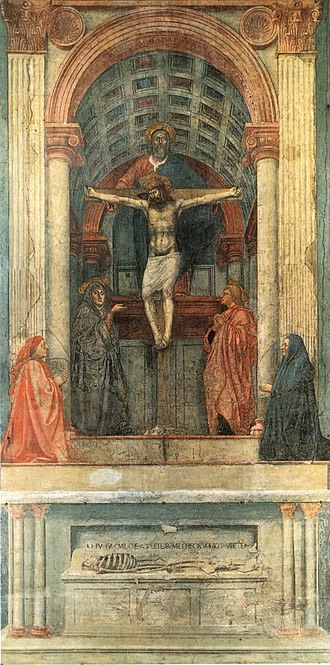
Santa María Novella, Florence
Sobre las fuentes de la sinodalidad en el sacrificio de Cristo
Quisiera destacar brevemente las fuentes de la sinodalidad en el sacrificio de Cristo. En particular, deseo abordar la importancia de la puerta única por la cual entramos en la nueva vida de los bautizados.
Los bautizados participan en nuevas relaciones de comunión y misión como iglesia precisamente porque el bautismo nos da esta vida nueva; es decir nos hace partícipes de la vida interior de Dios mismo, Padre, Hijo, y Espíritu Santo, y de las misiones que de allí derivan.
La vida ecclesial se constituye a través de — y simultáneamente con — esta participación bautismal. Sin embargo, me parece desorientador hablar de la nueva vida, la participación, y la misión sin anunciar y enseñar el misterio actual que impulsa el renacer de los bautizados: el misterio del Cristo que nos da la vida a través de su vida dada, su muerte.
La vida nueva es obra de Dios, y la obra se hizo a través de la entrega por amor de Cristo “quien murió por nosotros cuando todavía éramos pecadores”, como dice San Pablo. Es preciso colocar de manera concisa y fuerte en nuestros pensamientos y en nuestra enseñanza la grandeza del misterio de la muerte de Cristo, el misterio en que fuimos sumergidos cuando nos bautizaron, como dice San Pablo a los Romanos.
Este es el misterio de su sacrificio pascual, de su sangre derramada, la cual en cada Misa se manifiesta de nuevo “para el perdón de los pecados”. Esta es la fuente de vida que nos llega desde el costado abierto del Señor. Sin esta fuente actual, la vida nueva no nos toca, no llega a donde estamos. En este sentido el sacrificio de Cristo antecede la gracia que llega a los bautizados. Su sacrificio nos atrae a la pila bautismal. Nos incumbe entender esto, con la luz del Espíritu Santo quien ilumina a los bautizados. Es preciso hablar del amor del Buen Pastor y el perdón que nos ofrece desde la Cruz. Como dice el poeta: “Oye, pastor, pues por amores mueres, no te espante el rigor de mis pecados, pues tan amigo de rendidos eres.”
La muerte y la resurrección del Verbo hecho carne nos rescata del dominio de la muerte y del pecado, y nos ilumina la consciencia. A través de este misterio, el magnum sacramentum, come dice San Pablo, nos llega la gracia de la reconciliación con Dios, y esta misma gracia nos hace participantes del amor trinitario, capacitándonos a ser agentes vivos de su reconciliación en el mundo.
Si deseamos ser agentes del perdón y de la reconciliación, nos urge beber profundamente de la fuente de nuestro propio perdón y nuestra propia reconciliación. La grandeza de la obra de Cristo obrando en nosotros nos inspira — si lo permitimos — con humildad y con un espíritu de misión.
Los pobres conocen a este Cristo, el que murió rechazado, el que vive, el que respira la nueva vida. En mi diócesis los humildes se acercan al templo para tocar los pies del Crucificado. Este gesto sencillo da un testimonio que puede instruir a teólogos y a obispos.
En la carne crucificada de Cristo no hay nada en abstracto. Los pobres se identifican con él, y saben bien que en él empieza todo: en el Cristo “quien se hizo pobre, para hacernos ricos” como dice San Pablo. Nos hace ricos en la vida trinitaria, y ricos en los dones del Espíritu Santo, equipándonos e impulsándonos hacia la misión.
+df
22 de junio de 2025, Solemnidad del Cuerpo y la Sangre del Señor
+++
On the Sources of Synodality in the Sacrifice of Christ
I would like briefly to highlight the sources of synodality in Christ’s sacrifice. In particular I wish to address the importance of the unique door through which we enter the new life of the baptized.
The baptized participate in new relationships of communion and mission as a Church precisely because baptism gives us this new life; that is, it makes us sharers in the interior life of God, Father, Son, and Holy Spirit, and in the missions that from there flow.
Ecclesial life is constituted through—and simultaneously with—this baptismal participation. However, it seems to me disorienting to speak of this new life, participation, and mission without announcing and teaching the actually present mystery that prompts the rebirth of the baptized: the mystery of Christ who gives us life by giving over his life through his death.
New life is God’s work, and this work was accomplished through Christ’s loving gift, «Christ who died for us while we were still sinners,» as Saint Paul says. It is necessary to concisely and forcefully place in our thoughts and teaching the greatness of the mystery of Christ’s death, the mystery into which we were immersed when we were baptized, as Saint Paul tells the Romans.
This is the mystery of his Paschal Sacrifice, of his shed blood, which is manifested anew in every Mass “for the forgiveness of sins.” This is the source of life that comes to us from the Lord’s pierced side. Without this present source, new life does not touch us; it does not reach where we are. In this sense, Christ’s sacrifice precedes the grace that comes to the baptized. His sacrifice draws us to the baptismal fount. It is incumbent upon us to understand this with the light of the Holy Spirit who illumines the baptized. It is necessary to speak of the love of the Good Shepherd and the forgiveness he offers us from the Cross. As the poet says: “Oye, pastor, pues por amores mueres, no te espante el rigor de mis pecados, pues tan amigo de rendidos eres.”
The death and resurrection of the Word made flesh rescues us from the dominion of death and sin and enlightens our conscience. Through this mystery, the magnum sacramentum, as Saint Paul calls it in Ephesians 5, the grace of reconciliation with God reaches us, and this same grace makes us participants in the Trinitarian love enabling us to be living agents of Christ’s reconciliation in the world.
If we desire to be agents of forgiveness and reconciliation, we must draw deeply from the source of our own forgiveness and reconciliation. The greatness of Christ’s work working in us inspires us — if we let it —with humility and a spirit of mission.
The poor know this Christ, the one who died rejected, the one who lives, the one who breathes new life into us. In my diocese, the humble approach the Church to touch the feet of the image of the Crucified Christ. This simple gesture gives a witness that can instruct theologians and bishops.
In the crucified flesh of Christ, there is nothing abstract. The poor identify with him, and they know well that everything begins in him: in Christ «who became poor, so that we might become rich,» as Saint Paul says. He makes us rich in the Trinitarian life, and rich in the gifts of the Holy Spirit, equipping and propelling us toward mission.
+df
22 June 2025, Solemnity of the Body and Blood of the Lord
 Words and Things
🙏
Me gustaMe gusta