Pope Francis announced in 2020 the beginning of worldwide synodal consultations in the local churches in preparation for two Synod of Bishop assembles in Rome. These took place in October, 2023 and October, 2024. I was asked by Archbishop José Gomez, then President of the United States Conference of Catholic Bishops, to help guide the process of consultation in the United States. As part of my responsibilities, I gave reports to the bishops of the country on the work that was being done in our local dioceses and eparchies, and on the pastoral / theological implications of synodality itself. Below, are the four principal reports I have given to date. They were given in public session to the bishops assembled. The work of the Synod goes forward under Pope Leo XIV. We are now in the implementation stage.
+df
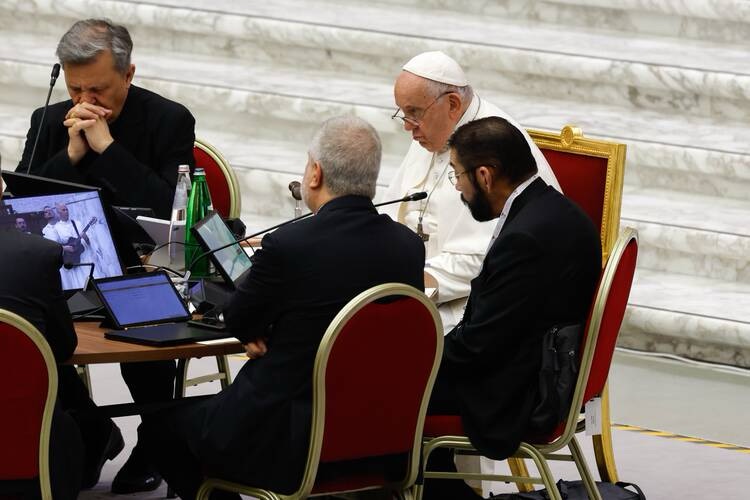
Synod Update to the Bishops
June Plenary 2023
Thank you, Archbishop. Good afternoon, everyone. I would like to use this time to give you an update on the Synod: where we are, and what’s next.
As you know the North American Final Document for the Continental Stage of the Synod was sent to the Holy See last March.
I would like to express my deep gratitude for all those who participated in the assemblies themselves, including delegates from Canada and the United Stares, as well as the bishops of Canada and the United States who generously participated.
Thanks also to those that served on the writing teams from our Conference and from the Canadian Bishops Conference. I am particularly grateful to Bishops Betancourt, Stowe, Tyson, Walkowiak, and Zinkula; and I am grateful to Julia McStravog, Richard Coll, Alexandra Carroll, Father Michael Fuller, and Sr. Leticia Salazar, who have all worked tirelessly and creatively.
I would also like publicly to thank Cardinal Grech of the Secretariat for the Synod, who in the name of the Holy Father, asked me to be part of the preparatory commission for the upcoming meeting of the Synod in October.
The North American Synodal Report is one of seven such reports prepared around the world, all of which together form the basis of the soon to be released Instrumentum Laboris for the October 2023 episcopal Synodal assembly.
The Instrumentum itself will be a praying / working document. Its preparation has involved a variety of consultants and commissions, and has involved direct reporting to, and direction from the Holy Father himself. When it is released later this month, I encourage you to read it carefully.
The Instrumentum is intended to offer a basis for pastoral and theological reflection in preparation for the October 2023 gathering. The Synodal Assembly itself, presided by the Holy Father, (as is its nature), will discuss and discern its content as the October sessions unfold.
As we have moved through the Synodal consultations, from the sessions in our local parishes and dioceses, the regional and national gatherings, and the more recent Continental Report, we have heard and learned many things.
A fair reading of the Seven continental reports suggests that all of the reporting churches find great reason to value the style and content of the more local manifestations of Synodal consultation and discernment.
It is clear also that there are many things that can be addressed best at the local level, and addressing them with a strengthened capacity to work together seems to have been widely experienced in the local churches that made a serious effort to promote Synodal style prayer and listening.
Many questions have been raised through the process. Indeed, the Synodal Way has elicited diverse expectations, discussions and debates. What is a Synod? What is different about this one? What will it accomplish? Will it bring changes? And if so, what kinds of changes?
Sincethe Second Vatican Council, the Catholic Church has celebrated a number of synods of bishops. They have been convoked by the Pope, and have been presided over by him. They have tended to focus on specific pastoral themes, and have offered consultative advice to the Holy Father.
What is notably different about this upcoming Synod is that the Holy Father has asked that an extensive, energetic and creative effort of consultation with the body of the baptized take place in all the dioceses of the world prior to the gathering of the assembly of bishops, with the participation of representative laity, in Rome.
Why? To answer that question we should look to the Apostolic letter Episcopalis Communio that Pope Francis published in 2018. But the short answer is that it is fitting and just that the bishops of the Church actively consult their own local churches in order to gather a sense of the faith and practice that the local church lives in order “carry to Peter”, so to speak, the reality of faith and life in the local Church during the Synodal Assembly that gathers to offer counsel to the Holy Father.
The wide consultative effort is in some way reflected in the National and Continental Reports. Such wide consultation is new to the Synodal process, but not foreign to it.
If it has felt at times that we were creating a pathway as we walked it, it is largely due to the fact that some things you just have to start doing in order to learn how it can be done, and how it can be done better.
It seems to me that the Holy Father prefers this manner of proceeding: reflection on something already attempted, rather than meeting to draw up a theoretical schema about how such a thing could be done within the Communion of the Catholic Church.
“Ecclesia facit quod facit”, the Church does what she does; and when she does, we can think more fruitfully about what she is capable of doing while remaining true to herself.
This is particularly important if we keep in mind that the theme of the 2023 / 2024 Synod of Bishops is Synodality itself. The question before the Synod is “how is it possible practically to incorporate the active participation of the Body of the Baptized into the Synodal consultation that the world’s bishops offer to the Pope?” Many other questions flow from this, all of them focused on how the Church can strengthen the participation and communion of her members for the sake of the evangelizing and eschatological mission entrusted to us by grace.
During the local, national and continental stages, we heard many things, from our people; we were probably already aware of many of these things. But the passion, faith and hope with which a particular person or community speaks in the Church carries it’s own inherent dignity and realism. We are all better for engaging and listening attentively.
During the listening sessions particular issues emerged with great frequency, and often from widely divergent points of view. These are reflected in the reports, from the most local to the seven Continental Reports.
We heard about great love for the Church, and we heard great frustration and pain at how things sometimes are in the Church. This was natural enough. People were asked what they thought, what they felt, and those who generously gave the time, told us.
The voices we heard also on spoke about many other things: about the dignity of the baptized; about welcoming and inclusion; about formation in the corresponsibilty of the laity for the mission of the Church; about the importance of addressing the increasing polarization and division within the Church; and about the Holy Father’s call for a Church that goes out to those on the peripheries.
It is reasonable to expect that the upcoming synod will focus on how Synodality itself as a form of lived Catholic Communion especially needed in our time, can contribute to addressing our problems and contentious disagreements as a Church in an authentically Catholic way. (As opposed to ways adopted from secular models of decision-making.)
The impulse to gather, pray, listen and speak in a setting that promotes the life and participation of the Communion of the Baptised is a gift to the Church, and has given us new realistic insight into the way the Church lives her struggle in the present moment of history, in the great variety of different circumstances across the world.
One of the things we have learned is that we can do much better in the future to integrate a more effective consultative style in our local churches. For a first effort, the amount of participation was notable. Though obviously, there is an enormous work to be done to integrate a more robust Synodal style into our local and regional churches.
For bishops on the local level, the challenge going forward is to integrate the appropriate settings and vehicles by which our people can hear each other and we as shepherds can hear them, as they express their faith, their challenges, their struggles and hopes. It should be natural for us to want to hear these things. And then, in a broadly consultative way, think about pastoral priorities and strategies moving forward. The “how”of this is likely to be a major theme of discussion in October 2023 and 2024.
Wide consultation does not replace the munera of the bishop as taught by the Tradition and elaborated by the Second Vatican Council; it is a complement to our shepherding responsibilities. Through it the bishop’s discernment becomes more sober, more sensitive, and more realistic in assessing where we are and where we need to be heading.
And it highlights the truth that the office of bishop is only really understood in relation to his people, with his people, and in relation to the life of the Triune God we are all, together, called to share.
I ask for your prayers for the Holy Father, and for the Synod, that the Spirit lead us along the path that enters ever more deeply into the mystery of Christ in his body the Church, the same Christ who leads us to the Father.
There is much yet that we must do.
Thank you for your kind attention.
+df
+++
Synod Update to the Bishops
November Plenary 2023
(After the first General Assembly of the Synod of Bishops, October 2023)
I want to thank Fr. Iván, Cynthia and Bishop Rhoades for their remarks and for their generous spirit while in Rome.
Brothers, if you have not already, I hope you will read the interim synthesis report released after the first session of the XVI Ordinary General Assembly of the Synod of Bishops. I am hopeful that at our assembly in June we will have time for some in depth discussion of the content of the Interim Report. This will help us all prepare for the second general session in October, 2024.
We are now in the “between time” – when we can reflect on the synthesis of the first session, and prepare ourselves for the second session. I anticipate that the Secretariate for the Synod, and the Synod Office of the USCCB, will be sending some resource material for us to use with our people during this interim.
When you read the interim document, you will find it raises thoughtful questions of pastoral and theological import. Some might say that contentious questions are raised. I can say that many difficult issues were raised, but they were not discussed in a contentious way. This in itself is remarkable.
At its most basic the term synodality describes a properly ecclesial style that prioritizes regular conversational interactions among the people of God, as decisions are made for the sake of the mission the Lord gave to the Church.
The Conversation in the Spirit method utilized during our local gatherings and at the Synod of Bishops this last October is one effective way to promote this aim. This does not preclude the development of other conversational methods.
Conversation as the Latin root suggests, implies more than talking and listening. It involves sharing a way and a style of life, a style of communal life described succinctly by St Paul in Gal 5, 22, marked by love, joy, peace, patience, kindness, generosity, faithfulness, gentleness, self-control.
Thiswider sense of the word as a way of life is echoed in the Tertia Pars when St Thomas asks about the Conversatio Christi. He speaks thiswaywhen referring to the Lord’s habitual manner of life: St Thomas notes how the Lord Jesus intentional moved and spoke easily among the people so as to instill in us confidence to approach Him, and through our approach receive the mercy he offers for the salvation of us sinners. This grace of approachability inaugurates the grace of the Kingdom. (cf ST III, 40). This is his conversatio.
We could say the conversations of the Synod are for the sake of building up an ethos, the conversatio of communion and confidence in the accessibility of Christ as He manifests himself in the Church. Our mission is meant to mirror his. The point is accessibility to Christ. The endeavor, we pray, is to be animated by the Spirit, who purifies and elevates our conversatio in every way.
In its primary instantiation the Synodal Conversatio Christi is local and particular. You cannot really listen to or speak with, or share an ethos with people in general. In the Church, though, the particular life of the community, our conversatio, can bear the sacramental imprint of the whole.
Thus, in its flesh and blood particularity, the local is already a manifestation of the Catholic mystery, since the Catholicity of the Church is sacramentally embodied in each community gathered around the local Bishop, celebrating the Eucharist, living and often dying in witness to the Faith in Christ we profess together. St Ignatius of Antioch witnesses to this, and Lumen Gentium explicates it.
Communio lived in the conversatio is already an expression of the Mission of the Church since we are called to be an anticipatory sign of the tribes, nations and tongues gathered around the heavenly throne of the Lamb who was slain.
During the gathering in Rome, great attention was given to how our sense of mission can flow more cohesively from the communion that baptism generates.
Thus, for example, many local churches seem at times to experience a disconnect between the Church as communion and the Church as evangelizing mission; and between the evangelizing mission and our public witness of Charity and social justice; and between the public witness of Charity and justice, and the eschatological horizon that the redemption anticipates. How can we better manifest the cohesivenesses of the Mystery we live?
Thus, the third section of the interim report asks about synodal approaches to formation, and about the Church’s pastoral structures governing participation in various aspects of ecclesial life.
All of this leads to reflection, discernment, and will ultimately lead to decisions, about how the conversatio can be promoted within the structures of the Church’s life to encourage a more conscious engagement in the mission, in all its variously related aspects. The whole Body has many gifts to put to the service of the mission.
That the laity by virtue of Baptism have an indispensable role in the mission of the Church is not in doubt. The questions are about how corresponsibility can be encouraged and facilitated in a way that respects the doctrinal principles that undergird ecclesial life and sound pastoral practice. Structure alone, of course, cannot insure a Christian way of life and a mission shared and promoted in common; for without the Spirit, the letter is dead.
As we read the interim report of the Synod, we can hear the many issues that the local churches grapple with globally. The Synod offers us a Catholic way to do so faithfully, realistically, prayerfully, thoughtfully and charitably. We have a lot of work to do, but we, together with our people, need to be actively involved in the conversation.
Finally, I want to close by giving special thanks to all of our US delegates for their witness, and good humor. They “done us proud”, as we say in Texas. We all learned a lot, and we laughed a lot. And I thank God for the friendships fostered during our time together.
Archbishop Broglio, I am happy to return the floor to you, and receive any questions from the body.
+df
+++
Synod Update to the Bishops
June Plenary 2024
Thank you, Archbishop Broglio, for this opportunity to address the body. Brothers, I would like to offer a few thoughts about the Synodal dynamic before I invite Archbishop Zinkula to share his reflections on this moment in the synodal experience. I first want to offer my gratitude to the many who participated in this interim moment in the United States. They have given vivid expression to deeply held hopes and concerns experienced by the People of God in the US. And thanks also, to you my brother bishops for continuing to shepherd your people along the synodal path with resourcefulness. I would like also to thank the diocesan synod leaders who, with their creativity and flexibility, have been indispensable in helping us achieve the aims set out by the Holy See. I especially want to thank Bishops Betancourt, Tyson, and Walkowiak and Archbishop Zinkula for their continued encouragement and companionship.
The interim report sent to the Secretariat for the Synod offers two images to express the hopes and tensions we live out in our local communities and institutions: the desire for the Church to serve as a Safe Harbor, and the desire to engage more robustly the prophetic mystery of the Church as a Fiery Communion that leans into the Kingdom. These images are not exhaustive, but can be elucidating.
The Safe Harbor speaks of a people who desire to embrace and sustain not just one another, but also the vulnerable, the walking wounded, the marginalized. It includes also those who tell us we need to communicate more clearly about what it means to be Catholic. But we hear also a desire to be bolder in expressing what distinguishes the way of Christ from the standard patterns and whims of the world we live in. The prophetic word is by its nature abrupt and disconcerting.
I think it is safe to say that our people speak from the heart about the importance of both of these ecclesial aspirations. And at the same time often disagree about how to live both aspirations faithfully in our time. I take it as a hopeful sign that what disagreements and tensions we talk about are rooted in a more basic agreement about what we should be about. We should be about the embracing love of Christ and about prophetic witness to what he announced and did. In this context, I think. evangelization can come into clearer focus for us.
In my own diocese, evangelization generally means going to newly established communities of immigrant families, often poor and isolated, and asking them first what they need. Often the first answer is simply “no se olvide de nosotros”, “don’t forget about us.” Hearing this is both sobering and challenging. We can go to those who suffer the poverty of isolation, we can listen to them, accompany them, “not forget them”. But we must be willing to learn from them also, and be willing to let the Gospel challenge our own complacent presuppositions and those of the world. I’m sure many of you could offer similar examples.
The Harbor of the Church welcomes persons who might never think of themselves as being in the same boat as “those others” who also seek respite with us. And, the fire is quite capable of singeing persons who feel called to wield it. And this is so because the Spirit desires to work through us, but is never limited by our individual or communal blind-spots. In this context, I would like to quote gratefully what one of the bishops said during our listening sessions: “The Synod fosters communion and creates space for relationship… It is important to come with humility.”
The process is not magic, it’s an invitation to the humility of the Gospel as we try to go out, to listen and to think together about how to be about, what we should be about, the concerns of Christ the Lord. Creating the space for relationship is the prerequisite for moving forward together, large and rambunctious communion that we are, faithful to the mission the Lord has given us.
+df
+++
Synod Update to the Bishops
November Plenary 2024
(After the Second General Assembly of the Synod of Bishops, October 2024)
The Synod on Synodality concluded its second and final general session just a few weeks ago. The Holy Father accepted the document approved by the synodal assembly and indicated he would not be issuing an Apostolic Exhortation in response to the synodal consultation; rather, he decided that it be sent to the local churches so that work can begin on implementation. It is necessary that we bishops receive the document in a spirit of docility, study it carefully, and discern its implementation. Although we have a provisional translation of the final document, we do not yet have the official English translation.
During the Holy Father’s discourse at the conclusion of the Synod, after he indicated that he was accepting the document as his own, I remember him saying: “there are yet decisions to be taken.” I take this to mean, at least in part, that there are some matters recommended in the document that will have to be studied by the competent dicasteries in Rome before decisions are made regarding any changes in canon law. I anticipate the making of those decisions will entail various kinds of consultation, perhaps even with the Episcopal Conferences.
Concerning Episcopal Conferences, the document treats them at some length. This will require us to study, reflect, and discern together. Obviously, the study and discernment should be consultative in style and substance.
As we all know, the nature of our communion involves, first of all our communion with the Successor of Peter, and it also involves our more local bonds within our provinces, regions and, notably our communion expressed at the level of the Episcopal conference. We also have important ties of communion with the Church in Canada, which in the synodal configuration, together with the Church in the United States, constitutes the North American Continent. We are also closely linked with the Church in Latin America and in particular, for historical and geographical reasons, with the Church in Mexico. According to the indications of the synodal document, we need to explore how to make these bonds even stronger and more effective. Attending to these bonds is not initially a structural issue, for we already have structures of collaboration in place, but we can look for ways, at different levels, of strengthening the coherent witness of the Church throughout North and South America.
At the level of our own dioceses, once we have an official translation in English and other languages, we can ask some of our consultative bodies to study the document we have received. I’m thinking of our presbyteral councils, pastoral councils, councils of Religious and Consecrated life, deacon councils, youth and young adult groups, Catholic Charities boards etc. They could be asked to get to know the document well, not just in its structural and organizational aspects, but also entering into its spirituality, and pastoral vision. I think it is helpful to remember that the ecclesiology of Lumen Gentium and Gaudium et Spes is mirrored in the teaching of Sacrosanctum Concilium and Dei Verbum, and as a consequence, our current engagement with a more synodal ecclesial praxis is best understood with these four pillars of the Second Vatican Council in mind.
Each diocese in this country has its unique history and organizational habits. So the move towards implementation has a decidedly local impetus. When we enter into local discernments about what we can begin to do now, we must understand that the priorities that emerge in one diocese may differ from those in a neighboring diocese. We act, however, as a communion at the service of announcing salvation in Christ Crucified and risen from the dead.
The document highlights an important distinction between “decision making” and “decision taking.” The former has to do with the consultations and discussions that go towards taking a final decision. Subsidiarity is already a significant part of our diocesan lives. Decisions, we know, need to be made at appropriate levels. Some matters, affecting the life of the whole diocesan church, only the bishop can take. The increased participation, collaboration and discernment with others on the way towards such decisions are what we will need to look at and act upon most carefully.
As we can see, the charge the Holy Father has given to us will involve a series of moving parts. The complexity might intimidate us; it need not. Our dioceses and the whole of the Catholic Church in the United States is richly blessed with an abundance of lay men and women, consecrated religious, apostolic movements, deacons, the young and the old, actively serving the mission in our dioceses. They are also ready and willing to work collaboratively with their bishops as we move toward a more participative ecclesial life, for the sake of that same mission. Many of the recommendations in the document involve habits of ecclesial life that are already a part of our practice. Some might require expansion, others a bolstering of participation, coordination and cohesion aimed towards our common witness to the Lord.
As we look forward, it is good to recall the tools, skills and personnel we have developed within the Conference during these last three years of synodal work. At the beginning of the 2021-2024 Synod, I was asked by Archbishop José Gómez, then President of the Conference, to be the “point person” for the Synod on behalf of the Episcopal Conference. We also hired a full-time person, Dr. Julia McStravog, to help coordinate the work of the Synod with other USCCB staff and with other working group of bishops. I might add that when we started we hardly had a clue about what the work would entail.
In the course of these three years we asked each bishop to designate a point person to be a diocesan synod leader. This helped us coordinate the diocesan, national, and continental listening sessions; as well as the reports we presented to the Holy See. These structures are still in place. These structures and practices, diocesan contacts and Conference staff, can help us move forward in developing and facilitating further plans and conduits for the implementation of synodal life within the Church at the level of the national conference, and at the level of our individual dioceses and eparchies. The work of the conference in these matters cannot and should not supplant the discernments and decisions of the diocesan Churches. It can help provide coordination and resources.
Our work as a Conference will include discerning and deciding what changes and adaptations we as a conference should undertake in light of the Synod on Synodality. In the short term I think we need first to decide how to understand the implications of the document as a whole.
As I mentioned, the USCCB has over the last three years developed a strong network of diocesan synod leaders from many of our dioceses that should be employed to further develop synodal practices with diocesan pastoral and presbyteral councils. It makes sense that as we move forward, we would build on this network and expand its availability to continue offering digital resources to particular dioceses.
I think much theological work is needed as we move forward. There are ecclesiological questions that need to be explored, as, for example, the place of episcopal conferences in the life of the Church. This was an issue widely discussed at the synodal assembly. Also, there is the topic of the sensus fidelium. In what sense can the synodal assembles, both local and more universal, be said to offer a kind of expression of the sense of the faithful? I phrase this carefully. This is far from a settled question. But we have a tradition to help us understand this. I think that we as bishops and as a Conference can encourage our many theologians to think together across institutional and cultural boundaries about these and other questions.
It is also true that we have a responsibility to help our presbyterates understand and engage the spiritual and pastoral dynamics of synodal life in our parishes. Participation in the communion of the church is mostly a local thing; organizing ourselves to fulfill the mission is also mostly a local thing. As the history of moments of renewal in the Church shows, if it does not reach the parishes, it hardly reaches the People of God. Here, in particular, the vital work of formation in «listening in the Holy Spirit» emerges in its most elemental form. The ability to hear each other with the patience and generosity that grace demands is a habitus in danger of being lost in our time. Yet it is the indispensable building block of more cohesive and less polarized ecclesial culture. Jesus listened without being threatened by what he heard; all of us in the Church, with the help of the Holy Spirit, can strive for the same.
Finally, recalling our national reports during the earlier phases of the synodal process, I think we heard consistent voices expressing a desire that we all be strengthened in our witness to the faith we have received from the Apostles, and at the same time that we make every effort to welcome the poor, the wounded, those who struggle with our teaching; those who just want to have a chance to walk with us as they seek to discover the voice of Christ in their lives. Doing both things at the same time has never been easy, but in the better moments of our history we have, with the Lord’s help, been able to do just that. If we can remember how we have done this, it will help us to do it better now. The issue is the credibility of our common witness as a body of sinners renewed and anointed in Christ, announcing a Gospel that is bigger than all of us.
Synodality is not a retreat from episcopal responsibilities; it is an invigoration of them in that it highlights our responsibility as bishops to encourage the active participation of all the baptized in our common movement forward to announce and live the Gospel in our time. The mission involves many things: it involves evangelizing, teaching, and our service in justice and charity to uphold and defend human dignity wherever it is neglected or threatened, to name a few. But, in the end the mission is one: To witness to Christ Jesus, Crucified and Risen, in every aspect of lives, and to offer the hope and love he brings to us and to the whole world.
Thanks for your kind attention.
+df

 Words and Things
Aclaro que si apoyo el gobierno de Obispos pero éste puede ser dictatorial como lo tenemos (con excepciones del sensus fide) ó con sinodalidad como lo queremos. Bendiciones
Me gustaMe gusta
En un párrafo dice:….can contribute to addressing our problems and contentious disagreements as a Church in an authentically Catholic way. (As opposed to ways adopted from secular models of decision-making.)……
El authentically Catholic way” consiste en que el Obispo u Obispos (incluyo a el: Papa, Cardenales y Arzobispos) deciden todo. Prefiero, con la Caridad católica, el modelo secular. Bendiciones
Me gustaMe gusta