I attempt here to pull together some themes I have long thought of vital theological and thus necessarily pastoral importance and with which I have long wrestled. My hope is that my thinking is a little clearer now than it used to be. +df
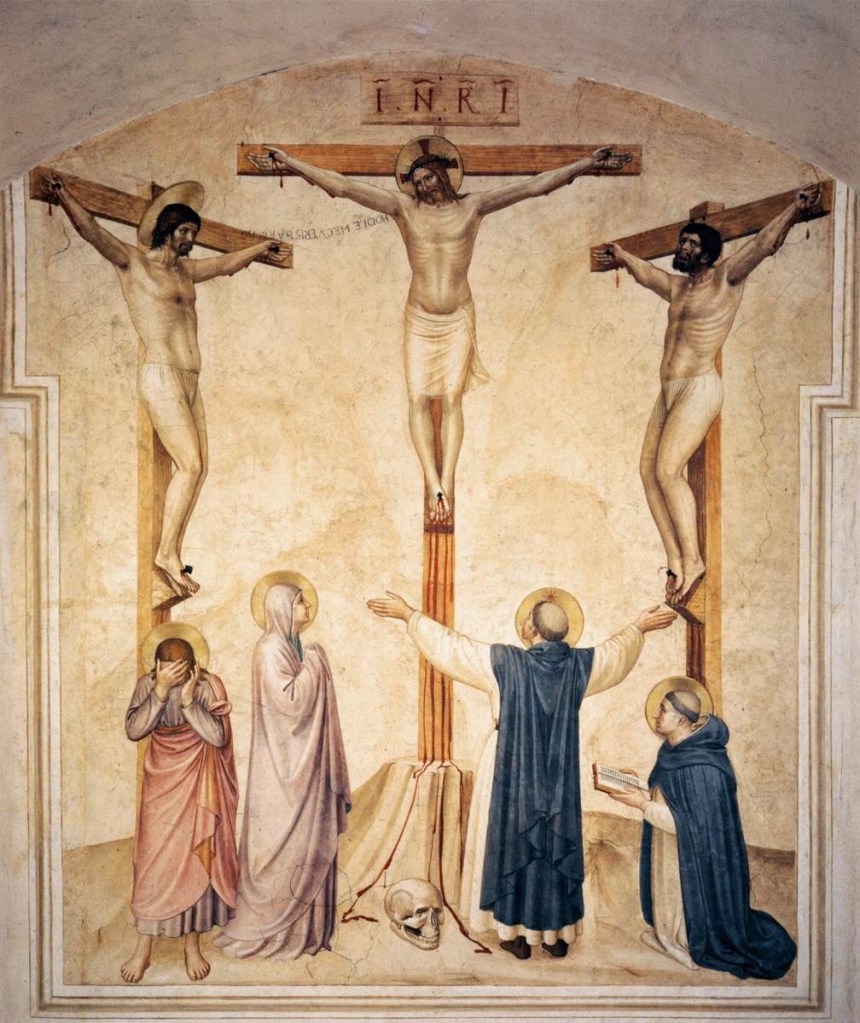
Museo Nazionale di San Marco
In an episode of Star Trek: The Next Generation, entitled “Darmok”, Picard encounters the Temarians, a people who communicate only by making reference to landmark events engrained in their historical memory.[1] “Shaka, when the walls fell”, evokes a tragic loss, which then serves to situate in the mind of the hearer to how the speaker understands the present moment. “Temba, his arms wide”, signifies the giving of a gift. It takes Picard and the crew an hour episode to figure out how this language works, but the moment of understanding (“Sokath, his eyes uncovered”) comes too late to save Dathon, Picard’s interlocutor, from a heroic death. Still, a sort of breakthrough occurs (“Darmok and Jalad on the ocean»), so the sacrifice is not in vain.
There is a fair amount of internet commentary, some of it good, some of it just weird, on the suggestiveness of this episode. What to my mind most intrigues, though, is that front and center, we are presented with an obscure way of communication, problematic not due to vocabulary or grammatical structures, but because of references to events not present at the current moment, though for the Temarians they are present in the current moment. The language is based on the act of understanding the sense of present events by remembering and amplifying the sense of past events. In this kind of language, without knowing the references to past significant events, the words remain unintelligible, and the sense of the present moment lost to the hearer.
Now then, from Genesis through the Psalms, to Malichi and Maccabees, from Matthew through to Acts and the Apocalypse, there are constant reference to events that are intelligible in light of other events. “Moses, with his arms upheld”; “Israel, with unmoistened foot”; “As at Meribah, when they hardened their hearts”. The Old Testament itself depends on these kinds of historical invocations in order to understand its later historical moments. In the late books of the Old Testament, the invocations of the Exodus event and the Davidic promises appear in carefully nuanced ways and help interpret the later moments of Israel’s history of exile and return. These understandings speak both of judgment and of hope in God’s fidelity. Overall, this kind of thinking in the present moment, in turn, expands Israel’s perception of the meaning of the earlier foundational historical events. Later events are figured in the foundational events, and the implications of the foundational events are made present, so to speak, in the subsequent history.
Insofar as the Catholic Tradition of Scriptural apprehension and transmission is concerned, the dynamic invocation of the history through subsequent figurative readings happens under the guidance and inspiration of the Holy Spirit who is auctor operating in the work of the Scriptural authors. Or, in what amounts to the same thing, the Scriptural words and sense are generated by the WORD, who authored the first Word-Events and guides the later prophetic and wisdom traditions into subsequent figurative amplifications, culminating in the literal / historical manifestation of the WORD made flesh. Dei verbum numbers 11 and 13 situates this theological datum admirably. Differences in interpretation of foundational events, internal to Scripture, need not be read as competitive, although historical criticism, either deliberately or by unreflected habit of mind, often leans towards reading them so. I will not pursue that quarrel here. Instead, I want to direct some attention to how the Church has thought about the near ubiquitous presence of figuration in her preaching, teaching, and liturgy.
Stated succinctly, a unified super-intelligible requires a multiplicity of explications. These explications can be in tension, but that is not to say they are mutually exclusive. Granted, this way of looking at things operates with a metaphysics of knowing in its background; it is not for that reason, though, to be discounted in how we can think about figuration. Thus, events understood a certain way in earlier traditions and subsequently elaborated with different emphases can, from this perspectives, witness to a super-intelligibiliy present in the founding, that is to say, an intelligibility more or less hidden, though not for that reason extraneous to the events themselves. Depending on one’s place in the unfolding history, hidden signification is more or less intelligible. That, at least is what underlies much of patristic preaching around the magnum sacramentum of Christ’s identity and salvific work. The medieval expositors of Scripture developed this trajectory within their specific commentaries and more systematic theological elaborations. And, of course, the various liturgical traditions in the apostolic churches witnesses to this kind of communicated understanding.
St Thomas’ commentary on the Psalms provides some help here. Thomas is a careful reader of the prior tradition of Scriptural exposition, and a particularly vigorous synthetic conveyor of how to understand this tradition. He is not the only one who conveys a way of understanding the givenness of figuration, but it is never a good thing to sideline him. For Thomas, most of the Psalms are primarily about what the psalmist was going through or is recalling: the Psalms are literally situated in Israel’s history. Thomas respects this, and in his commentary on the Psalms shows remarkable dexterity in locating, or in wanting to locate, the historical references. He talks about everything from creation, to the Exodus, to troubles with Absalom, thanksgiving for victory in battle, to psalms composed to accompany cultic worship, etc. After locating the history, he then goes on to read those events as figuring some aspect of the life and mission of Christ.
St Thomas is a disciplined commentator, and he is not given to dwelling on elaborate allegories transmitted through the prior tradition. He knows quite well Augustine’s Enarrationes in Psalmos, for example, but is more disciplined than Augustine in exposing the history. Thomas lets us know when he thinks the earlier tradition’s focus on the mystical sense of the Psalms witnesses to the mystery intimated by the events and descriptive words. But Thomas the commentator on Scripture focuses far more on elaborating what he takes to be the primary theological conviction guiding the way the Church understands figuration: Israel’s history was governed by a special providence, a grace that orders its signification in a way that is anticipatory of, and preparatory for, the final revelation of God’s historical intent in Christ. Dei verbum 15-16 teaches in similar terms.
Thus, Old Testament self-understandings vía the Exodus figurations and the happenings surrounding the Davidic kingdom are also anticipatory figurations of Christ’s coming. This in turn serves as the basis for a Christian reading of the psalms that respects the history of the psalmist. Figuration, in this tradition, is rooted in history, not in words; in events understood in a certain way, not in literary congruence. Thomas thus allows for a fluidity of readings in a text, so long as they do not oppose the rule of faith and the obvious intention of the human author. This way of speaking is not unrelated to what Dei Verbum 12 will call “the intention of the sacred writers” understood in relation to the “content and unity of the whole of Scripture.”
In large part Thomas sees in King David’s persecution by Saul or Absolom events that by their unfolding pattern bear the marks of Christ’s kingship resisted or opposed, and thus they adumbrate and anticipate the Paschal Mystery. These are events that, in retrospect, carry a Christological imprint. The intimation is not so clear until the the actual appearing and moving about of Christ himself. These are examples of the enigmas of Scripture that Thomas and many before him describe as having been made more intelligible by the coming of Christ and the preaching of the Gospel. By theological shorthand we could call this kind of exposition a discernment of Christ figured in history.
But, for St Thomas, this kind of signification does not fully account for the received tradition of reading the Psalms. There is something more in the Old Testament than events within which the history of Christ is figured. There is also a specifically prophetic intentionality that describes Christ in advance in quite literal terms. This datum of the tradition points not to Christ figured in history, but rather history figured in Christ. Christ is conveyed by more than simply reading the history of Abraham, Moses, David, Job etc as bearing the signs of Christ in their histories: there are also words that are spoken prophetically by King David (for example) that refer principally to Christ, and only secondarily to David’s remembered history.
We see this distinction most clearly in Thomas’ notes on Psalm 21. Somewhere in his thirsty pursuit of Greek texts translated into Latin, St Thomas encountered the decrees of the Second Council of Constantinople (553), and it’s condemnation of Theodore of Mopsuestia.[2] Both in the prologue to his commentary on the Psalms and in his exposition of Psalm 21, Thomas explicitly cites the Council as having condemned Theodore for denying that the Old Testament prophets ever spoke literally of Christ. Thomas never uses condemnatory language lightly, but he does apply it to Theodore’s reported teaching. It is another question whether Theodore of Mopsuestia actually taught this. Thomas thinks that Constantinople II judges he did, and that such a teaching is a grave error.
This helps to account for the fact that in his commentary on Psalm 21, Thomas makes a crucial distinction. He insists that the literal sense of the psalm refers to Christ’s passion. The history narrated in the Psalm is not about David primarily, it is about Christ. This is its literal sense. On this reading, David (the psalmist) has a vision of the Passion, and wrote of it. The psalmist’s own sufferings are secondarily referenced in the psalm, but only to the extent they bear similarity to and are figured in Christ’s sufferings. David saw himself in Christ; he did not see Christ in himself. Here is how Thomas states the matter:
«And among others, specifically this Psalm treats about the passion of Christ. And thus, this is its literal sense. Hence, specifically He spoke this Psalm in the passion when He cried out Heli Heli Lammasabactani: which is the same as God, my God, etc. as this Psalm begins. And thus, granted this Psalm is said figuratively about David, nevertheless specifically it refers to Christ ad litteram. And in the Synod of Toledo (sic) a certain Theodore of Mopsuestia, who exposed this Psalm about David ad litteram was condemned, and [he was condemned] on account of this and many other things. And, thus, [this Psalm] is to be exposed about Christ. [3]»
Now, we may think this is a distinction without a difference. But in fact, it implies a whole theological understanding of personal and historical spiritual progress. It is good to see creation as a reflection of God’s wisdom and power, but it is more perfect to see creation as present within God’s wisdom and power. This is, of course, the eschatological promise. More to the present point, however, it is more perfect to see oneself figured in Christ than it is to see Christ figured in oneself. This is because Christ is the supreme locus of intelligibility, and we understand ourselves better if we see ourselves figured in him. This is the distinction Thomas wishes tenaciously to preserve: Israel’s history pre-figures New Testament events, yet the prophets had moments of vision that saw the Christian history, and read their contemporary events as figured within the history of Christ.
St Thomas perceives that this specific element in the Church’s reading of the Psalms and other prophetic texts witnesses to the Church’s faith that at certain moments the history of Old sees and speaks quite literally of Christ and the final end of all things. This is a pedagogical preparation by literal anticipation. Israel was being taught to hope in more explicit ways as her history unfolds. One of the signs of this kind of prophecy is what St Thomas calls the principle of exceeded conditions. St Jerome seems to be Thomas’ principal guide in this kind of expository perception (4).
Now then, after the full revelation of Christ’s historical appearance, the Church has access to the aim of history. Hence, all the faithful now have the capacity by spiritual instinct and knowledge of the Gospel to see themselves in Christ. This, together with the gift of the Spirit guiding our reception of the history of Christ, is what is new about the New Testament revelation. And this is why the Fathers of the Church, following Saint Paul, call the definitive revelation in Christ an “unveiling”. What is unveiled? The aim of human living and all of history. This is a datum in the tradition which witnesses to what Ratzinger called the laying bare of the intelligibility of history by the revelation of its end in Christ.[5] For us who live after the foundational events of the Christian revelation, the figurations are clearer, though not perfectly so. And the literal prophecies of Christ now verified by New Testament authority root the unity of the two Testaments.
This acknowledgment of the enigmatic made clearer looms large in St Thomas’ exposition of the Gospels. In those expositions of the littera of Christ’s life, Thomas occasionally uses the term ‘allegory”, but he prefers the term mystice; the mystical sense is what is figured in the literal history of Christ. Thus, the ecclesiological sense of a text is the figure of the Church as body present in the person of Christ the head; the moral sense of a text is the norm of Christian living present in Christ’s teaching and actions; the eschatological sense is the destiny of the Christ as preparatory and anticipatory of the final destiny of the human race. All of this flows from the super-intelligibility of Christ. After all is said and done, the intelligibility of the Word-events of Israel’s history, our present moment, and our future history, are made manifest in the person of the WORD made flesh in history. [35]
This way of reading is rooted in a theology of participation by grace. Grace effects a participated likeness to the Christ who is source and summit, beginning and end of grace. The likeness is in turn progressively intelligible. There is a metaphysics of human sanctification implicit in this perspective. But then, metaphysics is always present in theology; we are just not always clear about what kind it is. I’ll leave that for another time. Nonetheless, one of the often overlooked aspects of this theology of participated likeness is Thomas’ conviction that the history of Israel narrated in the Scriptures is suffused with the grace of anticipation and preparation. The prior covenant histories could figure Christ because the grace of election effected a likeness by prior conformity to him. Such likenesses may well have been present in other nations, but compared to Israel, they are hardly and only tentatively discernible. Psalm 147,20 : Non fecit taliter omni nationi.
Christian theology breathes of figuration or it dies, as a thought dies when severed from living minds. The root of all figurative meaning is the Gospel history of Christ. The Christological truth revealed in Scripture is the living basis for all subsequent figurative readings. And this is to be understood in two principal ways. First, our understanding of the paschal sacrifice of Christ is embedded in the historical memory of the Exodus, and in the Old Testament’s progressive showing (by figuration and literal prophecy) of the WORD’s intententions when preparing and enacting those events. And secondly, the Paschal Mystery anticipates, figures and participates in the finality of the Kingdom yet to be finally enacted in history. The former is Christ figured and perceived in prior history, now made more manifest. The latter involves history figured in Christ moving towards its historical finality.
This helps us to understand the ecclesial tradition of reading Scripture in a way inextricably linked and transparent to the Eucharistic sacrifice. Sacramental enactment flows from the salvific economy itself. The re-presentation of Christ’s Sacrifice of praise is the manifestation of the final and definitive Word-event, revealed now as the source of the earlier foundational events; this occurs after the reading of the Scriptures and is thus the making actual of the fundamental ratio through which the Scriptures just read are understood. In the intensity of the Sacrifice, all things are figured. The Eucharist itself is the paramount mediated immediacy available to us, conveying the magnum sacramentum of Ephesians 5. Here, made manifest, is the sense of all that went before, what is now, and what is sure to come. The grace the Church and each of her members asks for is the grace to see, to taste, to understand, and to love according to the pattern of what has been manifested. Luke 18,41: “Quid tibi vis faciam?”. At ille dixit: “Domine, ut videam”. This is the ongoing work of the Spirit. [6]
+++
Notes
[1] Star Trek: The Next Generation, episode 102, (season 5, episode 2).
[2] I had occasion to write more extensively on the topic in “Thomas on the Problem of Theodore of Mopsuestia, Exegete” in The Thomist: A Speculative Quarterly Review, 69 (2), 251-277, 2005.
[3] Super Psalmo 21: Et inter alia specialiter iste Psalmus agit de passione Christi. Et ideo hic est ejus sensus litteralis. Unde specialiter hunc Psalmum in passione dixit cum clamavit, Heli Heli lammasabactani: quod idem est quod Deus Deus meus etc. sicut hic Psalmus incipit. Et ideo licet figuraliter hic Psalmus dicatur de David, tamen specialiter ad litteram refertur ad Christum. Et in synodo Toletana quidam Theodorus Mopsuestenus, qui hunc ad litteram de David exponebat, fuit damnatus, et propter hoc et propter alia multa; et ideo de Christo exponendus est…
[4] In Psalmis, Prologus: […] beatus ergo hieronymus super ezech. (sic) tradidit nobis unam regulam quam servabimus in psalmis: scilicet quod sic sunt exponendi de rebus gestis, ut figurantibus aliquid de christo vel ecclesia. ut enim dicitur 1 cor. 10: omnia in figura contingebant illis. prophetiae autem aliquando dicuntur de rebus quae tunc temporis erant, sed non principaliter dicuntur de eis, sed inquantum figura sunt futurorum: et ideo spiritus sanctus ordinavit quod quando talia dicuntur, inserantur quaedam quae excedunt conditionem illius rei gestae, ut animus elevetur ad figuratum. et ideo spiritus sanctus ordinavit quod quando talia dicuntur, inserantur quaedam quae excedunt conditionem illius rei gestae, ut animus elevetur ad figuratum.
Blessed Jerome, therefore, [in his commentary] on Ezechiel (sic) handed on to us a rule which we will use in the Psalms: namely that concerning things done, they are to be exposed thus, as figuring something about Christ or the Church. As, indeed, it is said in 1 Corinthians 10, [11]: all these things happened to them in figure. Prophecies, moreover, were sometimes said about things which were of the time then, but [the prophecies] were not principally said about those things, but, in fact, [the prophecies were said about those things] inasmuch as they are figures of future things: and thus the Holy Spirit ordered that when such things are said, certain things are inserted which exceed the condition of that thing done, so that the soul might be raised to the thing figured.
[5] Ratzinger, “Biblical Interpretation in Conflict” in Joseph Ratzinger and the Foundations of Biblical Interpretation edited by Josë Granados, Carlos Granados, Luis Sánchez-Navarro (Eerdmans, 2008). Electronic format, pos 466: “When things have reached their goal, one can discover cover the true sense that so to say lay hidden in them. This sense appearing at the end of the movement transcends whatever sense might be inferred from any given section of the now completed path. «This new sense thus presupposes the existence of a divine Providence, the existence of a (salvation) history arriving at its destination.»» God’s action thus appears as the principle of the intelligibility of history. The unifying principle of the whole of past and present «history, which alone confers sense on it, is, however, ever, the historical event of Christ.”
[6] Latin texts of St Thomas’ work are taken from the Corpus Thomisticum https://www.corpusthomisticum.org/iopera.html . Translations into English are my own.
+Daniel E. Flores, STD
Bishop of Brownsville
6 April 2006
 Words and Things