Translating is something we do every day. It is how we take into ourselves an understanding of the people around us. Here are a few authors I have spent time with recently. +df
Ex Sermónibus sancti Leónis Magni papæ (Sermo in Nativitate Domini 7, 2. 6: PL 54, 217-218. 220-221)
Nascens Dóminus noster Iesus Christus homo verus, qui numquam déstitit esse Deus verus, novæ creatúræ in se fecit exórdium, et in ortus sui forma dedit humáno géneri spiritále princípium.
En naissant comme un homme véritable, notre Seigneur Jésus Christ n’a jamais cessé d’être vrai Dieu, il a réalisé en lui les débuts d’une création nouvelle et il a donné au genre humain, par la manière dont il est venu, son principe spirituel.
Al nacer nuestro Señor Jesucristo como hombre verdadero, sin dejar por un momento de ser Dios verdadero, realizó en sí mismo el comienzo de la nueva creación y, en la manera de llegar, dio al género humano su principio espiritual.
By being born as a true man, our Lord Jesus Christ never ceased to be true God; he brought about in himself the beginnings of a new creation and gave to man, by the way in which he came, his spiritual principle (beginning).
I fiddled with the various vernaculars I could consult, and decided “ortus” is too narrowly translated as birth, and “princípium” should be translated respecting the varied and related Latin subtleties: beginning, origin, source etc. Leo was aware of all of those “implicities”.
+++
Faustus of Riez, referring to the Wedding at Cana. Ex Sermónibus Fausti Regiénsis epíscopi (Sermo 5, de Epiphania 2: PLS 3, 560-562):
Hæc ítaque vidéntibus mirácula erant, intellegéntibus sacraménta.
«To those who see with the eye, these happenings are wonders to observe; to those who understand, they are events that contain the mysteries [sacraménta].»
«Para quienes ven con los ojos, estos acontecimientos son maravillas para observar; para quienes entienden, son eventos que encierran los misterios.[sacraménta].»
[We don’t get the sense of “sacraménta” among the patristic Latins with a simple use of words like “sign” or “señal”.]
+++
Augustine Sermo185
Celebrémus festum diem, quo magnus et ætérnus dies ex magno et ætérno die venit in hunc nostrum tam brevem temporálem diem.
Celebremos el día festivo en el que el inmenso y eterno día que viene del inmenso y eterno día, llegó a nuestro tan breve día de tiempo.
Let us celebrate the festive day on which the great and eternal day (who is) from the great and endless day, came into our ever so brief temporal day.
+++
Leo the Great, Ep 31:
De hac autem participatióne mirábili sacraméntum nobis regeneratiónis illúxit, ut per ipsum Spíritum, per quem Christum et concéptus est et natus, étiam nos spiritáli rursus orígine nascerémur.
«Por esta admirable participación ha brillado para nosotros el sacramento de la regeneración, de tal manera que, gracias al mismo Espíritu por cuya virtud Cristo fue concebido y nació, hemos nacido de nuevo de un origen espiritual.»
«Through this admirable participation the sacrament of regeneration has shone forth for us, so that, thanks to the same Spirit by whose power Christ was conceived and born, we have been born again of a spiritual origin.»
I think for us to appreciate Leo’s frequent use of the word “sacramentum” we have to combine in our minds the word “mystery” with “visible participated sign”. This is how Jerome tended to use it in the Vulgate, and Augustine after him in his preaching.
+++
Anselm, Proslógion 1
Doce me quǽrere te, et osténde te quærénti; quia nec quǽrere te possum, nisi tu dóceas, nec inveníre, nisi te osténdas.
Enséñame a buscarte y muéstrate a quien te busca; porque no puedo buscarte a menos que tú me enseñes ni encontrarte si no te manifiestas.
«Teach me to seek you and show yourself to one who seeks you; for I cannot seek you unless you teach me, nor find you unless you show yourself.»
The encounter with the Most Holy is not something we can unearth. He is not hiding in some here of there of our place and time. He first intimates himself to us, to enkindle desire to look for him. And then we wait.
+++
St Augustine, at the end of tract 8 on John, knowing the condition of his hearers:
Sunt forte hodie multi qui propter solemnitatem, diei, non propter audiendum sermonem convenerunt. Crastino qui venient, veniant audituri; ut nec fraudemus studiosos, nec gravemus fastidiosos.
Perhaps many here today have come for the solemnity of the day, not to hear a sermon. Those of you who will come tomorrow, come to hear it. That way I will neither disappoint those who are interested nor tire those who are unenthusiastic.
Quizá hay hoy aquí muchos que han acudido por la solemnidad del día, no para oír el sermón. Quienes vendrán mañana, vengan a oírlo. Así no defraudaré a los interesados ni cansaré a los desganados.
+++
Augustine, Sermo 256,
Quómodo solent cantáre viatóres: canta, sed ámbula; labórem consoláre cantándo, pigrítiam noli amáre; canta et ámbula. Quid est, ámbula? Prófice, in bono prófice.
Como suelen cantar los caminantes: canta, pero camina; encuentra consuelo en tu trabajo cantando, pero no te dejes llevar por la pereza; canta y camina al mismo tiempo. ¿Qué significa caminar? Avanzar, progresar en el bien.
As travelers often do, sing: sing, but walk; find solace in your work by singing, but do not give in to laziness; sing and walk at the same time. What does it mean to walk? Move forward, make progress in goodness.
+++
Augustine on Psalm 32
Ineffábilis enim est, quem fari non potes. Et si eum fari non potes, et tacére non debes, quid restat nisi ut iúbiles?
«Es inefable, pues, lo que no puede ser expresado con palabras. Y, si no puedes expresarlo en palabras y, por otra parte, no te es lícito quedar callado, ¿qué te queda si no es cantar con júbilo?»
«What cannot be expressed in words is ineffable. And if you cannot express it in words, and moreover, you are not permitted to remain silent, what else is left but to sing with jubilation?»
+++
Augustine, Sermo 21
Unde autem iucundámur in Dómino, si a nobis longe est Dóminus? Et non sit longe! Ut longe sit tu facis. Ama et propinquábit; ama et habitábit. Dóminus in próximo est, nihil sollíciti fuéritis. Vis vidére quam si amáveris tecum sit? Deus cáritas est.
Pero ¿cómo podemos alegrarnos en el Señor si está lejos de nosotros? ¡No está lejos! Si lo está, es por tu culpa. Ama, y él se acercará; ama, y él habitará en ti. El Señor está cerca; no te preocupes. ¿Quieres saber cómo estará contigo si lo amas? Dios es caridad.
How can we rejoice in the Lord if he is far away? He is not far away! If he is, that is your doing. Love, and he will draw near; love, and he will dwell within you. The Lord is at hand; have no anxiety. Do you want to know how he will be with you if you love him? God is caritas.
+++
Augustine, on 1 John (sermo 7, 6):
Ergo habere sacramenta ista omnia et malus potest; habere autem caritatem, et malus esse, non potest. Hoc est ergo proprium donum; ipse est singularis fons. Ad hunc bibendum, vos hortatur Spiritus Dei; ad se bibendum vos hortatur Spiritus Dei.
Así pues, también el malo puede poseer todos los sacramentos y ser malo, pero lo que no puede es ser malo y poseer la caridad. Éste es, pues, el don propio; es la fuente singular. El Espíritu de Dios os exhorta a beber de la caridad, a beberle a Él.
Thus, even the wicked can possess all the sacraments and still be wicked, but what they cannot do is be wicked and possess charity. This, then, is the proper gift; it is the singular source. The Spirit of God exhorts you to drink from charity, to drink from Him.
+++
S Bernard, Sermo 2
Hanc ergo glóriam tota et tuta ambitióne concupiscámus. Sane ut eam nobis speráre líceat et ad tantam beatitúdinem aspiráre, summópere nobis desideránda sunt suffrágia quoque sanctórum, ut quod possibílitas nostra non óbtinet, eórum nobis intercessióne donétur.
Deseemos ardentemente esta gloria con un afán seguro y total. Mas, para que nos sea permitido esperar esta gloria y aspirar a tan gran felicidad, debemos desear también, con fervor, la intercesión de los santos, para que ella nos conceda lo que nuestro alcance no puede obtener.
Let us ardently desire this glory with a sure and total desire. But, in order that we may be permitted to hope for this glory and aspire to such great happiness, we must also greatly desire the intercession of the saints, that it may grant us what our efforts cannot obtain.
+++
St Thomas Aquinas, ST 1a,34,2,ad 3
Ut ostendatur connaturalis patri, dicitur filius; ut ostendatur coaeternus, dicitur splendor; ut ostendatur omnino similis, dicitur imago; ut ostendatur immaterialiter genitus, dicitur verbum. Non autem potuit unum nomen inveniri, per quod omnia ista designarentur.
para mostrarlo connatural con el Padre, se dice “Hijo”; como coeterno, se dice “Esplendor”; como del todo semejante, se dice “Imagen”, como inmaterialmente engendrado, se dice “Verbo”; y esto porque no ha sido posible hallar un nombre a propósito para designar todas estas cosas.
… and this because it has not been possible to find one name to signify all these things.
+++
Gregory the Great (Homily 17):
Prædicatóres enim suos Dóminus séquitur, quia prædicátio prǽvenit, et tunc ad mentis nostræ habitáculum Dóminus venit, quando verba exhortatiónis præcúrrunt, atque per hæc véritas in mente suscípitur.
«El Señor sigue a los predicadores, porque primero la predicación avanza, y entonces el Señor viene a la morada de nuestra mente; cuando las palabras de exhortación se adelantan, entonces por estas cosas la verdad es recibida en nuestras mentes.»
«For the Lord follows after the preachers, because preaching goes ahead, and then the Lord comes to the dwelling place of our mind; when the words of exhortation hasten forward, then by these things the truth is received in our minds.»
+++
Augustine today, Tract 26 on John
… non necéssitas sed volúptas, non obligátio sed delectátio, quanto fórtius nos dícere debémus trahi hóminem ad Christum, qui delectátur veritáte, delectátur beatitúdine, delectátur iustítia, delectátur sempitérna vita, quod totum Christus est?
«… no por necesidad, sino por placer, no por obligación, sino por gusto, ¿no podremos decir nosotros, con mayor razón, que el hombre se siente atraído por Cristo, si sabemos que el deleite del hombre es la verdad, la justicia, la vida sin fin, y todo esto es Cristo?»
«… not by necessity but by delight, not by obligation, but by pleasure, then how much more must we say that a man is drawn to Christ, when he delights in truth, in blessedness, in holiness and in eternal life, all of which is in Christ?»
The poet Augustine cites in the passage just prior to this line from Tractate 26 on John, is Virgil, Eclogues II.65.
10-16-25
+++
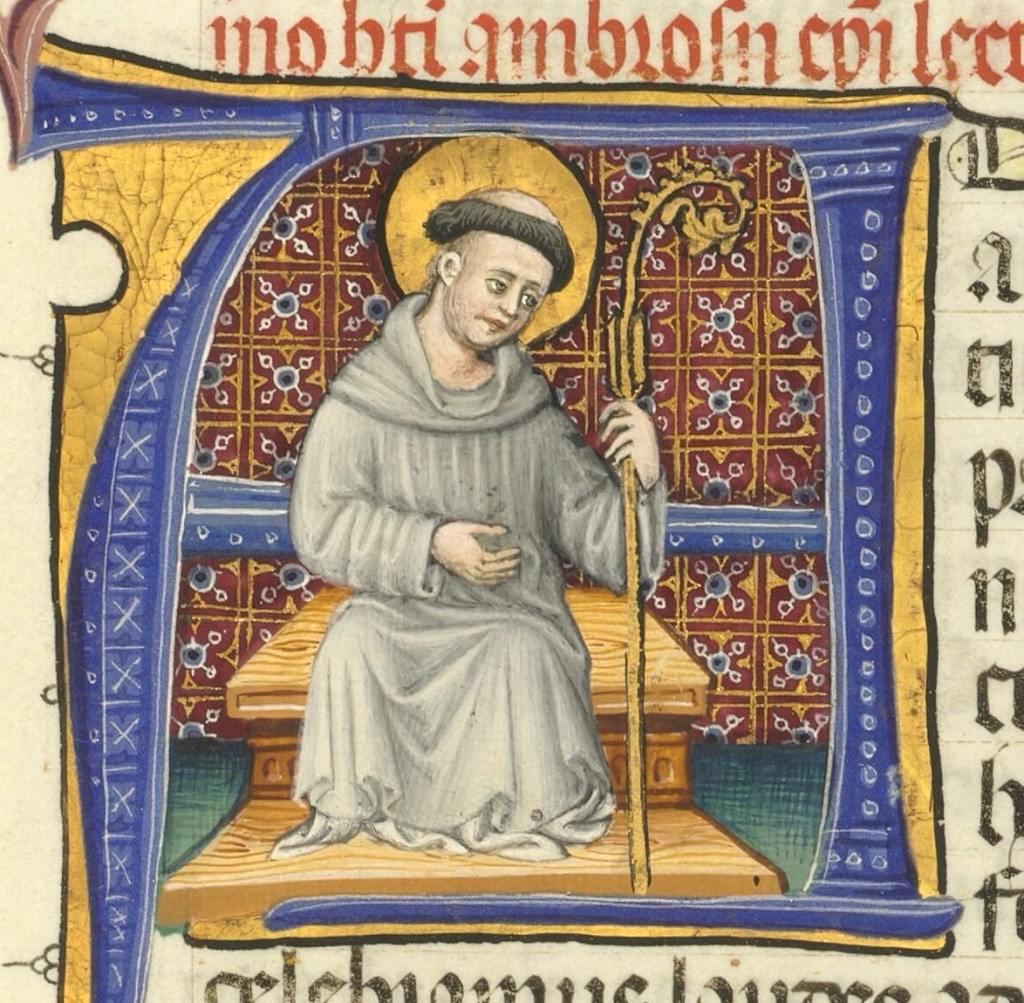
Saint Bernard as an Abbot
From a Breviary
Spanish (Catalan), c. 1398-1430
Paris, Bibliotheque nationale de France
MS Rothschild 2529 (16b)lVI(bas), 1, 18, fol. 374r
 Words and Things