quóniam nihil áliud est dilígere Deum quam amáre iustítiam. Dénique sicut illi dilectióni Dei próximi cura subiúngitur, ita et huic desidério iustítiæ virtus misericórdiæ copulátur..
Amar la justicia no es otra cosa que amar a Dios. Y como este amor a Dios siempre está ligado al amor que se preocupa por el bien del prójimo, el anhelo de justicia se une a la virtud de la misericordia.
To love justice is nothing other than to love God. And since this love of God is always affiliated to the love that is concerned for the good of the neighbor, the hunger for justice is coupled with the virtue of mercy;
Amar la justicia no es otra cosa sino amar a Dios. Y, como este amor de Dios va siempre afiliado al amor que se preocupa por el bien del prójimo, el hambre de la justicia se ve coplado con la virtud de la misericordia;
+++
Misericórdem te misericórdia, iustum vult te esse iustítia, ut in creatúra sua Creátor appáreat et in spéculo cordis humáni per líneas imitatiónis expréssa Dei imágo respléndeat.
La misericordia misma quiere que seas misericordioso, la justicia, que seas justo, para que aparezca el Creador en su criatura, y por líneas de semejanza la imagen expresiva de Dios brille resplandeciente en el espejo del corazón humano.
Mercy itself wants you to be merciful, justice, that you be just, so that the Creator may appear in his creature, and through lines of similarity the expressive image of God may shine resplendently in the mirror of the human heart.
Mercy itself wishes you to be merciful, justice, that you be just, so that by lines of similitude the Creator may appear in his creature, and the expressed image of God shine resplendent in the mirror of the human heart.
+df
East Façade of the Basilica of the Immaculate Conception, Washington DC
I was invited to give The Pallium Lecture, in the Archdiocese of Milwaukee, as part of a larger conference entitled “Synods, Councils and Creeds”. The Conference was designed to help celebrate the 1700 anniversary of the Council of Nicaea. The text of the lecture is given below, entitled “Inviting Nicaea to Speak.” I am grateful for the gracious welcome I received from the people of the Archdiocese. (The references cited in the talk are listed at the end of the text.)
+df
Apse Mosaic of St John Lateran Archbasilica, Cathedral Church of the Bishop of Rome, dedicated by Pope Sylvester in 324.
Inviting Nicaea to Speak
+Daniel E Flores, STD
Bishop of Brownsville
For a Christian there is a kind of lectio divina that attends to history, just as their is one attending to the Sacred Text of Scripture. Like the Lectio of Scripture it is marked by an attending to the letter, the historical events, and never prescinding completely from them. History is populated by the realism of things done and said, the human acta that are in some way visible to us. This aspect keeps history from being easily malleable to our will. We cannot make it mean and say what we want. By attending to the littera Nicaea is open to being understood, to helping us rise to a consideration of the truth of things perceived as a larger whole.
For our limited purposes this evening I would like to look at Nicaea not simply as a Council of the Church that took place in 325, but as a time-frame event of roughly 56 years, beginning with the eruption of the Arian controversy around 318, and culminating in the work of the Council of Constantinople in 381. Between the articulation of the homoousion of the Son at Nicaea and the elaboration of the Holy Spirit’s With the Father and the Son he is worshipped and glorified at Constantinople, a great deal was fought over, clarified, agreed to, canonized, and set in motion.
Fifty-six years is a brief time, brief like a human life. It is roughly the time span between us and the Second Vatican Council. The lectio of history causes us to ask questions. I think, though, we should try to let the lectio of Nicaea speak to us, like a peripheral parishioner who will never speak unless asked. We should even let this parishioner question us about our current presumptions and preoccupations. I will gesture gently to some of the questions Nicaea might ask us, but will mostly leave the questions for you to hear, think, and pray about. In the current context, this seems a synodal way to proceed.
1 The Only Begotten Son.
The presenting controversies that led to Nicaea originated in Alexandria around the year 318 when the Patriarch Alexander of Alexandria condemned the teaching of a priest in Alexandria by the name of Arius. The gist of what Arius taught is sketchily known, but it is safe to say he wrote disapprovingly of what the Patriarch Alexander taught concerning the Godhead.
Essentially, for Alexander the relation between Father and Son is an eternal one. As long as there was the Father there was his eternally begotten Son. (Ayres pos 361). God is called Father because he eternally begets the Son. It was this eternal Son who became flesh so as to lead us back to the glory he shares with the Father since before the world began.
Athanasius was a deacon in Alexandria, an advisor to the Patriarch. He wrote the treatise On the Incarnation around 318. He makes no mention of Arius, so he likely wrote it before the teaching of Arius became prominent. The treatise, therefore, is a good indicator of what the Church in Alexandria, under the Patriarch Alexander, taught as received tradition about the Son. In On the Incarnation we hear the young deacon-theologian say things like this: … to change the corruptible to incorruption was proper to none other than the Savior Himself, Who in the beginning made all things out of nothing; that only the Image of the Father could re-create the likeness of the Image in men,(On the Incarnation 20).
The text is a pre-Arian witness to a soteriological context for understanding the work of the Son, and for perceiving the identity of the Son. What Athanasius says as a matter of course reveals a tradition of teaching about the Son’s relation to the Father. The “in the beginning he made all things out of nothing” of the Son places him decidedly on the side of the eternal Godhead of the Father. Athanasius is not arguing the point, he is using what he considers a given of the faith to make a related but different point, namely that it was fitting the Son should come in the flesh to restore creation.
Arius, we know, declined to count the Son / Word of the Father as eternal and divine in the same way as God the Father who sent him. For Arius the first creative act of the Father is the Son, created spiritual reflection of the Father’s glory. It was this created reflection who became flesh in the womb of the Virgin. Thus, the famous catch-phrases of Arius and of his varied supporters afterwards were simply, “There was a time when he was not”, and “he is not the same” as the Father.
The phrase “He is not the same”, surely meant two things primarily: that the Son is not the Father, and (consequently) since the Father is the only eternal God, the Son must be something other and less than that. The argument proposes a straightforward claim of metaphysical verity. It can’t be otherwise. If the Son is not the Father, and the Father is the One True God, then the Son must be something else. If the Son is the Only-Begotten from the Father, as Scripture says, then the Begetter is the eternal unbegotten, and the begetting of the Son was a creative act on God’s part. Only of the True God, the Father, can it be said “there never was a time when he was not”. Despite the enchanting logic of this way of describing the Mystery, it presents a sad confesión of faith, because from eternity, God the Father Almighty was alone.
Arius was willing to say the WORD, prior to his enfleshment in the womb of the Virgin, was divine in a participated sense, as much like God as a created thing can be, but created nonetheless. To speak otherwise, Arius would say, is to introduce into the eternal and simple Godhead a principle of modality: sometimes the One God acts as Father, sometimes as Son or as Spirit. The catch-word for diverse modalities in the Godhead is Sabellianism, which had been condemned in the previous century as an erroneous account of what the Scriptures teach and what the Church believes. Sabellianism is related to the abhorrent claim of the Patripassionists, that the Godhead suffered the Cross, since for them the difference between the Father and the Son is in name only.
So much of doctrinal development is about clarifying first what the church cannot say: by all accounts scriptural and traditional, we can never say the Father suffered and rose from the dead. Or that the Father and the Son are the same such that what happens to the Son happens to the Father also. We do say the Father accepts the gift offered by the enfleshed Son. Arius thought his Patriarch Archbishop was a Sabellian without the name. Because if the Son is True God like the Father is, and there can be no difference within the Godhead of the One God, then by what logic can the Incarnational mysteries be said not to involve the passio of the Father?
The structure of human thought creaks when looking for ways to describe the identity and works of the God revealed in Christ and testified to in Scripture. Arius and his later defenders were not unintelligent; but they could not see a way, or find the words, to preserve the teaching about “One God creator of heaven and earth” while speaking of an eternal Son, not the Father, within the Godhead.
2 Of Synods and Councils
Probably in 320, Alexander of Alexandria called what could be described as a local synod of the Church of Alexandria. He prepared a profession of the Trinitarian faith of the Church, which Arius refused to sign (Ayres 285). By 324 Alexander had convoked various synods of local bishops within the territory of Egypt and Libya to meet and address the doctrinal discord caused by Arius’ teaching. During this same time period, Arius went to Palestine and the environs of Antioch to seek support, which he found. Supporters of Arius’ teaching included the bishop Eusebius of Nicomedia and Eusebius of Caesarea. Rival synodal gatherings were convened, supporting Arius and disavowing the decisions of the synods previously held within the ecclesial sphere of Alexandria.
These competing synods occasioned the taking of sides by many bishops who were previously unaware of the problem stirring in Alexandria. A dispute of this type in Alexandria had effects far and wide because Alexandria was a great Church, an Apostolic Church, recognized at that time as second in ecclesiastical precedence only to the Church of Rome.
The custom was that once a Synodal action involving bishops of a province or region took place, letters are sent to the bishops of the other major sees, Rome being the first, asking that their decisions be recorded and recognized in their Churches. After the local and regional Synods Alexander sent letters to the other churches, including Rome. Meanwhile, once the synods at Nicodemia and elsewhere took place, supporters of Arius sent letters of their own to the other churches. If recognition was given to the decisiones of local synods, then the Churches were in Communion with one another; if not, communion was ruptured, at least until the matter was straightened out in some way. By 324 a serious rupture of communion between the Churches was underway.
It is important to note that concomitant to the central Christological issue in dispute, there is also an inextricably connected ecclesiological practice being enacted. The communion of the Churches was an indispensable good presumed throughout the controversies leading to Nicaea and after. As the Church sweated to resolve the Christological issue, it did so because the communion of the Churches had to be maintained. The Church could not address what we believe about the Christ without also manifesting in actu how the Catholicity of the Church is lived, expressed and verified.
Further, it is singularly significant that the first great affirmation of the One Holy Catholic and Apostolic Church, (as the Church describes herself in the Creed at Constantinople), is about the faith of the Church in Christ. The Communion within the Catholic Church is inseparably a matter of communion of the faith professed in the local Churches in Christ: faith in who Christ is, in what he does for us, and how we relate through him to one another and to the Father.
The actions of local synods were a vital way of addressing these issues affecting the communion of the Church. The controversial local synods leading to Nicaea witness to the fact that the Christological faith of the Church is embedded and expressed in the life and communion of the local Churches. Taken as a whole, synodal gatherings prepared the ground for the vehicles of the Church’s more universal judgement about the content of our communion in Christ. Still, we could not have gotten to Nicaea without having heard from the synods. It is also true that on matters touching upon the communion of the Catholic Church, the decisions of the local synods eventually yielded to the decisions of two General Councils whose actions were recognized by the See of Rome.
After 325, while the Niceneprofession of faith was being disputed and defended, the question of the Spirit imposed itself on the Catholic communion almost immediately by a kind of theological necessity. This necessity is based on the lived experience of the Church. We relate to Christ in the Spiritto the Father. The dynamic of salvation in Christ and the communion of the Church in Christis at the same time a manifestation of the Spirit’s mission and identity. Elaborating upon the work of the Spirit while clarifying the identity of the Son is like noticing the air we breathe as we behold a sunrise: we wouldn’t be able to see the one without receiving the life sustained by the other.
3 A Work of Translation
In 325 Emperor Constantine issued invitations to the bishops of the Church to a Council to settle the festering dispute about what the Church believes concerning the Father and the Son. Constantine’s letters inviting the bishops to come to Nicaea, not far from the newly establish imperial seat in Constantinople. The pope in Rome, Sylvester, sent two priests as his delegates, pleading failing health as the reason he could not attend in person. We have every reason to believe that the Bishop of Rome was fully aware of the issues at stake and was engaged through his delegates. The Greek speaking bishops greatly outnumbered the Latin Westerners at Nicaea. There were also Syriac speaking bishops there from Persia and Mesopotamia. Thus, in addition to Greek, Latin and Syriac were also spoken at Nicaea. The emperor Constantine, it is reported, gave his opening address to the bishops at Nicaea in Latin (Davis 58).
There was a bishop by the name of Ossius who was present at a regional synod of Antioch held just a few months before Nicaea (Ayres, pos 300 ff). He had signed his recognition of its decisions condemning Arius’ teaching. Ossius is an interesting figure. He was a personal advisor to the Emperor Constantine, a bishop of Córdoba, from the Western part of the empire, in modern day Spain. Constantine, it is good to remember, knew a lot of people in the West. He had been emperor in the West since 312, and did not consolidate his rule in the East until 324. Ossius had connections to Rome and was likely Constantine’s primary line of contact with Pope Sylvester. Ossius was fluid in Greek and Latin, and indications are he had a good understanding of what the Alexandrian controversies implied. He is a one of those bridge figures that quietly play a role in making things move along. He actually presided at Nicaea, and he, together with the two Roman priest-delegates sent by the pope, were the first to sign the acta of the Council at Nicaea (Davis, 57).
We should be careful, therefore, not read back into this time period the linguistic, cultural and theological estrangement between East and West that developed later. In the fourth Century knowledge of Greek was not lost in the West. This was the century of Ambrose, who knew Greek quite well, and had connections in the East. It is also the time of Jerome and Hilary of Potiers, equally conversant in both Latin and Greek culture. Jerome was translating Didymus the Blind into into Latin while Didymus was still alive. Neither was knowledge of Latin or Syriac lost in the East.
We can be sure that while the decisive terms of the Nicene profession were being hammered out in Greek, the Latins and Persians and Mesopotamians were simultaneously translating the terms in their heads and in letters. Thus, for example, the Latin translation of homoousion as consubstantialem was contemporaneous to the Council itself.
The issue of translation is not a secondary one. One can describe the very mystery of the Inarnation of the WORD as God’s self-translation to us. Translation has to do with more than finding equivalent words. Words seek to transmit understandings. They express thought patterns flowing through literature and culture. Nicaea was possible as an achievement of communion in the midst of controversy in great part because polycultural polylingualism was not rare in the 4th Century.
But it is not just a matter of tracing translations across linguistic and cultural contexts, it is also a deeper matter of how people, and Christians in particular, in late antiquity traveled, listened, and learned from each other in simple human ways. People heard things, translated things in their head, remembered things, copied things, sang things, and moved about more than we know. We hardly have a clue as to the dimensions of this aspect of the Church’s transmission of the faith across language and culture before, during and after the Council of Nicaea.
4 The Baptismal Faith
Prior to Nicaea, handing on faith in the Most Holy Trinity was an essential aspect of the Church’s practice when initiating catechumens, baptizing them in the name of the Father and of the Son and of the Holy Spirit. No baptized person denied the Father, Son and Holy Spirit.
What we know today as the Apostles’ Creed is based on earlier creedal forms in use in Rome and Jerusalem. These in turn formed the basis of baptismal catechesis in the Greek, Latin and Syriac speaking Churches.The Catechumens were given the Trinitarian baptismal profession of faith, and they were required to profess it back from memory, often to the bishop, prior to baptism. As de Lubacargues, there is no sound historical reason to think there was an intermediate, non-Trinitarian baptismal usage emerging from the age of the Apostles, prior to the Trinitarian form we know from ancient times. (See de Lubac, The Christian Faith, 71ff).
The Arian problem, however, brought to the fore the question about what we mean when making the baptismal profession of faith. The broader issue is what the Churches intentionally understand about the relation of the Three in light of the Church’s equally firm profession of faith in one God, summarized in the phrase common to the most ancient Baptismal creeds: “I believe in One God, the Father Almighty”.
Thus, the Nicene Creed is formulated for its moment atop the earlier baptismal creeds of the Churches. And these reflected the baptismal traditions of the Churches, and their inescapably Trinitarian Structure. Notably, Nicaea marks the first time a creedal statement takes center stage as a way of assuring the communion of faith, not of catechumens, but of the bishops themselves. The Creed of Nicaea affirms by each phrase what the bishops agreed was a recognizable expression of the faith handed down from the Apostles to the Churches, and what is taught in the Scriptures rightly understood.
This does not mean that the earlier creeds in use within local churches for the liturgical rites were no longer used (See Ayres pos 1404-1407). Nor is it the case that the form of the Nicene profession was initially perceived by even the participants in the Council of 325 as possessing the stature and authority it came to gather over time. This growing stature was built up through the confirming gestures of Constantinople I, the Councils of Ephesus, Chalcedon and beyond (Ayres pos 1407 ff).
5 The Christological Confession
The text of the Nicene Creed is itself predominantly a positive statement of faith. The decisive articulations that address the problem of Arius and his supporters are found where the baptismal creed phraseology is expanded upon. It is mostly a series of affirmative assertions about what we can rightly say : And We believe in one Lord Jesus Christ the Son of God, begotten as only begotten of the Father, that is of the being of the Father, God of God, Light of Light, true God of true God, begotten not made, consubstantial with the Father, through whom all things came into existence,.. (Ayres, pos 319).
Nicaea itself used the term ousia (substance / being) twice in its formula. The first time is when it says only-Begotten of the Father, that is, from the substance of the Father. This phrase is not retained at Constantinople I. At Nicaea it renders emphatic that the Only-begotten is of the same God-reality as God the Father. This is reinforced by saying he was not made, or created. The Son does not flow from the creative act alluded to in the profession about God the Father, maker of heaven and earth. The Son is not a created Son, but he is the begotten Son, generated within the eternity of the Father. The Creed makes no attempt to explain how this can be. This is a profession, not a treatise. The Son is not less God than God. The clear line enunciated between the created order and God places the Son as having an origin, a begetting, on the God side of things. And there is only One God.
The Faith professed in the Creed goes on to add that he is of the same substance, homoousios / consubstantialem to the Father. He is from the Father, with the Father in the eternity of the divine being. The Father is not Father because he created and adopted the WORD. He is Father of the Son from eternity.
Thus the Son is professed and announced in the dynamic of the divine internal relations. The Creed of Nicaea does not offer a metaphysical term of similar weight to ousia to name in what way the Son is not the Father. There is no word agreed upon at Nicaea for the particularity of the relations between Father and Son. In the canons of Nicaea there is a specific rejection of speaking about a distinct hypostasis, in the generation of the Son. The intention here is to rule out a use of hypostasis in a sense that suggests a different ousia / substance. So in 325 we have not yet reached a point of speaking about hypostasis/ prosopon/ persona as a settled way of naming the distinctions within the Trinity.
There were energetic theological efforts after Nicaea dedicated to finding an acceptable language, a counter-weight word of sorts to substance, to name the distinct identities of the Father and the Son. The specification of hypostasis in the later writings of Basil the Great, Gregory Nanzianzus and Gregory of Nyssa amounts to a purification and baptism of the word Nicaea had disavowed. They were able to do so by carving out a specific sense of the word, one aiming at naming the reciprocal dynamic relations that constitute distinct identities within the Godhead (see Maspero, Metaphysics, 141 ff).
Before the Cappodocian chiseling of the language of hypostasis, the Creed at Nicaea lets the prepositions carry the weight of the relationships internal to God. The Son is from the Father, as God from God, Light from Light, True God from True God. The from presupposes that the Son is in the Father, with the Father. The intimacy of the Johannine prologue is implicit here: The Word was with God. The adoption of ousia/substantia language does not mean we know what the substance or being of God actually is. We don’t. Substance is the best stand-in word available for whatever the uncreated life of the One God is. We don’t really know how the hypostases are either; but we can truly name them as distinct within the One God. (See Maspero, Metaphysics, 82 ff and Ayres, pos 2421 ff, and 3078 ff.)
The Creed presumes that the ecclesial practice of initiation through baptism involves being swept into something bigger than we are. Conversion is not a moral code we adopt, nor an intellectual system we buy into. It is a going into a new, un-anticipated life, ungenerated by us. Once there, with the help of Scripture, we name what we live, but do not fully see. Along this line, there is a fittingness to the grammatical decision in the Creed to use the accusative case and not the ablative in the Greek and Latin texts, when saying Credo in unum Deum, … in unum Dominum Jesum Christum … in Spritum Sanctum. We are reborn into a mystery the dimensions of which we can only begin to glimpse once we have been brought into it. Christ is God from, who is sent as God towardus at the Incarnation.
Our being reborn from above is actually a being brought into the life of the Son born from the Father before all ages. Ourbaptismal identity rests on the faith professsed at Nicaea: we are invited and adopted participants in the eternal filiation of the Son. Being children of God by grace of Christ in the Spirit is of an entirely different order when compared to being God’s children at our creation.
6 The Triple reference to Creation
Taking into view the elaborations included at Constantinople in 381, we should condider the fact that all three Trinitarian sections of the Creed make references to the creative act of the Triune God. The Father is Maker of heaven and earth… The Son through whom all things were made,… The Spirit Lord and giver of life.
First of all, the Father is origin of the Eternal Trinitarian dynamic and origin of the creative act. The Father acts through the Son. The through whom all things are made implies the speaking dynamic within God referenced in Genesis: God said let there be light. And the through whom of the Son carries implied also the Psalms and wisdom literature that expand the sense of the WORD as issuing from God, and creative in itself.
The Creed makes no explicit reference to the WORD as title of the Son. This is all the more noteworthy because the Scriptural expositions that accompany the Trinitarian controversies before and after Nicaea are saturated with references to the interpretation of the Gospel of John, particularly the Prologue.
How to understand this? There is deliberate tendency at Nicaea and Constantinople to preserve the structure and content of the baptismal creeds, and of the Baptismal formula (See Ayres pos 4149 ff ). The title WORD, after all, is not invoked at the moment of baptism. Nicaea shows us that when the Church seeks to clarify an aspect of the transmitted faith, the instinct is not to change the received wording any more than the immediate issue requires. Thus older formulations continue in use but our understanding of them is specified. We still use the Apostles’ Creed, the older formulation, yet Nicaea informs how we rightly understand the earlier forms of profession.
The creedal formulation indicates that the title Son remains primary. This is an exegetical indicator on how to read the Johannine usage of both terms, Son and WORD. The term Logos / Verbum has a long prior history in philosophical circles. It is thus prone to interpretation along different lines, including that of an impersonal emanation, or as a participated creation of a more neo-platonic stripe. Scripturally, Son names more clearly a distinct personal relation within the Father. Through the right reading of the Johannine word Son, the Johannine word WORD, is rightly estimated.
With reference to the Spirit, Lord, giver of life, inGenesis it says “he breathed life into the clay”. The breath of God is associated to the Spirit. This usage is developed in the Psalms, like 147, 18, where it says He sends forth his word and it melts them; at the blowing of his breath the waters flow. And so the phrase Giver of life at Constantinople specifies a particular aspect of the Spirit’s work at creation.
There was discussion among the Cappadocians after Nicaea about the appropriateness of the phrase Life from Life as a parallel to the phrases God from God, light from light, true God from true God (See Maspero, Filioque 131-134). Gregory of Nyssathought it was a true phrase, but easily given to a purely physical understanding, tied as it is to breath and the physical life it sustains. In his Catechetical Instruction (Part 1, no, 3)Gregory of Nyssa puts it this way, citing Psalm 36,6 in the LXX version: By the Word of the Lord,” it says, “the heavens were established, and by the Spirit of his mouth all their host.” By what kind of “word” and what kind of “spirit”? For the Word is not a saying, nor is the Spirit mere breathing.
Throughout the controversies, the Cappodocian Fathers were working to purify our use of language away from physicalist understandings. And so, while true when properly understood (spiritually understood), such phraseology as Life from Life was not used in creedal elaboration of the Spirit. Still, the phrase Lord, giver of life, is a nod in that direction (See Ayres, pos 5618ff).
This triple reference to Creation in the Creed witnesses to an important theological perception that reached classic theological form during the years after Nicaea, namely the describing of the unity of God’s action ad extra. The Trinity acts as One with respect to creation. The Father creates, the Son creates, the Spirit creates: there is One Creator (See Ayres’ discussions at pos 4484).
7 The Spirit an d the Life of Glory
The phrase Giver of Life associated to the Spirit also expansively includes the giving of the new life, that is, access to the life of God himself in and through Christ. The Crucified Christ breathes out his Spirit from the Cross; the Risen Christ breathes forth the Spirit on the Church. God is life, we participate in it, by the Spirit: He breathed on them and said “Receive the Holy Spirit” (Jn 20,22).
On this point, Athanasius and the Cappodician Fathers after Nicaea unfailingly link together the work of the Son and the Spirit in accomplishing our salvation. The language they use to describe how the Spirit and Word act in us is particularly careful and instructive. Our age tends to speak soppily of these things, and by doing so might unintentionally suggest that the Son and the Spirit are independent actors on our behalf. So, listen for a moment to Athanasius (to Sarapion 1.19.4), from a text dating from the 350’s:
But when we are enlightened in the Spirit, it is Christ who enlightens us in him. For it says: He was the true Light who enlightens every man coming into the world [Jn 1.9]. And again, the Father is the Fountain and the Son is called the River, and so we are said to drink of the Spirit. For it is written: we were all made to drink of the one Spirit [1 Cor 12.13]. But when we drink of the Spirit, we drink of Christ. For they drank of the spiritual Rock that followed them, and the Rock was Christ [1 Cor 10.4].
This perception of the intimate and inseparable interrelation between the mission of the Son and the mission of the Spirit is an enduring aspect of the Catholic Faith, and its articulation during the period of Nicaea is both a gift and safeguard to us. Thinking with Nicaea on this point specifically can help us approach more profoundly the relation between Truth and Love in the life of the Church. This is so because the relation between truth and love in the life of grace is rooted in the prior relation between the Son and the Spirit together in the Godhead: distinct but never competitive or apart.
The action of the WORD and the Spirit in concert on our behalf aims to enfold us within the Glory of the Triune God. Around 374, 50 years after Nicaea and 6 years before the Council of Constantinople, Basil the Great wrote a work entitled On the Holy Spirit. Early on he mentions that the enemies of the Holy Spirit criticize him for the two doxologies he permitted for use in his Diocese of Caesarea. In one formula used at Caesarea the people sing: Glory to the Father, with the Son, together with the Holy Spirit. In another formula the Church in Caesarea sings: Glory to the Father, through the Son, in the Holy Spirit etc is sung. (See Basil the Great, On the Holy Spirit,Ch 1, no. 3 ff). Here again, the prepositions are crucial for they speak of relation: to, with, through, together with. Over the course of several chapters, Basil defends the usage of the two different formulas as expressive of right faith and as traditional. Basil’s work is a reminder that liturgical useage in the church is never far from these controversies.
Just as the initiation rites culminating in baptism carried an ecclesial sense of the faith prior to the explicitation of Nicaea, so the traditional doxologies carried an implicit sense of how to account for the full divinity of the Holy Spirit. As he presents the full divinity of the Spirit as the traditional understanding of the Churches, Basil carefully focuses on the Scriptural prepositions and those used in the doxologies to speak of the Spirit.
What you will notice in the two doxological formulas referred to by Basil is their fairly close formulaic resemblance to two forms of doxology present in the tradition of the Roman Liturgy. The first is like when we say Glory to the Father and to the Son and to the Holy Spirit. The second is like what we have said since antiquity at the conclusion of the collect prayers in the Mass and Liturgy of the Hours. The collect prayer is directed ordinarily to the Father and concludes with through our Lord Jesus Christ, your Son, who lives and reigns with you in the unity of the Holy Spirit, God, for ever and ever. Amen
The first doxogy in both Basil’s Church and in the Roman Rite announces to whom Glory belongs. The second form of the doxology announces basically how God has acted on our behalf such that we have learned the Mystery of to whom Glory belongs. Salvation is From the Father, through the Christ, in the Holy Spirit to us.Our doxology is thus directed back by the same path, in the Spirit, through the Son, to the Father. We have been taught of the True God, to whom we offer glory. The theological shorthand that distinguishes between these two kinds of doxologies is the distinction between praise of the Godhead in itself (the immanent Trinity), and the Godhead as acting in time on our behalf (the economic Trinity). Theologians subsequent to Nicaea take this distinction as given, but it was the work of Athanasius and the Cappodocians after Nicaea on the way to Constantinople that hammered it out in the defense of the teaching that the Spirit is in himself as fully of the same God- substance as the Father and the eternally generated Son
And with the Father and the Son He is worshipped and glorified is a statement about the immanent Trinity. Yet it rests on the prior instructive action of God. We can glorify the Triune Godhead because we do so in the Spirit through the Son back to the Father. Really, we can only glorify God by being in the God we glorify, and this means being in the Spirit. To be in the Spirit is already to be, in some real way, within the Godhead (See Maspero, Filioque, 140 ff).
This kind of human movement towards the glorification of the Godhead is an ascesis of truth and love, of truth in love, of Christ in the Spirit, moving us to intensify our participation in God’s own inner life. Thus the work of the economic Trinity leads us to our life of participation in the immanent Trinitarian relations within the One God.
One way of looking at this aspect of the work of the Son and the Spirit is to ask: What does the faith in what God has done for us in Christ say to us about the God who gives the gift of Christ the Son? St Bernard is a spokesman for the importance of this question in the Western monastic tradition: We move from loving God for what he does for us, up, to loving and knowing God in himself. The love moves us, and grants glimpses of sapiential perception into the truths of faith.
8 Toward the Final Ascent
The center of God’s action on our behalf is the self-emptying of the Son made flesh. We apprehend its meaning through the Spirit who enlightens us to perceive the love manifested in the gift given. The Spirit draws us into this Christ and transforms us at the center of the revelation which is the Crucified flesh of the Son (see Catechetical Discourse, Part 3, 32. 4-11). Here we learn in the Spirit that the glory of the Son consists in giving himself to the Father for our sakes. This is the pivotal point, the rendering accesible to us of an entry into the self-donating fullness of God. Dios no sabe otra cosa menos darse, as St John of Ávila says somewhere; God doesn’t know anything other than to give himself.
Our participations in Christ are a work of the Spirit and take us through Christ to the Father, who with the Son and in the Spirit is adored and glorified. Ascetical ascent is eschatological ascent, an intensified participation in the uncreated love whose inner life is pure fullness through self-donation (See Maspero, Metaphysics, 43 ff).
The Father pours himself out into the Son without losing the fullness of himself. And the Son by the Spirit pours himself back to the Father without losing his fullness as Son. This he does from eternity, and by becoming flesh he translates the mystery of the pure gratuitous giving of God into a language we can understand at least well enough to begin to learn it better. And the Spirit, in ways even more mysterious, is agent and recipient of the self-donating fullness that is the reciprocal self-donation of the Father and the Son. In the Trinity not One possesses what is not also ecstatically give away (See Athanasius to Serapion 1.30.4 ff).
The sources of the Church’s identity and mission lie within the Trinitarian life of God, precisely because the Church participates in this life by grace, in the Spirit. The rationes of our communion, our mission, and our eschatological finality are to be sought in nothing less than the Trinitarian life. If I had another hour to speak to you, I would try to point toward how the self-donating life of the Trinity is impressed upon the Church as the proper form of her communion. The Father is the Fountain and the Son is called the River, and so we are said to drink of the Spirit, as Athanasius says.This communion in the river of the Son moves us by the Spirit to pour out from ourselves to those who have not known the Self-Giving God revealed in Christ; pouring out from ourselves also to the poor and to the vulnerable, to those who cannot repay us. For the self-donation that is the Trinitarian life is given to us not for ourselves to possess, but for us to give away in whatever way we can, so as to begin to possess. If the River does not flow out of us, then it can never really fill us. But, I will leave these indications for your own lectio and consideratio going forward.
Thank you for your patience,
+df
+Glory be to the Father, and to the Son, and to the Holy Spirit, as it was in the beginning, is now and ever shall be, world without end. Amen.
Works Referenced in the lecture:
Athanasius, On the Incarnation: Translated by a Religious of CSMV, St Vladimir’s Seminary Press, 2002.
Athanasius, Letters to Serapion on the Holy Spirit in Works on the Spirit: Athanasius’s Letters to Serapion on the Holy Spirit and Didymus’s On the Holy Spirit Translated, with an Introduction and Annotations, by Mark DelCogliano, Andrew Radde-Gallwitz, and Lewis Ayres, St Vladimir’s Seminary Press, 2011.
St Basil the Great, On the Holy Spirit: Translation by David Anderson, St Vladimir’s Seminary Press, 1980.
Saint Gregory of Nyssa, Catechetical Discourse A Handbook for Catechists: Introduction, Translation, Notes, Glossary, and Bibliography by Ignatius Green, St Vladimir’s Seminary Press, 2019.
Lewis Ayres, Nicaea and its Legacy An Approach to Fourth-Century Trinitarian Theology: Oxford University Press, 2004. (Electronic version, which is why positions are referenced not pages.)
Leo Donald Davis SJ, The First Seven Ecumenical Councils (325-787): Liturgical Press, 1983.
Henrí de Lubac, The Christian Faith, An Essay on the Structure of the Apostles’ Creed, Translated by Brother Richard Arnandez, FSC: Ignatius Press, 1986.
Giulio Maspero, The Cappadocian Reshaping of Metaphysics Relational Being, Pontifical University of the Holy Cross: Cambridge University Press, 2024
Giulio Maspero, Rethinking the Filioque with the Greek Fathers: Eerdmans Publishing, 2023.
In September, 2018, I gave a lecture to a conference for «Young Theologians» in Washington DC. Conferences of this kind are held every few years, sponsored by the Doctrine Committee of the USCCB, as part of an ongoing effort to encourage conversation and dialogue between bishops and theologians for the good of the Church. I am grateful for having had the opportunity to participate in the conversations engendered during the conference. There is such a great richness of thought and experience in many of our younger theologians, so many of them articulate lay voices in the Church today. The topic in general on that occasion was loosely entitled «Connecting the Disconnects» in theological education. My contribution aimed at focusing our attention for a while on the importance of recovering the vison of Dei Verbum and the centrality of Scripture in the life of the Church. And I am particularly grateful to Doctor John Cavadini, Director of the McGrath Institute for Church Life at the University of Notre Dame, for his work in organizing the conference, and for his early suggestions to me about the importance of this topic.
Apse mosaic, St John Lateran Archbasilica, Cathedral Church of the Bishop of Rome
Dei Verbum: Christ, Scripture and the Life of the Church
+Daniel E. Flores, STD
Bishop of Brownsville in Texas
Part of our moment, I think, is a searing reminder to us all that in some mysterious sense, we never live in ordinary times. We kid ourselves into what Pope Francis once called the “grey pragmatism of the daily life of the Church”, that the Holy Father, quoting Bernanos, then described as “the most precious of the devil’s potions”.[1] The Church in the world is more like Bernanos’ descriptions in The Impostor than even Greene’s simple Whiskey Priest. The battle between grace and sin goes on every day more on the scale of Benson’s Lord of the World than in the form of Chesterton’s The Man who was Thursday. There are elements of Apocalypse Chapter 12 that are operative in history, have been and will be until the final consummation of all things. We have been for too long content with programs and policies, as if by themselves they can keep the ship afloat. Oh, the ship will remain afloat and will be righted, and God’s inscrutable providence will not be frustrated, but it will not be because we figured out the right formula. The Lord would have us be conformed to the charity of his poor Crucified Son, even if it kills us: I admire thee, master of the tides, […] Ground of all being, and granite of it: past all / Grasp God, throned behind / Death with a sovereignty that / heeds but hides, bodes but abides; […].[2]
+++
This lecture is based on the conviction that if we do not sustain an effort to get the connections right between Christ himself, the Scriptural Tradition and the life of the Church, all of our efforts aimed towards the renewal of Church life and theology ultimately fail.
1. “The work of at least another whole generation”
From Dei Verbum 12:
«For the correct understanding of what the sacred author wanted to assert, due attention must be paid to the customary and characteristic styles of feeling, speaking and narrating which prevailed at the time of the sacred writer, and to the patterns men normally employed at that period in their everyday dealings with one another. But, since Holy Scripture must be read and interpreted in the sacred spirit in which it was written, no less serious attention must be given to the content and unity of the whole of Scripture if the meaning of the sacred texts is to be correctly worked out.[3]»
Theologians hold an office. St Thomas used the language of his day in what I still consider the noblest description of your office: Magistri Sacrae Paginae, Masters of the Sacred Page, Teachers of Sacred Scripture. If the University teaching of theology in Thomas’ time recognized the magistri as canonically missioned by the Church, it was because they were understood to be at the service of the same ends evidenced in Scripture itself, pursued by the preaching and teaching office of the bishops, and at the service of the whole Church. St Thomas says this in his commentary on the Sentences:
«To teach Sacred Scripture happens in two ways. One from the office of prelates, like those who preach and teach,… the other way is from the office of Magister, like the masters of theology teach,.. the aim of those who teach Sacred Scripture is the same aim as those who brought forth Sacred Scripture; hence, since the publication of sacred Scripture was ordered to this, that man might attain to eternal life, as is clear from John 10, whoever impedes the end of this doctrine, sins by teaching.[4]»
I like this exemplary passage because Thomas articulates a deep part of the common tradition. The exposition of Scripture either by the ordained or by the teachers of theology shares in the aims and ends of the Scriptural authors themselves. This element of the Tradition was repeated forcefully in Dei Verbum when it speaks of Scripture being interpreted in the sacred spirit in which it was written. In some ways this phrase from Dei Verbum seemed remarkable at the time. Ignace de la Potterie puts it this way:
«Certainly, even the Constitution Dei Verbum says that «due attention must be paid both to the customary and characteristic styles of feeling, speaking and narrating which prevailed at the time of the sacred writer» (DV 12:2). But this affirmation is immediately followed by a truly novel paragraph on the ecclesial interpretation of Sacred Scripture «in the sacred Spirit in which it was written» (DV 12:3); strangely enough, after the Council, this remained a dead letter.[5]»
The formulation in Dei Verbum 12 may be described as novel in that it unites the contemporary problematic of the critical appraisal of the sacred writers’ historical setting together with the notion that teaching Scripture necessarily involves participation in the Spirit that inspired its composition. But the latter point is as traditional a theological given as you will find. Thomas is a spokesman for the tradition; De Lubac can give us countless other pre-critical citations from the tradition. De la Potterie’s contention that the pre-critical datum of the tradition emerged from the Council without much attention in a certain way helps frame the circumstance I wish to address.
Cardinal Ratzinger’s critical appraisal of the state of Scriptural exegesis in his 1988 lecture on Biblical interpretation in Conflict remains a pivotal and fruitful post-Conciliar theological text.[6] You’ve probably read it, or if you haven’t I hope you soon will. Still, it might be useful to recall a few things Ratzinger said in the 1988 lecture.
First, he notes the bleakness of the disconnect between Scripture and dogma:
«The negative side of what has happened consists in the fact that the gap between exegesis and dogma has become complete now among Catholics, too. Scripture has become for them so many words from the past; everyone tries to transport to the present in his own way, without being able to put too much faith in the raft he is relying on to do the job. Faith sinks to the level of a sort of philosophy of life that the individual tries to distill from the Bible as best he can. Dogma, now deprived of grounding in Scripture, no longer holds. The Bible, detached from dogma, has become a record of past events that therefore itself belongs to the past.[7]»
Ratzinger’s point about the separation of dogma and Scripture speaks for itself. It is useful to note that he uses the word dogma here, which testifies to the cascading bifurcations of theological disciplines since the Counter-Reformation. The diversification of theological disciplines and courses is a dominant feature of post-Tridentine, baroque, modern and contemporary theology. This is a great part of our reality today. How to link specialized areas of study like theological bioethics or theological appraisals of a neo-liberal social and economic order with the Scriptural revelation would require a whole series of lectures by a series of specialists. I am not such a specialist. Thomas, though reminds us of an older way; he would rather us speak of Sacred Doctrine as a wider term naming the whole tradition of teaching that flows from Scripture read in the Church. Thomas, in fact, practically equates Sacred Doctrine with Sacred Scripture itself, (Sacra Scriptura seu doctrina) testifying to the close identification with which the patristic and medieval tradition understood the living voice of the Church and the Sacred Scripture itself.[8]
A little later, the future pope goes on to restate the dilemma, cautioning us against withdrawing our efforts to the mere repetition of pre-critical perspectives:
«[Exegesis] also cannot withdraw to the Middle Ages or the Fathers and use them as a shield against the spirit of modernity. That said, it also cannot take the opposite tack of dispensing with the insights of the great believers of all ages and of acting as if the history of thought begins in earnest only with Kant. In my judgment, the recent discussion surrounding the problem of biblical hermeneutics suffers to a large extent from this restricted horizon. One does not dispose of patristic exegesis simply by labeling it «allegorical,» nor can one set aside the philosophy of the Middle Ages by classifying it as «pre-critical.»[9]»
Dei Verbum quite clearly wanted to shepherd bishops and theologians and theology as a whole toward a recovery of the primacy of the revealed Word in the Church in a way that both transmits the pre-Enlightenment depth of theological exposition, and integrates the varied tools of critical textual analysis. But as many of us know by experience and as many great post-Conciliar minds have observed, we are yet far from that. Again, from the 1988 Ratzinger lecture:
«[…] hardly anyone is likely to affirm that we are already ready in possession of a convincing master idea that would do justice to the irrevocable insights of the historical method, while at the same time overcoming its limitations and opening it up to an appropriate hermeneutics. The achievement of this goal still requires the work of at least another whole generation.[10]»
2. A Direct yet Mediated Word
De facto, we teach by saying something like “in Matthew’s account of Christ tempted in the desert, etc.” Or we say “the Johannine theology of Logos and flesh suggests, etc.” Both examples may be followed with expressive statements that are quite true critically speaking and quite Catholic, theologically speaking. Yet, the teacher, and certainly the preacher desires ultimately to say something more than “Matthew tells us”. And the Church’s preaching tradition certainly insists on saying more. This is a given of Tradition. Matthew, John, the Church, and the contemporary preacher need to be able to say with the conviction of faith: It is the Lord Himself who asks, who teaches, who reprimands, cajoles and heals. Without this capacity to hear the Lord speak his word directly, without this voice that is in the Church but not of her making, we are denied the grace of prophetic announcement and of authoritative self-critique.[11]
Theologically we must speak of the Word of the Lord as both directly from him yet mediated through Scripture, the Tradition of faith, and the contemporary teaching voice of the Church. This is a problem for us today, because the dominant metaphysics of knowing sees direct speaking and mediated speaking as mutually exclusive. Theologically, I think a Catholic must affirm that mediated direct address is possible; how to account for its manifestation is another matter.[12]
If as Thomas taught and DeiVerbum insists, the expositor shares in the Spirit of the sacred authors of Scripture than surely this must include the graced ability to say: It is the Lord who speaks. If we cannot say this, we may speak with learned authority, but we do not speak with the authority of Christ.[13] It is Christ who changes people by the impact of his Word and presence. Teachers in the Church either aim to be transparent to this direct address or we labor in vain.
We have, it seems to me, reduced most all of our disputations about Christian faith and life to ecclesiology. Sooner or later a teaching about the Eucharistic sacrifice as constitutive of the Church Jesus established, or about immigration, or the death penalty is distilled into a dispute about what level of ecclesiastical authority proposes the teaching. A self-referential Church is not only a Church focused on itself, it is also a Church that cannot, for the most part, remember how to talk more about Christ than about herself, even when discussing outward looking issues. We do not even realize the dimensions of our own reductionism, which, paradoxically, are enormous in their narrowness.
The profound disconnect in practice between our customary ways of citing Scripture as authoritative and our conviction that it is the Lord whose voice is heard through the text is in large part responsible for what Ratzinger described as everyone trying to transport Scripture to the present in his own way, “without being able to put too much faith in the raft he is relying on to do the job.”
This, then, is part of our theological muddle today. We have forgotten how to express with confidence the Church’s Scriptural access to the person of Christ Himself. This is a wide, varied and deep problem that has been with us for a while. Scripture is no longer expected to be transparent to a presence in a way analogous to the Sacrament. Yet, the Tradition does hear a Voice speak directly from the Scriptural text, it is a kind of sacramentally mediated presence. Surely not in the same way as the preeminent Eucharistic presence, but an efficacious sign nonetheless, through which we attain to knowing WORD himself, and not another.
Scripture is truly expressive for the same reasons the Eucharistic sacrifice is truly expressive. The WORD, after all, is known personally and most perfectly in the Incarnation; expresse se manifestavit, St Thomas says in his commentary on Hebrews 1.[14] This is to affirm that the direct address of the Eternal WORD is necessarily mediated through the humanity of Christ. Human nature, as it were, united to the Person of the WORD becomes an expressive word itself, transparent to the Wisdom interior to the Godhead. The human words of the WORD are themselves physical signs expressive of his person, which is itself mediated to us through his enfleshed existence.[15]
I want to pull this notion of Christ’s mediated immediacy together in some way by referring to a novel entitled La Confesión by Javier Sicilia, a Mexican poet/novelist/human rights activist. In it he describes the mystery of the poverty of the WORD made flesh. The novel itself is a devastating critique of the ecclesiastical culture within which the Maciel disaster was embedded. Early in the novel a fairly impractical, not to say useless priest, exiled to a poor mountain village in central Mexico, is having an interview with his fairly powerful Cardinal Archbishop. No one reading in Mexico would doubt the realism of the dialogue between poverty and power in the Church. Javier Sicilia’s vision of the poverty and powerlessness of Christ permeates the novel and is here encapsulated in this fragment. It picks up with the priest speaking quietly while the Cardinal sips a tequila. My translation cannot do justice to the beauty of this passage.
«Do you know what amazes me [Eminence] about the Incarnation? I continued, that it is altogether contrary to the modern world: the presence of the infinite in the limits of the flesh, and the fight, the fight with no quarter, against the temptations of the devil’s excesses. You do not know how much I have meditated on the temptations in the desert. “Take up the power”, the devil told him; that power that gives the illusion of being able to disrupt and dominate everything. But he maintained himself in the limits of his own flesh, in his own poverty, in his own death, so poor, so miserable, so hard. Our age, nevertheless, showing a face of enormous kindness, has succumbed to those temptations. “They will be like gods, they will change the stones into bread, and they will dominate the world”… to such an age we have handed over the Christ, and we do not even realize it.[16]»
Much later in the novel, the miserable priest is visiting with an elderly religious sister with whom he shares an abiding friendship. Here it is not so much the dialogue between poverty and power as it is the dialogue between poverty and the anguished preacher. This passage focuses on the denigration of the poor, and thus the denigration of the Christ. Father hears Sister utter the following:
«If misery exists, Father, and the statistics do not lie, it is because the dream of the rich has contaminated the dreams of the poor. At the bottom of things, poverty no longer exists, dear Father. The only thing that exists is wealth and misery, … Do you know why? I know well that you know … Because they have been made to believe that their poverty is a shameful disease, a wound unworthy of the world. Never before has humanity, and here, excuse me, Father, I also included our Holy Mother Church, spit so much on the face of Christ, as if his poverty were a filth, that unclean filth that they hung from the cross and which we, as did his detractors, make fun of.[17]»
These passages are deeply Scriptural, with a lively sense of the nearness of Christ in his poverty and powerlessness to us today. The Scriptural episode of Christ in the desert, tempted by the devil, acts as a mirror to the mystery of the Incarnation as a whole, and the brutality of the Cross in particular. Incarnation and the Paschal Mystery are the principal lights through which Christ’s particular words and deeds are interpreted. Now this is a very Catholic way of reading Christ, that is to say, of providing access to the identity and mission of WORD made flesh himself.[18] The contemplative apprehension of the meaning of the particular accounts of the Lord’s life contained in the Gospels is enveloped, so to speak, in the intense intelligibility of the Incarnation and Passion of the Lord.
The immediacy of the references to the Lord, in both the conversation with the Cardinal and to the elderly Religious Sister, presumes a transparent movement from the Christ of Scripture, the Christ of the Church, the Christ present today in our midst. A radically realist Johannine Christology, (God really did become flesh), and a fierce defense of his identification with the poor undergirds this passage scripturally. It is the Lord who speaks to us directly: what you did not do for the least, you did not do for me. Yet, these passages are a mediation of that direct address.
There is a difference between a naïve understanding of Scriptural composition and the profound attitude of faith that takes the Gospels as coherently expressive, giving us intelligible access to the voice of the Lord Himself.[19] To confess that it is part of the faith of the Church that Christ speaks directly through the Scriptures yet in a manner mediated by human authors is an important thing to reflect upon theologically. Yet, to begin to account for how this happens is a subtly difficult question.
3. CHRIST in History
St Leo the Great, On the Beatitudes:
«And so it was that he who had spoken to Moses spoke also to the apostles. Writing in the hearts of his disciples, the swift hand of the Word composed the ordinances of the new covenant.[20]»
The tale of Scriptural exposition since the development of the critical methods is rather complex. It is fair to say, though, that we have been on the defensive about Catholic approaches to Scripture for quite some time now.[21] Theologians and magisterium alike have been searching for ways to defend the reliability of Scripture and the Gospels in particular. Sometimes we have labored from within the historicist frame, unaware of the limitations imposed by “today’s regnant plausibility structure”.[22] Klemens Stock, the Jesuit biblicist, puts the matter more succinctly and with greater authority than I could in the following remarkable passage:
«Our fundamental desideratum is to know Jesus as he really is in the integrity of his person. Now, it is widely believed that, in order to do so, we have to read the gospels against the grain. The gospels are used as quarries. Jesus and his deeds are extracted from them in their pure form, or at least that is the intention. The very thing that the gospels do not give us we must laboriously, if only fragmentarily, retrieve from them: «the audio and video recordings,» the «stenographic transcripts» of Jesus in action, now «freed» from the perspective of the gospel writers. These, so it seems, are what is indispensable for getting at the real Jesus. The question arises whether these «audio and video recordings» – even supposing that it is possible to reconstruct with a certain probability sufficiently long segments free from background noise and distortion – are indeed the best way to get at the real Jesus.[23]»
Jean Luc Marion, certainly Ratzinger himself, Klemens Stock, and to a certain extent even Rene Girard point us toward a less defensive position with respect to post-Enlightenment historicist hermeneutics.[24] Each in their own way argue for a more robust stance that takes its instruction from the phenomenon itself. As Cardinal Ratizinger stated it in 1988:
«[The exegete] must not rule out a priori the possibility that God can speak in his own voice in the world using human words; he must not rule out the possibility that God can work in history and enter into it without ceasing to be himself, however improbable this might appear. He must be ready to take instruction from the phenomenon.[25]»
For our purposes I would like to focus on Stock’s contribution to this approach that seeks instruction from the phenomena itself:
«Do not the gospels, […] correspond much better to the whole character of how Jesus actually acted and what he actually intended? It is clear that the gospels are not stenographic reports. […] But Jesus did gather a circle of disciples, who accompanied him on all his journeys and were under the constant influence of his person. The real Jesus is never isolated and alone. Rather, he always lives in communion with his disciples. He does not want literal exactness. What he wants is for these living men to understand him and to be shaped by him. […] Generally speaking, words and deeds are not the only things that come from a person and give us a glimpse into who he is. […] The impression and understanding grounded in this real, and not merely verbal, communication sometimes are not, and cannot be, formulated either at the moment of encountering this person or during the period of immediate communion with him, but become clarified only with time -and, despite this time lapse, still find a valid, truthful verbal expression. Jesus, then, is inseparable from the disciples.[26]»
Historical reliability is a human phenomenon wider than YouTube recorded accuracy. It is more true to human history and culture in its near infinite varieties to locate the ground of history in the human relation that is the basis of communication. This is to say, in the transmission of understanding not simply understood as the transmission of transcripted words, but in the transmission of human impact and interiorization. Put simply, human history is impossible without prior human communication, and communication is the experience of human apprehension of persons who say and do things. Perhaps our way forward is focused not on Scripture’s stenographic exactness, but rather on understanding the form of its transparency to Christ.
Within the New Testament the form of this transparency is inseparable from the phenomenon of the Spirit poured-out to facilitate the apprehension of the person of Christ. This gift described in Scripture itself opens us to a properly theological phenomenon. Luke in particular goes to great lengths to associate the ecclesial reading of Scripture as a gift from the Risen Christ: He said to them, «These are my words that I spoke to you while I was still with you, that everything written about me in the law of Moses and in the prophets and psalms must be fulfilled.» Then he opened their minds to understand the scriptures.[27]
For us, though, it is important to appreciate that the gift of the Spirit is embedded in the human phenomenon of personal communion as the basis for communication, and in the expressed desire of Jesus himself to throw all of his pedagogical intent into the forming of persons in his company and not in the composition of a text.[28] The text, he no doubt knew, was going to be produced in time, but that would be the work of those whom he impacted. The impact, ultimately rooted in Trinitarian missions, is the prior reality: the Son manifested in the flesh, the Spirit enlightening the apprehension of the Son and conforming the human will to him by charity.
Put another way, what if God knows that the only way we can know him as he is, is through his relation with those who have known him, for the simple reason that God in himself is Unity in relation? If that is anywhere near the case, than the phenomenon of the formation of the New Testament itself witnessed to the Trinitarian economy, and is aimed at gathering a people into relation with the God who is Trinitarian relationality.
In this light, the formation of the New Testament is ordered to a mediated immediacy. The text of the New Testament witnesses to what the impacted apprehended, and the aim of reading the New Testament is perception of the One impacting. The perception is based on understanding the text as offering a mirror into the human authors precisely as impacted by Christ. They reflect Christ before their written words do; and their written words serve to open us to the phenomenon of Christ operative in them. But in the end, it is the Christ they knew that we wish to know. It is not enough to know Matthew or John or Paul.
There is a post-modern theological freedom to this way of appreciating the purposes of Scripture, because it situates the text as fruit of personal impact; the text has no authority apart from that relation to the Son’s engagement with his disciples, and the Spirit’s gift of guiding their apprehension over time, and our apprehension of the One they knew. This is a pedagogy of grace suitable to the way people teach and learn. This perspective on history and textual rootedness in prior human relationality actually frees many a non-theologian from an inhuman hermeneutic. Personal engagement of the teacher is the prior condition that makes it possible for the learner to teach another. This is the stuff of which history is made. It is always mediated. If we are to teach Scripture, though, we must ask for a share of the Spirit that informed those who composed it.
It should be noted that the modern impulse to know Jesus in isolation from those who knew him is a reflection of a wider anthropological move in modernity to understand the person first as an individual and discrete entity whose relations to other persons may initially be biologically necessary, but are not necessary to account for the person as person. The Gospels, therefore, in the way Stock and others describe them, propose an alternative anthropology, one that does not begin with a hostile view towards the claims and implications of human relation.
What then, becomes of the historical-critical apparatus? Well, certainly it is at the service of discerning what these persons impacted by the Person of Christ intended to tell us about him. That is not always an easy task, given the fact that our habits of reading are not usually attuned to what an ancient person wants to say through the text they wrote.[29] For us, the importance of this kind of approach lies in its freeing us from a defensive posture before the exegetical menace of approaching the Scriptural texts as somehow reliable only to the extent we can recover what Jesus was about prior to or apart from his relational impact on those around him. Quite the opposite is true.
This approach is not out of sync with the pre-critical testimony of Irenaeus who located the discipleship of the barbarians in the fact that they, though illiterate and unable to read the Scriptures, did in fact know Christ through the impact of the preaching and catechetical work of the Church, and the gift of the Spirit. Nor does this theological path upend the elegant line from Saint Leo the Great with which I began this section. And, Thomas’s insistence that the New Testament is first of all the Gift of the Spirit, and only secondarily a written text, is part of this tradition. [30]
4. CHRIST in Figure and the Figure in CHRIST
In an episode of Star Trek: The Next Generation, entitled “Darmok” Picard encounters the Temarians, a people who communicate only by making reference to landmark events engrained in their historical memory.[31] “Shaka, when the walls fell”, evokes a tragic loss, which then serves to situate in the mind of the hearer to how the speaker understands the present moment. “Temba, his arms wide”, signifies the giving of a gift. It takes Picard and the crew an hour episode to figure out how this language works, but the moment of understanding (“Sokath, his eyes uncovered”) comes too late to save Picard’s interlocutor, Dathon, from a heroic death (“Kailash, when it rises”). Still, a sort of breakthrough occurs (“Darmok and Jalad on the ocean»), so the sacrifice is not in vain. Obviously, if you don’t know the history, the references to foundational events, you don’t know the language, and you won’t understand the present moment. Not surprisingly, there is a fair amount of internet commentary, some of it good, some of it just weird, on the significance of this episode. I have found little or no reference to its similarity to the Scriptural tradition of figurative understanding. That, though, is where my mind immediately went the first time I saw the episode.
Figuration is an essential element within the Scriptural tradition, and in the Catholic tradition of Scriptural interpretation. Part of our problem is we have confused the theological category of figuration with the more ambiguous notion of allegory. Further, we read the Fathers without always perceiving the theological intuitions that guided them. History is about things that happen, and human history is about how peoples understand things that happen. In human matters, event and Word are inseparable. Even if we encounter events that are initially unintelligible, that in itself is a way of understanding them.
Figuration is built into the Scriptural self-understanding. It concerns events that are intelligible in light of other events. “Moses, with his arms upheld”; “Israel, with unmoistened foot”; “As at Meribah, when they hardened their hearts”. The Old Testament itself depends on these kinds of historical invocations in order to understand its later historical moments. In the last books of the Old Testament, the invocation of the Exodus event in remarkably nuanced ways both interpret the later moments of Israel’s history, and expand Israel’s perception of the meaning of Israel’s foundational historical event. Later events are figured in the foundational event.
Insofar as the Scriptural books are concerned, the dynamic invocation of the history through subsequent figurative readings all happens under the guidance and inspiration of the Holy Spirit. Or, in what amounts to the same thing, the WORD, who authored the first Word-Event, guides the later prophetic tradition to its figurative amplifications. One notes the variety of ways Scripture interprets itself by invoking its foundational history. These internal differences need not be read as competitive; they do witness to a super-intelligibiliy present in the founding. A unified super-intelligible requires a multiplicity if explications.
St Thomas’ commentary on the Psalms provides some help here. For Thomas, most of the Psalms are primarily about what the psalmist was going through, that is to say, they are historically situated in Israel’s history. Thomas respects that and shows remarkable dexterity in locating, or in wanting to locate, the historical references to anything from the Exodus, to troubles with Absalom, thanksgiving for victory in battle, to psalms composed to accompany cultic worship, etc. After locating the history, he then goes on to read those events as prefiguring something having to do with Christ. This is not an exercise in seeking out fanciful allegories; rather it is rooted in the theological conviction that Israel’s history was governed by a special providence, a grace that orders its signification in a way that is anticipatory of the final revelation of God’s historical intent in Christ. Old Testament self-understanding vía the Exodus figurations is thus also anticipatory figuration of Christ’s coming. This is perfectly legitimate, and serves as the basis for a Christian reading of the psalms that respects the history of the psalmists. Figuration, in this tradition, (and here I must insist Thomas is very traditional) is rooted in history, not in words; in events understood a certain way, not in poetic allusions.
Comes now Thomas’ notes on Psalm 21. Somewhere in his thirsty pursuit of Greek texts translated into Latin, St Thomas encountered the decrees of the Second Council of Constantinople (553), and it’s condemnation of Theodore of Mopsuestia.[32] Both in the prologue to his commentary on the Psalms and in his exposition of Psalm 21, Thomas explicitly cites the Council as having condemned Theodore for denying that the Old Testament prophets ever spoke literally of Christ. Thomas never uses the word heresy lightly, but he applies it to Theodore’s reported teaching. It is another question whether Theodore of Mopsuestia actually taught this. Thomas thinks that Constantinople II judges he did, and that such a teaching is a grave error.
This helps to account for the fact that in his commentary on Psalm 21, Thomas makes a fierce turn and makes a crucial distinction. [33] He insists that the literal sense of the psalm refers to Christ’s passion. The history narrated in the Psalm is not about David, it is about Christ. This is its literal sense. On this reading, David (the psalmist) has a visionary perception of the Passion, and wrote of it. The psalmists own sufferings are secondarily referenced in the psalm, but only to the extent they are figured in Christ’s sufferings. David saw himself in Christ; he did not see Christ in himself. Now, you may think this is a distinction without a difference. But in fact, it sustains a whole theological understanding of spiritual progress. It is more perfect to see oneself figured in Christ than it is to see Christ figured in oneself. This is because Christ is the supreme locus of intelligibility, and I understand myself better if I see myself figured in him. This is the distinction Thomas wishes at all costs to preserve: Israel’s history pre-figures New Testament events, yet the prophets had moments of vision that saw the manifestation of the Christ, and read their contemporary events as figured within the history of Christ.
Now then, after the full revelation of Christ’s historical appearance, the Church has access to the aim of history. Hence, all the faithful now have the capacity by spiritual instinct and knowledge of the Gospel to see themselves in Christ. This, together with the gift of the Spirit guiding our reception of the history of Christ, is what is new about the New Testament revelation. And this is why the Fathers of the Church, following Saint Paul call the definitive revelation in Christ an “unveiling”. What is unveiled? The aim of human living and all of history. This is a datum in the tradition which witnesses to what Ratzinger called the laying bare of the intelligibility of history by the revelation of its end in Christ.[34] For us who live after the foundational events of the Christian revelation, the figurations are clearer, though not perfectly so. Many enigmas of Scripture remain. [35]
Thus the transparency of the ecclesial tradition of reading Scripture to the Eucharistic sacrifice emerges from the salvific economy. The re-presentation of the founding Word-event after the reading of the Scriptures is an unveiling of the fundamental ratio through which the Scriptures of both Testaments are understood. In the intensity of the sacrifice, all things are figured. The Eucharist itself is the paramount mediated immediacy available to us, following as it does the logic of the Incarnation of the WORD. Christian theology breathes of figuration or it dies. And the root of all figurative meaning is the Gospel history of Christ. The Christological truth revealed in Scripture and enacted in the Eucharistic intervention is the basis for all subsequent figurative readings.
+++
During these last weeks my Scriptural meditations have spontaneously turned to the Lamentations of Jeremiah: “Bitterly she weeps at night, tears upon her cheeks, With not one to console her of all her dear ones; Her friends have all betrayed her and become her enemies.” (Lam 1, 2). But as a Catholic I cannot weep the wound of the Virgin Daughter Zion without seeing her suffering figured in the concrete historical suffering of the Virgin Mother of God following the destiny of her poor, Crucified Son. And further, I cannot contemplate the wounds of the Church apart from seeing them figured in the bloody birth of the Church figured in Mary at the foot of the Cross. Immaculate honor of our race, she is also the recipient of the flowing blood and water, and in her is figured the whole People of God who in anguish attain to the Kingdom. The Church’s moments, our moments, are figured in him, and in her insofar as she is the Church born from his side. But not just us, so also the wounded, the abused, the poor, the immigrant with no place to lay his head, the death row inmate, the least of the discarded unborn. If we cannot see ourselves and others, and all our moments together in Christ, we should probably not be writing or teaching or preaching at all. We would have nothing to say because we will have seen but not understood: The Virgin Daughter of Israel, alone with none to console her.
+df
NOTES:
[1] Evangelii Gaudium, no 83.
[2] Hopkins, Wreck of the Deutschland.
[3]Dei Verbum 12, around which this lecture revolves is here given in full: «However, since God speaks in Sacred Scripture through men in human fashion, the interpreter of Sacred Scripture, in order to see clearly what God wanted to communicate to us, should carefully investigate what meaning the sacred writers really intended, and what God wanted to manifest by means of their words. To search out the intention of the sacred writers, attention should be given, among other things, to «literary forms.» For truth is set forth and expressed differently in texts which are variously historical, prophetic, poetic, or of other forms of discourse. The interpreter must investigate what meaning the sacred writer intended to express and actually expressed in particular circumstances by using contemporary literary forms in accordance with the situation of his own time and culture. For the correct understanding of what the sacred author wanted to assert, due attention must be paid to the customary and characteristic styles of feeling, speaking and narrating which prevailed at the time of the sacred writer, and to the patterns men normally employed at that period in their everyday dealings with one another. But, since Holy Scripture must be read and interpreted in the sacred spirit in which it was written, no less serious attention must be given to the content and unity of the whole of Scripture if the meaning of the sacred texts is to be correctly worked out. The living tradition of the whole Church must be taken into account along with the harmony which exists between elements of the faith. It is the task of exegetes to work according to these rules toward a better understanding and explanation of the meaning of Sacred Scripture, so that through preparatory study the judgment of the Church may mature. For all of what has been said about the way of interpreting Scripture is subject finally to the judgment of the Church, which carries out the divine commission and ministry of guarding and interpreting the word of God.»
[4] In IV Sententiarum, d. 19, q. 2, a. 2b, ad 4: […] docere Sacram Scripturam dupliciter contingit. Uno modo ex officio praelationis, sicut qui praedicat, docet; non enim licet alicui praedicare, nisi officium praelationis habeat, vel ex auctoritate alicujus praelationem habentis; rom. 10, 15: quomodo praedicabunt, nisi mittantur? alio modo ex officio magisterii, sicut magistri theologiae docent,…eorum qui docent Sacram Scripturam est idem finis et eorum qui Sacram Scripturam ediderunt; unde, cum ad hoc ordinetur Scripturae editio, ut ad vitam aeternam homo perveniat, ut patet Joan. 10; quicumque impedit finem doctrinae, docendo peccat.
[5] Ignace de la Potterie, “Biblical Exegesis: A Science of Faith” in Opening up the Scriptures: Joseph Ratzinger and the Foundations of Biblical Interpretation edited by Josë Granados, Carlos Granados, Luis Sánchez-Navarro (Eerdmans, 2008). Electronic format, pos 597.
[6] Ratzinger, “Biblical Interpretation in Conflict: On the Foundations and Itinerary of Exegesis Today”, in Opening up the Scriptures.
[7] Ratzinger, Biblical Interpretation, pos 269.
[8] Sacra Scriptura seu doctrina, in effect identifying Scripture with the doctrine taught with authority in the Church. See Prima pars, q. 1, art. 2, ad 2.
[9] Ratzinger, Biblical Interpretation, pos 413.
[10] Ratzinger, Biblical Interpretation, pos 275.
[11] This theme is related to the distinction between the Church in the holiness of her members and the Church as constituted also with an objective teaching office. See Von Balthasar, III, Dramatis Personae, (Ignatius, 1992), 358-359: “Only the Catholic Church has this bipolar character of Marian subjective holiness and Petrine, objective holiness. It constitutes her irreducible, inner dramatic tension and is what makes her the extension (“fullness”, “body”) of Christ as well as his partner (“bride”), enabling her to participate in Christ’s redemptive mission and, undergirding this, in his trinitarian being. There is drama in the encounter between the believer’s experiential knowledge, which comes from the fullness of Christ, and authorities official knowledge, which is imparted by Christ directly. … Rather, it invited the individual to examine in faith, his own conscience, which is only a Christian conscience if it lets itself be guided by the great stream of revelation — interpreted by tradition and official Church teaching and preserved in Scripture — and enters into it. Given all this, it is possible for the official Church to make demands, according to the mind of Christ, that seem unintelligible and extreme to an individual or group; there is nothing strange in Christ leading us along the path of the Cross not only in person but also, most definitely, through the institution he himself has appointed.”
[12] Even when we say something like “The Lord encountered three principal temptations from the devil in the desert,…”, we might actually think to ourselves that there is a whole critical mental reservation that would be too hard to unravel in a sermon or lecture, so we simply speak as the Gospel speaks. Many a preacher feels unease at holding two ways of speaking in his mind, one way for preaching, another for critical analysis of Matthew’s or John’s text.
[13] Learned authority has a place in theological teaching, but it is secondary and supportive of sacred doctrine, analogous to the relation Thomas describes between philosophy and Sacred Doctrine. The doctrine is authoritative because it is visibly and audibly linked to Christ who reveals, either in his Incarnate state, or in his mission as WORD generating the words of the prophetic ages.
[14] Ad Hebraeos, Caput 1, Lectio 1, (Marietti 15): Prima autem expressio, scilicet in creatione, non ordinatur ad manifestationem, sed ad esse, Sap. I creavit Deus ut essent omnia. Cum ergo expressio non habeat rationem locutionis nisi prout ordinatur ad manifestationem, manifestum est, quod illa expressio non potest dici locutio, et ideo numquam dicitur, quod Deus loquatur creando creaturas, sed quod cognoscatur. Rom. I, 20: invisibilia Dei per ea quae facta sunt, intellecta conspiciuntur. Secunda vero expressio, quae est editio specierum in mente angelica, vel humana, ordinatur tantum ad cognitionem sapientiae divinae, et ideo potest dici locutio. Tertia vero, quae est per assumptionem carnis, ordinatur ad esse, et ad cognitionem, et ad expressam manifestationem, quia per assumptionem carnis, et verbum factum est homo, et nos in cognitionem Dei perfecit. (Io. XVIII, 37: ad hoc natus sum, ut testimonium perhibeam veritati). Et se nobis expresse manifestavit. Bar. c. III, 38: post haec in terris visus est, et cum hominibus conversatus est. Sic ergo, licet Deus loquatur in novo et veteri testamento, perfectius tamen in novo nobis loquitur, quia ibi per revelationes in mentibus hominum, hic per incarnationem filii.
[15] Dei Verbum 13: “For the words of God, expressed in human language, have been made like human discourse, just as the word of the eternal Father, when He took to Himself the flesh of human weakness, was in every way made like men.” On Scripture as having analogous relation to the Incarnation itself, a line of thought I would have liked to pursue further in this lecture, see Denis Farkasfalvy, O, Cist., “Inspiration and Incarnation”, in Verbum Domini and the Complementarity of Exegesis and Theology (Eerdmans, 2015).
[16] Javier Sicilia: La confesión: El diario de Esteban Martorus (Debolsillo, 2016, electronic format): pos. 176: Sabe qué me maravilla de la encarnación? —continué—, que es todo lo contrario del mundo moderno: la presencia del infinito en los límites de la carne, y la lucha, la lucha sin cuartel, contra las tentaciones de las desmesuras del diablo. No sabe cuánto he meditado en las tentaciones del desierto. ”‘ Asume el poder’, le decía el diablo; ese poder que da la ilusión de trastocar y dominar todo. Pero él se mantuvo en los límites de su propia carne, en su propia pobreza, en su propia muerte, tan pobre, tan miserable, tan dura. Nuestra época, sin embargo, bajo el rostro de una enorme bondad, ha sucumbido a esas tentaciones. ‘Serán como dioses, cambiarán las piedras en panes, dominarán el mundo’… A ella le hemos entregado a Cristo y no nos damos cuenta.
[17] Javier Sicilia, La confesión, pos. 1669: Si la miseria existe y las estadísticas no mienten es porque el sueño de los ricos ha contaminado los sueños de los pobres. En el fondo ya no existe la pobreza, querido padre. Lo único que existe es la riqueza y la miseria,.. ¿Sabe por qué? Sé bien que lo sabe,… Porque se les ha hecho creer que su pobreza es una enfermedad vergonzosa, una llaga indigna del mundo. ”Nunca la humanidad, y aquí, discúlpeme, padre, incluyo también a nuestra Santa Madre, había escupido tanto sobre el rostro de Cristo, como si su pobreza se tratara de una porquería, de esa inmunda porquería que colgaron de la cruz y de la cual, como lo hicieron sus detractores, nos burlamos.
[18] Liturgically, this reception of the twin event-lights of Incarnation and Cross through which the rest of Scripture is understood is reflected in the Christmas- Easter cycles through which the readings of all the other seasons are ecclesially apprehended.
[19] Neither in the preaching tradition of the Church, nor in the theological novel is there any footnoting about what the source traditions say about the accounts of the Lord in the desert, and the historical accuracy of the different Gospel accounts. There is no re-positioning of the historical reasons that may have actually, apart from the Gospel’s telling, accounted for why Christ was arrested and crucified.
[20]Leo the Great, Sermon 95, 1-2: Qui ergo locútus fúerat Móysi, locútus est et Apóstolis et in córdibus discipulórum velox scribéntis Verbi manus novi testaménti decréta condébat.”
[21] See, Ratzinger, “Exegesis and the Magisterium of the Church” (originally published in Communio, 2003), in Opening up the Scriptures.
[22] Ratzinger, Biblical Interpretation, pos 460.
[23] Klemens Stock, “Christ in Contemporary Exegeis: Where We Are and Where We Are Going”, in Opening Up the Scriptures, pos 1272.
[24] Jean-Luc Marion, Givenness and Revelation, (Oxford University Press, 2016, electronic format) Introduction: “In fact, biblical revelation puts into operation the privilege of a givenness that surpasses every expectation, every prediction, and, finally, every reception: “If you knew the gift of God … ” (Jn. 4: 10). Indeed, gift and givenness offer a perfectly univocal concept: givenness in phenomenology (the excess of intuition and the advent of significations unthinkable by men) is found again and prolonged in “every perfect gift that comes from above” (James 1: 17). Paradoxically, but logically, revelation, by virtue of the givenness that it alone performs perfectly, would accomplish the essence of phenomenality.” René Girard, El Sacrificio (Ediciones Encuentro: 2012, electronic format), cap. 3: He Aquí la verdadera diferencia entre lo mítico y lo bíblico. Lo mítico permanece como el engaño de los fenómenos de chivo expiatorio. Lo bíblico desvela su mentira al revelar la inocencia de las víctimas. Si no se identifica el abismo que separa lo bíblico de lo mítico es porque, bajo el influjo de un viejo positivismo, se imagina que, para ser realmente diferentes, los textos deben referirse a asuntos diferentes. En realidad, lo mítico y lo bíblico difieren radicalmente porque lo bíblico rompe por primera vez con la mentira cultural por excelencia, hasta entonces oculta, de los fenómenos de chivo expiatorio sobre los cuales se ha fundado la cultura humana.»
[25] Ratzinger, Biblical Interpretation, pos 436.
[26] Stock, Christ in Contemporary Exegesis, pos 1277 ff.
[27] Luke 24, 44-45.
[28] Stock, Christ in Contemporary Exegesis, pos 1288: “Primarily, it is the living human beings who had the grace of knowing his person and his message in a community of life with him. Jesus did not act with an eye to documentation, but to living testimony.”
[29] Stock, Christ in Contemporary Exegesis, pos 2098: “One might ask, in fact, what need remains for the whole exegetical enterprise, if attentive listening to the texts in their present form is sufficient for easy access to the real Jesus. In response, we must not forget that these texts are almost two thousand years old. On the subject of attentive listening, it is just that this demands respecting the texts as historical realities, as realities of their time and environment, which in turn requires us to refrain from imposing our concepts, questions, and expectations upon them. […].”
[30] See Against Heresies, Book 3, Ch 4, no. 2; see also Summa Theologiae, I-II, q 106.
[31] Star Trek: The Next Generation, episode 102, (season 5, episode 2).
[32] I had occasion to write on this topic in “Thomas on the Problem of Theodore of Mopsuestia, Exegete” in The Thomist: A Speculative Quarterly Review, 69 (2), 251-277, 2005.
[33] Super Psalmo 21: Et inter alia specialiter iste Psalmus agit de passione Christi. Et ideo hic est ejus sensus litteralis. Unde specialiter hunc Psalmum in passione dixit cum clamavit, Heli Heli lammasabactani: quod idem est quod Deus Deus meus etc. sicut hic Psalmus incipit. Et ideo licet figuraliter hic Psalmus dicatur de David, tamen specialiter ad litteram refertur ad Christum. Et in synodo Toletana quidam Theodorus Mopsuestenus, qui hunc ad litteram de David exponebat, fuit damnatus, et propter hoc et propter alia multa; et ideo de Christo exponendus est. Sciendum est autem quod quinque Psalmi agunt de passione Christi prolixe: quorum iste Psalmus primus est. Alii enim brevius tangunt passionem Christi. Secundus est, judica domine nocentes me, Ps. 34. Tertius est, ibi, exaudi Deus orationem meam, et ne despexeris deprecationem meam. Quartus, Ps. 68: salvum me fac Deus, quoniam intraverunt aquae. Quintus, Ps. 108: Deus laudem meam ne tacueris. Et hoc propter quinque plagas Christi: vel propter quinque effusiones sanguinis. Et unus est modus procedendi in omnibus, quia incipiunt a gemitu, et terminantur in salutem populorum: quia ex passione facta est salus omnibus hominibus.
[34] Ratzinger, Biblical Interpretation, pos 466: “When things have reached their goal, one can discover cover the true sense that so to say lay hidden in them. This sense appearing at the end of the movement transcends whatever sense might be inferred from any given section of the now completed path. «This new sense thus presupposes the existence of a divine Providence, the existence of a (salvation) history arriving at its destination.»» God’s action thus appears as the principle of the intelligibility of history. The unifying principle of the whole of past and present «history, which alone confers sense on it, is, however, ever, the historical event of Christ.”
[35] Thomas does occasionally use the term ‘allegory”, but he prefers the term “mystice”; the mystical sense is what is figured in the history of Christ. Thus, to state the matter briefly, the ecclesiological sense of a text is the figure of the Church present in the person of Christ; the moral sense of a text is the norm of Christian living present in Christ’s actions; the eschatological sense is the destiny of the Christ as anticipatory of the final destiny of the human race. All of this flows from the super-intelligibility of Christ in his Person, who, after all is said and done, reveals that the intelligibility of Word-event is a person. Thomas allows for a fluidity of readings in a text, so long as they do not oppose the rule of faith and the obvious intention of the human author. This way of speaking is shorthand for what DeiVerbum will call “the intention of the sacred writers” understood in relation to the “content and unity of the whole of Scripture.“
Pope Francis announced in 2020 the beginning of worldwide synodal consultations in the local churches in preparation for two Synod of Bishop assembles in Rome. These took place in October, 2023 and October, 2024. I was asked by Archbishop José Gomez, then President of the United States Conference of Catholic Bishops, to help guide the process of consultation in the United States. As part of my responsibilities, I gave reports to the bishops of the country on the work that was being done in our local dioceses and eparchies, and on the pastoral / theological implications of synodality itself. Below, are the four principal reports I have given to date. They were given in public session to the bishops assembled. The work of the Synod goes forward under Pope Leo XIV. We are now in the implementation stage.
+df
From the Synod of Bishops, October 2023
Synod Update to the Bishops
June Plenary 2023
Thank you, Archbishop. Good afternoon, everyone. I would like to use this time to give you an update on the Synod: where we are, and what’s next.
As you know the North American Final Document for the Continental Stage of the Synod was sent to the Holy See last March.
I would like to express my deep gratitude for all those who participated in the assemblies themselves, including delegates from Canada and the United Stares, as well as the bishops of Canada and the United States who generously participated.
Thanks also to those that served on the writing teams from our Conference and from the Canadian Bishops Conference. I am particularly grateful to Bishops Betancourt, Stowe, Tyson, Walkowiak, and Zinkula; and I am grateful to Julia McStravog, Richard Coll, Alexandra Carroll, Father Michael Fuller, and Sr. Leticia Salazar, who have all worked tirelessly and creatively.
I would also like publicly to thank Cardinal Grech of the Secretariat for the Synod, who in the name of the Holy Father, asked me to be part of the preparatory commission for the upcoming meeting of the Synod in October.
The North American Synodal Report is one of seven such reports prepared around the world, all of which together form the basis of the soon to be released Instrumentum Laboris for the October 2023 episcopal Synodal assembly.
The Instrumentum itself will be a praying / working document. Its preparation has involved a variety of consultants and commissions, and has involved direct reporting to, and direction from the Holy Father himself. When it is released later this month, I encourage you to read it carefully.
The Instrumentum is intended to offer a basis for pastoral and theological reflection in preparation for the October 2023 gathering. The Synodal Assembly itself, presided by the Holy Father, (as is its nature), will discuss and discern its content as the October sessions unfold.
As we have moved through the Synodal consultations, from the sessions in our local parishes and dioceses, the regional and national gatherings, and the more recent Continental Report, we have heard and learned many things.
A fair reading of the Seven continental reports suggests that all of the reporting churches find great reason to value the style and content of the more local manifestations of Synodal consultation and discernment.
It is clear also that there are many things that can be addressed best at the local level, and addressing them with a strengthened capacity to work together seems to have been widely experienced in the local churches that made a serious effort to promote Synodal style prayer and listening.
Many questions have been raised through the process. Indeed, the Synodal Way has elicited diverse expectations, discussions and debates. What is a Synod? What is different about this one? What will it accomplish? Will it bring changes? And if so, what kinds of changes?
Sincethe Second Vatican Council, the Catholic Church has celebrated a number of synods of bishops. They have been convoked by the Pope, and have been presided over by him. They have tended to focus on specific pastoral themes, and have offered consultative advice to the Holy Father.
What is notably different about this upcoming Synod is that the Holy Father has asked that an extensive, energetic and creative effort of consultation with the body of the baptized take place in all the dioceses of the world prior to the gathering of the assembly of bishops, with the participation of representative laity, in Rome.
Why? To answer that question we should look to the Apostolic letter Episcopalis Communio that Pope Francis published in 2018. But the short answer is that it is fitting and just that the bishops of the Church actively consult their own local churches in order to gather a sense of the faith and practice that the local church lives in order “carry to Peter”, so to speak, the reality of faith and life in the local Church during the Synodal Assembly that gathers to offer counsel to the Holy Father.
The wide consultative effort is in some way reflected in the National and Continental Reports. Such wide consultation is new to the Synodal process, but not foreign to it.
If it has felt at times that we were creating a pathway as we walked it, it is largely due to the fact that some things you just have to start doing in order to learn how it can be done, and how it can be done better.
It seems to me that the Holy Father prefers this manner of proceeding: reflection on something already attempted, rather than meeting to draw up a theoretical schema about how such a thing could be done within the Communion of the Catholic Church.
“Ecclesia facit quod facit”, the Church does what she does; and when she does, we can think more fruitfully about what she is capable of doing while remaining true to herself.
This is particularly important if we keep in mind that the theme of the 2023 / 2024 Synod of Bishops is Synodality itself. The question before the Synod is “how is it possible practically to incorporate the active participation of the Body of the Baptized into the Synodal consultation that the world’s bishops offer to the Pope?” Many other questions flow from this, all of them focused on how the Church can strengthen the participation and communion of her members for the sake of the evangelizing and eschatological mission entrusted to us by grace.
During the local, national and continental stages, we heard many things, from our people; we were probably already aware of many of these things. But the passion, faith and hope with which a particular person or community speaks in the Church carries it’s own inherent dignity and realism. We are all better for engaging and listening attentively.
During the listening sessions particular issues emerged with great frequency, and often from widely divergent points of view. These are reflected in the reports, from the most local to the seven Continental Reports.
We heard about great love for the Church, and we heard great frustration and pain at how things sometimes are in the Church. This was natural enough. People were asked what they thought, what they felt, and those who generously gave the time, told us.
The voices we heard also on spoke about many other things: about the dignity of the baptized; about welcoming and inclusion; about formation in the corresponsibilty of the laity for the mission of the Church; about the importance of addressing the increasing polarization and division within the Church; and about the Holy Father’s call for a Church that goes out to those on the peripheries.
It is reasonable to expect that the upcoming synod will focus on how Synodality itself as a form of lived Catholic Communion especially needed in our time, can contribute to addressing our problems and contentious disagreements as a Church in an authentically Catholic way. (As opposed to ways adopted from secular models of decision-making.)
The impulse to gather, pray, listen and speak in a setting that promotes the life and participation of the Communion of the Baptised is a gift to the Church, and has given us new realistic insight into the way the Church lives her struggle in the present moment of history, in the great variety of different circumstances across the world.
One of the things we have learned is that we can do much better in the future to integrate a more effective consultative style in our local churches. For a first effort, the amount of participation was notable. Though obviously, there is an enormous work to be done to integrate a more robust Synodal style into our local and regional churches.
For bishops on the local level, the challenge going forward is to integrate the appropriate settings and vehicles by which our people can hear each other and we as shepherds can hear them, as they express their faith, their challenges, their struggles and hopes. It should be natural for us to want to hear these things. And then, in a broadly consultative way, think about pastoral priorities and strategies moving forward. The “how”of this is likely to be a major theme of discussion in October 2023 and 2024.
Wide consultation does not replace the munera of the bishop as taught by the Tradition and elaborated by the Second Vatican Council; it is a complement to our shepherding responsibilities. Through it the bishop’s discernment becomes more sober, more sensitive, and more realistic in assessing where we are and where we need to be heading.
And it highlights the truth that the office of bishop is only really understood in relation to his people, with his people, and in relation to the life of the Triune God we are all, together, called to share.
I ask for your prayers for the Holy Father, and for the Synod, that the Spirit lead us along the path that enters ever more deeply into the mystery of Christ in his body the Church, the same Christ who leads us to the Father.
There is much yet that we must do.
Thank you for your kind attention.
+df
+++
Synod Update to the Bishops
November Plenary 2023
(After the first General Assembly of the Synod of Bishops, October 2023)
I want to thank Fr. Iván, Cynthia and Bishop Rhoades for their remarks and for their generous spirit while in Rome.
Brothers, if you have not already, I hope you will read the interim synthesis report released after the first session of the XVI Ordinary General Assembly of the Synod of Bishops. I am hopeful that at our assembly in June we will have time for some in depth discussion of the content of the Interim Report. This will help us all prepare for the second general session in October, 2024.
We are now in the “between time” – when we can reflect on the synthesis of the first session, and prepare ourselves for the second session. I anticipate that the Secretariate for the Synod, and the Synod Office of the USCCB, will be sending some resource material for us to use with our people during this interim.
When you read the interim document, you will find it raises thoughtful questions of pastoral and theological import. Some might say that contentious questions are raised. I can say that many difficult issues were raised, but they were not discussed in a contentious way. This in itself is remarkable.
At its most basic the term synodality describes a properly ecclesial style that prioritizes regular conversational interactions among the people of God, as decisions are made for the sake of the mission the Lord gave to the Church.
The Conversation in the Spirit method utilized during our local gatherings and at the Synod of Bishops this last October is one effective way to promote this aim. This does not preclude the development of other conversational methods.
Conversation as the Latin root suggests, implies more than talking and listening. It involves sharing a way and a style of life, a style of communal life described succinctly by St Paul in Gal 5, 22, marked by love, joy, peace, patience, kindness, generosity, faithfulness, gentleness, self-control.
Thiswider sense of the word as a way of life is echoed in the Tertia Pars when St Thomas asks about the Conversatio Christi. He speaks thiswaywhen referring to the Lord’s habitual manner of life: St Thomas notes how the Lord Jesus intentional moved and spoke easily among the people so as to instill in us confidence to approach Him, and through our approach receive the mercy he offers for the salvation of us sinners. This grace of approachability inaugurates the grace of the Kingdom. (cf ST III, 40). This is his conversatio.
We could say the conversations of the Synod are for the sake of building up an ethos, the conversatio of communion and confidence in the accessibility of Christ as He manifests himself in the Church. Our mission is meant to mirror his. The point is accessibility to Christ. The endeavor, we pray, is to be animated by the Spirit, who purifies and elevates our conversatio in every way.
In its primary instantiation the Synodal Conversatio Christi is local and particular. You cannot really listen to or speak with, or share an ethos with people in general. In the Church, though, the particular life of the community, our conversatio, can bear the sacramental imprint of the whole.
Thus, in its flesh and blood particularity, the local is already a manifestation of the Catholic mystery, since the Catholicity of the Church is sacramentally embodied in each community gathered around the local Bishop, celebrating the Eucharist, living and often dying in witness to the Faith in Christ we profess together. St Ignatius of Antioch witnesses to this, and Lumen Gentium explicates it.
Communio lived in the conversatio is already an expression of the Mission of the Church since we are called to be an anticipatory sign of the tribes, nations and tongues gathered around the heavenly throne of the Lamb who was slain.
During the gathering in Rome, great attention was given to how our sense of mission can flow more cohesively from the communion that baptism generates.
Thus, for example, many local churches seem at times to experience a disconnect between the Church as communion and the Church as evangelizing mission; and between the evangelizing mission and our public witness of Charity and social justice; and between the public witness of Charity and justice, and the eschatological horizon that the redemption anticipates. How can we better manifest the cohesivenesses of the Mystery we live?
Thus, the third section of the interim report asks about synodal approaches to formation, and about the Church’s pastoral structures governing participation in various aspects of ecclesial life.
All of this leads to reflection, discernment, and will ultimately lead to decisions, about how the conversatio can be promoted within the structures of the Church’s life to encourage a more conscious engagement in the mission, in all its variously related aspects. The whole Body has many gifts to put to the service of the mission.
That the laity by virtue of Baptism have an indispensable role in the mission of the Church is not in doubt. The questions are about how corresponsibility can be encouraged and facilitated in a way that respects the doctrinal principles that undergird ecclesial life and sound pastoral practice. Structure alone, of course, cannot insure a Christian way of life and a mission shared and promoted in common; for without the Spirit, the letter is dead.
As we read the interim report of the Synod, we can hear the many issues that the local churches grapple with globally. The Synod offers us a Catholic way to do so faithfully, realistically, prayerfully, thoughtfully and charitably. We have a lot of work to do, but we, together with our people, need to be actively involved in the conversation.
Finally, I want to close by giving special thanks to all of our US delegates for their witness, and good humor. They “done us proud”, as we say in Texas. We all learned a lot, and we laughed a lot. And I thank God for the friendships fostered during our time together.
Archbishop Broglio, I am happy to return the floor to you, and receive any questions from the body.
+df
+++
Synod Update to the Bishops
June Plenary 2024
Thank you, Archbishop Broglio, for this opportunity to address the body. Brothers, I would like to offer a few thoughts about the Synodal dynamic before I invite Archbishop Zinkula to share his reflections on this moment in the synodal experience. I first want to offer my gratitude to the many who participated in this interim moment in the United States. They have given vivid expression to deeply held hopes and concerns experienced by the People of God in the US. And thanks also, to you my brother bishops for continuing to shepherd your people along the synodal path with resourcefulness. I would like also to thank the diocesan synod leaders who, with their creativity and flexibility, have been indispensable in helping us achieve the aims set out by the Holy See. I especially want to thank Bishops Betancourt, Tyson, and Walkowiak and Archbishop Zinkula for their continued encouragement and companionship.
The interim report sent to the Secretariat for the Synod offers two images to express the hopes and tensions we live out in our local communities and institutions: the desire for the Church to serve as a Safe Harbor, and the desire to engage more robustly the prophetic mystery of the Church as a Fiery Communion that leans into the Kingdom. These images are not exhaustive, but can be elucidating.
The Safe Harbor speaks of a people who desire to embrace and sustain not just one another, but also the vulnerable, the walking wounded, the marginalized. It includes also those who tell us we need to communicate more clearly about what it means to be Catholic. But we hear also a desire to be bolder in expressing what distinguishes the way of Christ from the standard patterns and whims of the world we live in. The prophetic word is by its nature abrupt and disconcerting.
I think it is safe to say that our people speak from the heart about the importance of both of these ecclesial aspirations. And at the same time often disagree about how to live both aspirations faithfully in our time. I take it as a hopeful sign that what disagreements and tensions we talk about are rooted in a more basic agreement about what we should be about. We should be about the embracing love of Christ and about prophetic witness to what he announced and did. In this context, I think. evangelization can come into clearer focus for us.
In my own diocese, evangelization generally means going to newly established communities of immigrant families, often poor and isolated, and asking them first what they need. Often the first answer is simply “no se olvide de nosotros”, “don’t forget about us.” Hearing this is both sobering and challenging. We can go to those who suffer the poverty of isolation, we can listen to them, accompany them, “not forget them”. But we must be willing to learn from them also, and be willing to let the Gospel challenge our own complacent presuppositions and those of the world. I’m sure many of you could offer similar examples.
The Harbor of the Church welcomes persons who might never think of themselves as being in the same boat as “those others” who also seek respite with us. And, the fire is quite capable of singeing persons who feel called to wield it. And this is so because the Spirit desires to work through us, but is never limited by our individual or communal blind-spots. In this context, I would like to quote gratefully what one of the bishops said during our listening sessions: “The Synod fosters communion and creates space for relationship… It is important to come with humility.”
The process is not magic, it’s an invitation to the humility of the Gospel as we try to go out, to listen and to think together about howto be about, what we should be about, the concerns of Christ the Lord. Creating the space for relationship is the prerequisite for moving forward together, large and rambunctious communion that we are, faithful to the mission the Lord has given us.
+df
+++
Synod Update to the Bishops
November Plenary 2024
(After the Second General Assembly of the Synod of Bishops, October 2024)
The Synod on Synodality concluded its second and final general session just a few weeks ago. The Holy Father accepted the document approved by the synodal assembly and indicated he would not be issuing an Apostolic Exhortation in response to the synodal consultation; rather, he decided that it be sent to the local churches so that work can begin on implementation. It is necessary that we bishops receive the document in a spirit of docility, study it carefully, and discern its implementation. Although we have a provisional translation of the final document, we do not yet have the official English translation.
During the Holy Father’s discourse at the conclusion of the Synod, after he indicated that he was accepting the document as his own, I remember him saying: “there are yet decisions to be taken.” I take this to mean, at least in part, that there are some matters recommended in the document that will have to be studied by the competent dicasteries in Rome before decisions are made regarding any changes in canon law. I anticipate the making of those decisions will entail various kinds of consultation, perhaps even with the Episcopal Conferences.
Concerning Episcopal Conferences, the document treats them at some length. This will require us to study, reflect, and discern together. Obviously, the study and discernment should be consultative in style and substance.
As we all know, the nature of our communion involves, first of all our communion with the Successor of Peter, and it also involves our more local bonds within our provinces, regions and, notably our communion expressed at the level of the Episcopal conference. We also have important ties of communion with the Church in Canada, which in the synodal configuration, together with the Church in the United States, constitutes the North American Continent. We are also closely linked with the Church in Latin America and in particular, for historical and geographical reasons, with the Church in Mexico. According to the indications of the synodal document, we need to explore how to make these bonds even stronger and more effective. Attending to these bonds is not initially a structural issue, for we already have structures of collaboration in place, but we can look for ways, at different levels, of strengthening the coherent witness of the Church throughout North and South America.
At the level of our own dioceses, once we have an official translation in English and other languages, we can ask some of our consultative bodies to study the document we have received. I’m thinking of our presbyteral councils, pastoral councils, councils of Religious and Consecrated life, deacon councils, youth and young adult groups, Catholic Charities boards etc. They could be asked to get to know the document well, not just in its structural and organizational aspects, but also entering into its spirituality, and pastoral vision. I think it is helpful to remember that the ecclesiology of Lumen Gentium and Gaudium et Spes is mirrored in the teaching of Sacrosanctum Concilium and Dei Verbum, and as a consequence, our current engagement with a more synodal ecclesial praxis is best understood with these four pillars of the Second Vatican Council in mind.
Each diocese in this country has its unique history and organizational habits. So the move towards implementation has a decidedly local impetus. When we enter into local discernments about what we can begin to do now, we must understand that the priorities that emerge in one diocese may differ from those in a neighboring diocese. We act, however, as a communion at the service of announcing salvation in Christ Crucified and risen from the dead.
The document highlights an important distinction between “decision making” and “decision taking.” The former has to do with the consultations and discussions that go towards taking a final decision. Subsidiarity is already a significant part of our diocesan lives. Decisions, we know, need to be made at appropriate levels. Some matters, affecting the life of the whole diocesan church, only the bishop can take. The increased participation, collaboration and discernment with others on the way towards such decisions are what we will need to look at and act upon most carefully.
As we can see, the charge the Holy Father has given to us will involve a series of moving parts. The complexity might intimidate us; it need not. Our dioceses and the whole of the Catholic Church in the United States is richly blessed with an abundance of lay men and women, consecrated religious, apostolic movements, deacons, the young and the old, actively serving the mission in our dioceses. They are also ready and willing to work collaboratively with their bishops as we move toward a more participative ecclesial life, for the sake of that same mission. Many of the recommendations in the document involve habits of ecclesial life that are already a part of our practice. Some might require expansion, others a bolstering of participation, coordination and cohesion aimed towards our common witness to the Lord.
As we look forward, it is good to recall the tools, skills and personnel we have developed within the Conference during these last three years of synodal work. At the beginning of the 2021-2024 Synod, I was asked by Archbishop José Gómez, then President of the Conference, to be the “point person” for the Synod on behalf of the Episcopal Conference. We also hired a full-time person, Dr. Julia McStravog, to help coordinate the work of the Synod with other USCCB staff and with other working group of bishops. I might add that when we started we hardly had a clue about what the work would entail.
In the course of these three years we asked each bishop to designate a point person to be a diocesan synod leader. This helped us coordinate the diocesan, national, and continental listening sessions; as well as the reports we presented to the Holy See. These structures are still in place. These structures and practices, diocesan contacts and Conference staff, can help us move forward in developing and facilitating further plans and conduits for the implementation of synodal life within the Church at the level of the national conference, and at the level of our individual dioceses and eparchies. The work of the conference in these matters cannot and should not supplant the discernments and decisions of the diocesan Churches. It can help provide coordination and resources.
Our work as a Conference will include discerning and deciding what changes and adaptations we as a conference should undertake in light of the Synod on Synodality. In the short term I think we need first to decide how to understand the implications of the document as a whole.
As I mentioned, the USCCB has over the last three years developed a strong network of diocesan synod leaders from many of our dioceses that should be employed to further develop synodal practices with diocesan pastoral and presbyteral councils. It makes sense that as we move forward, we would build on this network and expand its availability to continue offering digital resources to particular dioceses.
I think much theological work is needed as we move forward. There are ecclesiological questions that need to be explored, as, for example, the place of episcopal conferences in the life of the Church. This was an issue widely discussed at the synodal assembly. Also, there is the topic of the sensus fidelium. In what sense can the synodal assembles, both local and more universal, be said to offer a kind of expression of the sense of the faithful? I phrase this carefully. This is far from a settled question. But we have a tradition to help us understand this. I think that we as bishops and as a Conference can encourage our many theologians to think together across institutional and cultural boundaries about these and other questions.
It is also true that we have a responsibility to help our presbyterates understand and engage the spiritual and pastoral dynamics of synodal life in our parishes. Participation in the communion of the church is mostly a local thing; organizing ourselves to fulfill the mission is also mostly a local thing. As the history of moments of renewal in the Church shows, if it does not reach the parishes, it hardly reaches the People of God. Here, in particular, the vital work of formation in «listening in the Holy Spirit» emerges in its most elemental form. The ability to hear each other with the patience and generosity that grace demands is a habitus in danger of being lost in our time. Yet it is the indispensable building block of more cohesive and less polarized ecclesial culture. Jesus listened without being threatened by what he heard; all of us in the Church, with the help of the Holy Spirit, can strive for the same.
Finally, recalling our national reports during the earlier phases of the synodal process, I think we heard consistent voices expressing a desire that we all be strengthened in our witness to the faith we have received from the Apostles, and at the same time that we make every effort to welcome the poor, the wounded, those who struggle with our teaching; those who just want to have a chance to walk with us as they seek to discover the voice of Christ in their lives. Doing both things at the same time has never been easy, but in the better moments of our history we have, with the Lord’s help, been able to do just that. If we can remember how we have done this, it will help us to do it better now. The issue is the credibility of our common witness as a body of sinners renewed and anointed in Christ, announcing a Gospel that is bigger than all of us.
Synodality is not a retreat from episcopal responsibilities; it is an invigoration of them in that it highlights our responsibility as bishops to encourage the active participation of all the baptized in our common movement forward to announce and live the Gospel in our time. The mission involves many things: it involves evangelizing, teaching, and our service in justice and charity to uphold and defend human dignity wherever it is neglected or threatened, to name a few. But, in the end the mission is one: To witness to Christ Jesus, Crucified and Risen, in every aspect of lives, and to offer the hope and love he brings to us and to the whole world.
Thanks for your kind attention.
+df
Pope Leo XIV with members of the Synod Council, June 2025
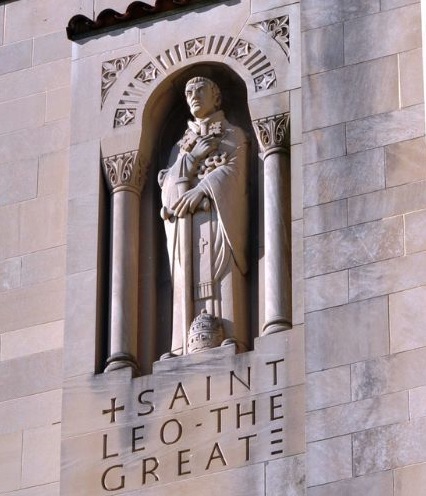
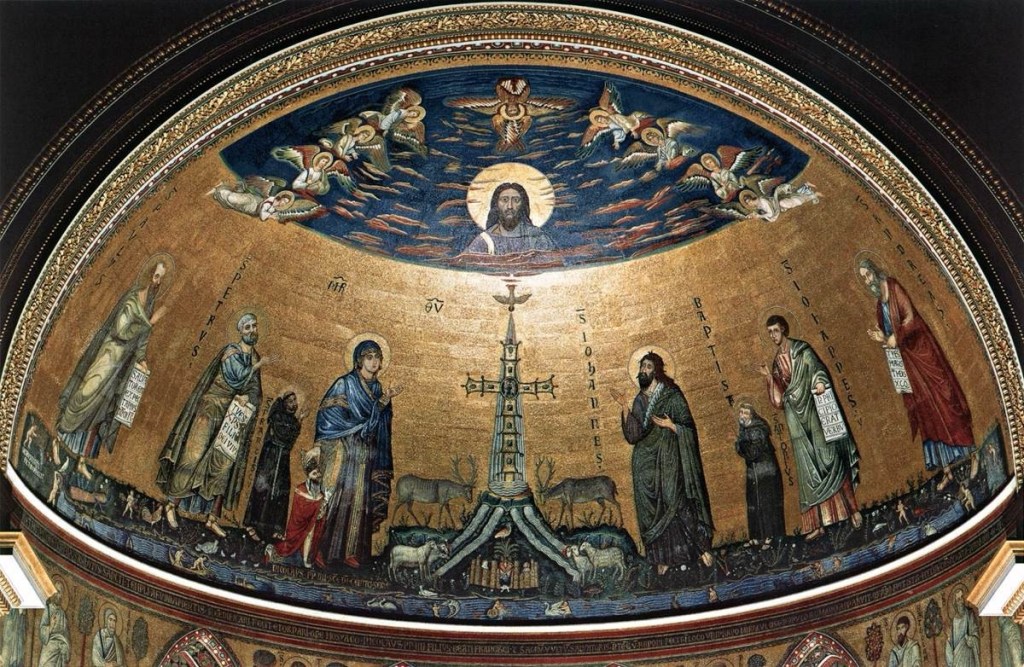

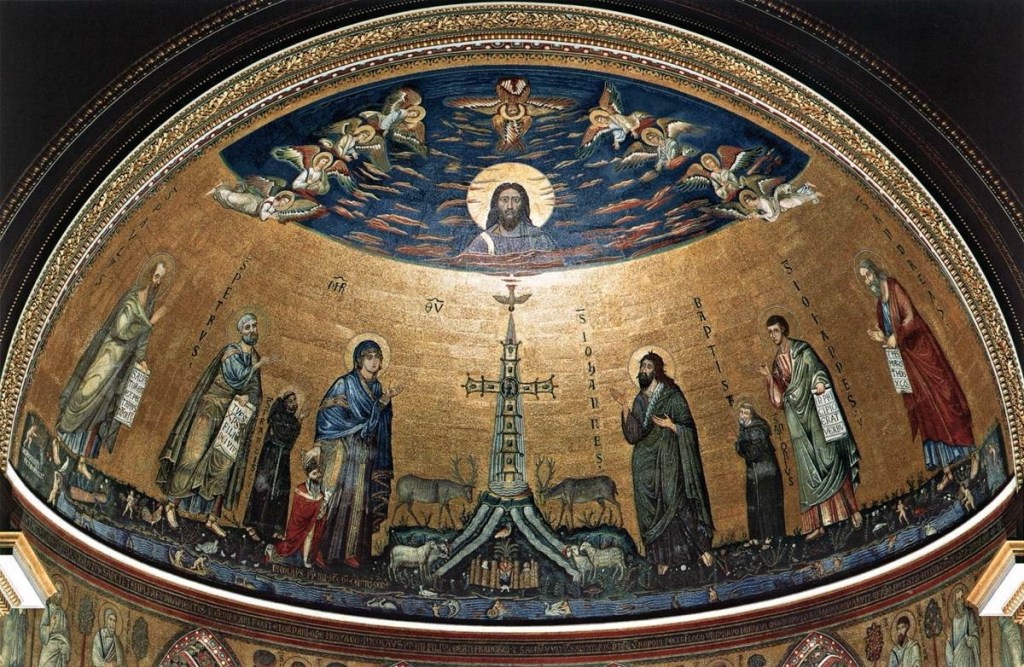
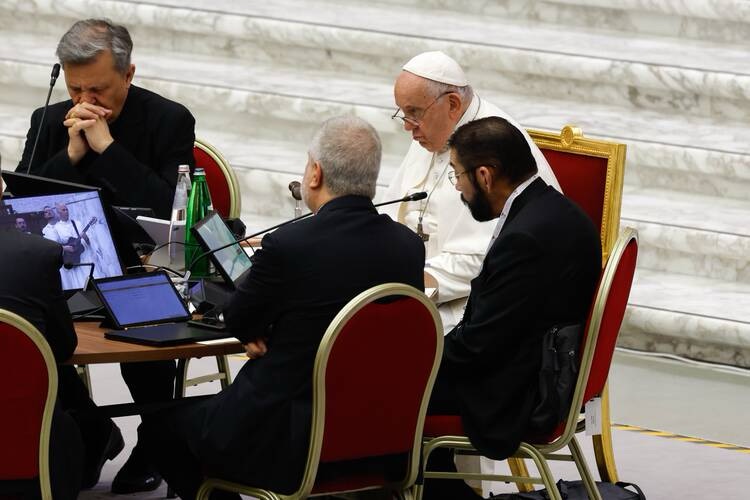

 Words and Things